
Written by DivinHeal Editorial Contributor, Rahul Kumar, Embryologist | Medically Reviewed by Dr Indu Priya, Gynecologist(MD) Published on: 2026-05-30
Exercises for Male Pelvic Floor, Pelvic Congestion
Syndrome & Pelvic Echography in India
Pelvic floor exercises can cut urinary
leakage risk by up to 70%. For men in Australia, the UK, and the UAE,
expert-led treatment in India costs 70–85% less than at home. India’s
JCI-accredited hospitals — Apollo Hospitals Chennai, Max Healthcare Delhi, Fortis
Healthcare Gurugram — have specialist urologists, pelvic physiotherapists, and
radiologists all in one place.
You may be dealing with chronic pelvic
pain, pelvic congestion syndrome (PCS), or pelvic girdle pain (PGP). Or you may
need a pelvic echography (ultrasound) to find the cause. India gives you the
full care pathway. Divinheal guides your journey — from your first call to your
flight home — with clear costs in AUD, GBP, or AED.
Plan My Journey
Tell us your condition and budget — our AI matches the right destination, hospital and doctor and visa pathway
What Is Male
Pelvic Floor Dysfunction?
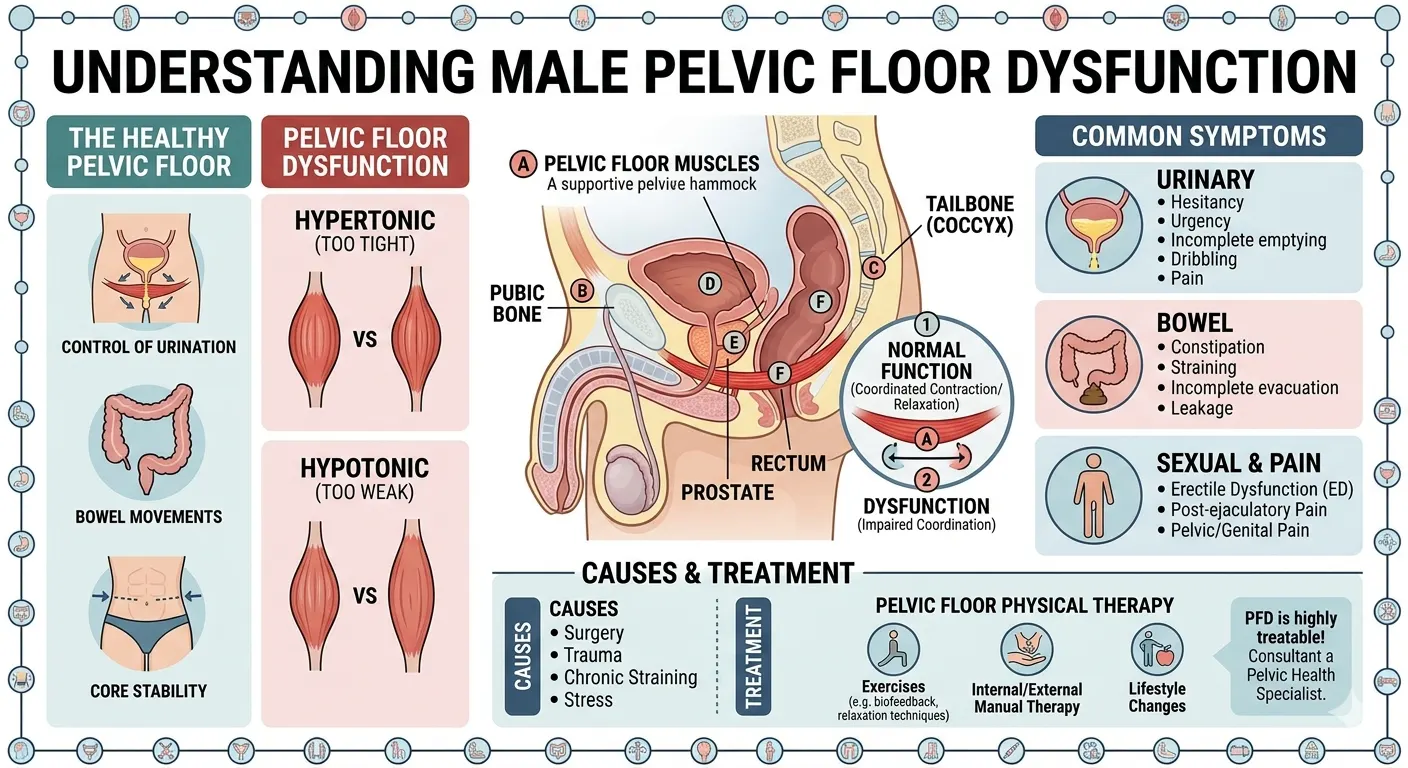
Your pelvic floor is a group of muscles. They run from your pubic
bone to your tailbone. These muscles control your bladder, bowel, and sexual
function. When they weaken, tighten, or stop working together, that is pelvic
floor dysfunction (PFD). PFD affects roughly 1 in 10 men globally (WHO, 2021).
Common symptoms include:
• Difficulty emptying your bladder or bowel fully
• Persistent pelvic or perineal
pain
• Erectile dysfunction or pain
during sex
Causes include prostate surgery, nerve damage, and prolonged
sitting. PFD rarely goes away on its own — it needs targeted treatment, per the
Cleveland Clinic (2023). An accurate diagnosis is the first step. India’s top
centres offer urodynamic testing and pelvic echography for that.
How Is Pelvic
Floor Dysfunction Diagnosed?
Your
specialist starts with a clinical exam and symptom history. They may order a
pelvic ultrasound (echography). They might also do a cystoscopy — a thin camera
that checks inside your bladder. Or they may run urodynamic studies — pressure
tests that measure how your bladder fills and empties. JCI-accredited hospitals
in India offer all three. Results are in English. Arabic-speaking coordinators
are available for UAE patients.
5
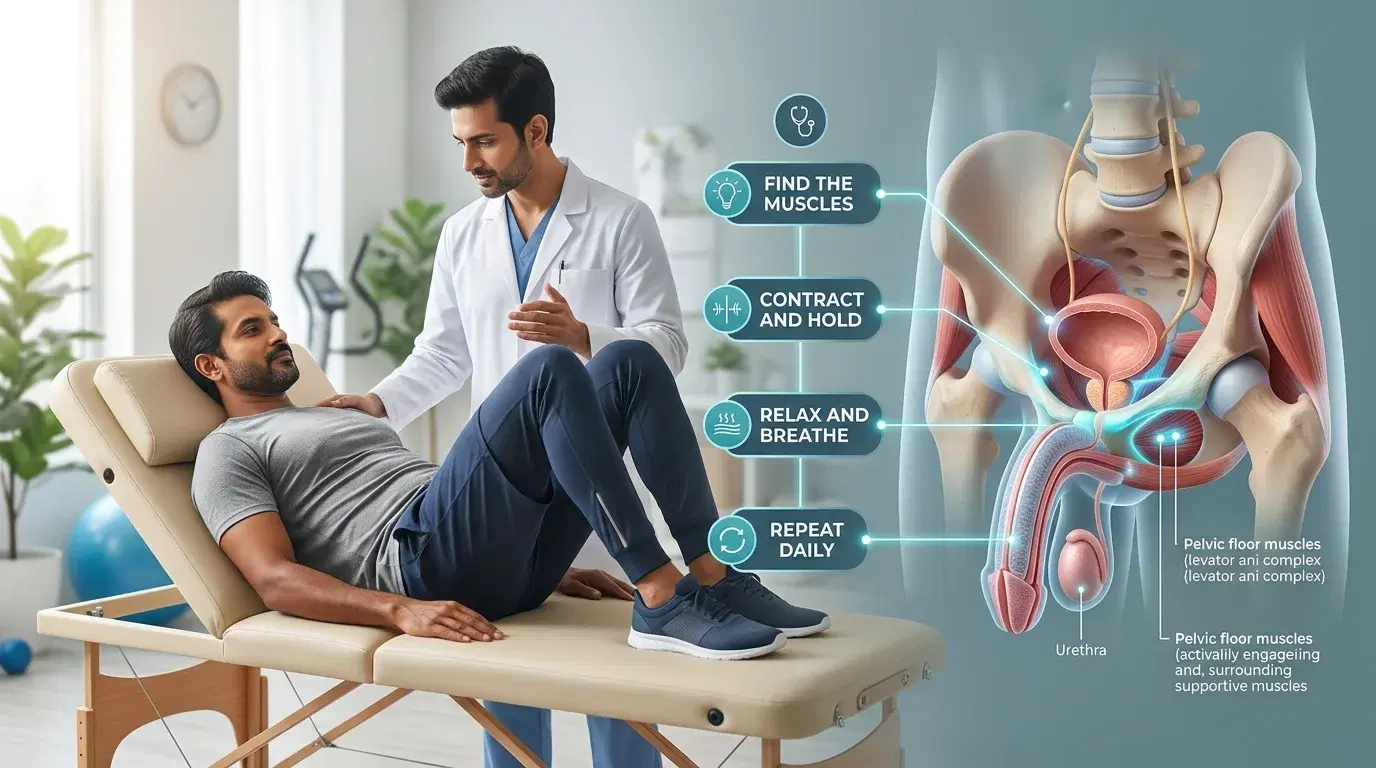
Effective Exercises for Male Pelvic Floor
Pelvic
floor exercises are usually one of the first things doctors suggest for issues
like urine leakage, ongoing pelvic discomfort, or recovery after prostate
surgery. They help by strengthening the muscles that control urination and
support the bladder. A 2023 study in the Indian Journal of Urology found that
men who followed a structured pelvic floor routine improved bladder control by
around 70% in about 12 weeks. Here are five simple exercises that are commonly
used in these programmes:
1. Kegel Contractions
Kegel exercises are usually the
foundation of pelvic floor recovery in men. To figure out the right muscles,
imagine trying to stop your urine flow halfway—that’s the muscle group you’re
targeting. Once you’ve found them, gently tighten, hold for about 3–5 seconds,
and then fully relax for the same amount of time. Do this for around 10–15
repetitions, three times a day. If done regularly, most men start noticing
better bladder control and strength within about 6–8 weeks.
2. Reverse Kegels (Pelvic
Drop)
Reverse Kegels
help muscles that are too tight — which cause pain and urgency. Take a slow
deep breath. Gently bear down, as if about to pass wind — but don’t. Hold 5
seconds, then release. Repeat 10 times. These work best when a pelvic
physiotherapist uses biofeedback to check your technique.
3. Glute Bridges
Lie on your back with your knees bent
and feet flat on the floor. Gently engage your pelvic floor and squeeze your
glutes, then slowly lift your hips up until your body forms a straight line
from your shoulders to your knees. Hold for about 5 seconds, then slowly lower
back down. Do this for 3 sets of 10. Over time, glute bridges help build hip
and core strength, which naturally supports better pelvic floor control.
4. Pelvic Tilts
Stand with your back against a wall and
keep your feet slightly forward. Take a slow breath in, and as you breathe out,
gently press your lower back into the wall and hold for about 5 seconds. Then
relax and reset. It’s a very simple movement, but it helps your core and pelvic
floor start working together again, especially if stronger exercises feel
difficult in the beginning.
5. Diaphragmatic Breathing
Deep breathing is one of the
easiest ways to reconnect with your pelvic floor. As you breathe in, your
diaphragm moves down, and the pelvic floor naturally relaxes. As you breathe
out, everything gently lifts back up together. Just spend about 5 minutes a day
on slow, relaxed breathing like this. It can help release tension in the pelvic
area, improve how the muscles work together, and is especially useful if stress
tends to make pelvic pain worse.
Divinheal’s
partner hospitals, including Apollo Hospitals Chennai, offer
biofeedback-assisted pelvic floor training. Real-time feedback can improve
exercise accuracy by up to 40% over doing the exercises on your own.
What Is
Pelvic Congestion Syndrome (PCS)?
Pelvic congestion syndrome (PCS) is when veins inside the pelvis
become enlarged and fail to drain blood efficiently — similar to varicose
veins, but inside the body. Blood pools and creates pressure. This causes a
dull, constant ache in the lower abdomen or perineum. PCS accounts for up to
15% of chronic pelvic pain cases in adults, per peer-reviewed vascular
research.
What Are the
Symptoms of Pelvic Congestion Syndrome?
The
most common symptom is a dull ache. It gets worse after standing, walking, or
being active. It gets better when you lie down. Other symptoms include:
• Discomfort during or after sex
• Varicose veins on the inner
thighs or groin area
• Bladder urgency or irritable
bowel symptoms
• Pelvic heaviness that builds
through the day
What Happens If
Pelvic Congestion Syndrome Goes Untreated?
PCS can gradually
get worse if it isn’t treated. Over time, symptoms like pain during sex,
irregular bleeding in women, and visible varicose veins may become more
frequent and harder to manage (NorthStar Interventional Radiology, 2023). That’s
why many doctors prefer not to delay treatment, since early embolisation often
leads to better symptom relief and outcomes compared to waiting longer.
How Is PCS Treated in India?
Mild PCS
often improves with dietary adjustments — reducing spicy and acidic foods that
irritate the bladder — combined with targeted pain management. For cases that
don’t improve, pelvic vein embolisation (PVE) is the gold-standard treatment.
During pelvic vein
embolisation (PVE), a specialist passes a very thin catheter (under 2 mm) into
the affected pelvic veins, usually through a vein in the neck, and it’s done
under local anaesthetic. Through this, small platinum coils and a special
liquid (sclerosant) are used to block the abnormal backflow of blood that’s
causing the problem. It’s a day procedure, so most people go home within a
couple of hours. Many are back to work or their normal routine within 1–2 days.
Success rates are generally reported around 85–95% (Image-Guided Health London,
2023).
Here’s how
PCS treatment costs compare:
|
Treatment |
India
(INR) |
India
(USD) |
Australia
(AUD) |
UK
(GBP) |
UAE
(AED) |
|
Pelvic Vein
Embolisation |
₹1,50,000–₹6,00,000 |
$1,580–$6,316 |
AUD 5,500–10,000 |
£4,000–£10,000 |
AED 15,000–40,000 |
|
Estimated
Savings vs India |
— |
— |
50–70% |
60–75% |
40–60% |
These figures are
only approximate private healthcare ranges. The final cost can vary depending
on the hospital, the doctor’s experience, and how complex the case is.
Pelvic
Girdle Pain During Pregnancy: What You Need to Know
Pelvic girdle pain (PGP) is pain in the joints that connect your
pelvis. These are the sacroiliac joints at the back and the pubic symphysis at
the front. During pregnancy, the hormone relaxin loosens ligaments to prepare
the body for birth. But it can also make the pelvis less stable. PGP most often
starts between weeks 12 and 20 of pregnancy.
What Does Pelvic
Girdle Pain Feel Like?
PGP (pelvic girdle
pain) is usually felt as pain in the lower back, hips, groin, or inner thighs.
Some women also describe a sharp or shooting pain, and sometimes a clicking
sensation in the pelvic joints. It often gets worse with simple daily movements
like walking, climbing stairs, turning in bed, or standing on one leg. If there
are any red flag signs such as sudden severe pain, fever, unexplained bleeding,
or fainting, it’s important to get medical help the same day (Physio Reform,
2024).
How Do You Relieve
Pelvic Girdle Pain?
A
pelvic support belt takes the load off the sacroiliac joints. Sleeping with a
pillow between your knees helps at night. When getting out of a car, keep your
knees together and turn your whole body. Aquatic therapy during pregnancy works
well — the water lifts the load off the pelvis and allows safe, low-impact
exercise. Divinheal’s partner hospitals offer supervised aquatic therapy for
pregnant patients.
Core exercises for
pregnancy-related PGP are usually quite gentle. They often include things like
pelvic tilts, clamshells (done lying on your side), and supported glute
bridges. A physiotherapist will usually customise these based on your trimester
and how much pain you’re having, so the exercises stay safe and manageable.
When Does Pelvic
Girdle Pain Start in Pregnancy?
PGP
can start in the first trimester. But it is most common between weeks 12–20, as
relaxin increases joint movement and the pelvis begins to widen. Pain often
gets stronger in the third trimester as the baby gets heavier. Most cases are
clear within 3 months of birth with physiotherapy.
What Is
Pelvic Echography (Pelvic Ultrasound)?
Pelvic echography is the medical name for a pelvic ultrasound scan.
It uses sound waves to show real-time images of the organs inside your pelvis —
the bladder, prostate, uterus, ovaries, fallopian tubes, and blood vessels.
There is no radiation. The scan takes 15–30 minutes.
What Does a
Pelvic Ultrasound Check For?
A pelvic
ultrasound is commonly done to check for things like fibroids, ovarian cysts,
prostate problems, bladder stones, and, in PCS cases, enlarged or varicose
veins. It also helps pick up any structural issues that could be causing pelvic
pain. A Doppler ultrasound looks at blood flow. It can show if blood is flowing
backward in the veins, which is an important sign of PCS. Overall, it’s
considered quite accurate for spotting structural problems, with accuracy
reported above 90.
Is a Pelvic Ultrasound
Painful?
A standard
abdominal pelvic ultrasound is painless. You may feel mild pressure as the
probe moves across your skin. A transvaginal ultrasound — where a small probe
is gently placed into the vagina — may cause brief discomfort but is not
painful. A lubricating gel helps. Results are available the same day at
Divinheal’s partner hospitals in India.
What’s the
Difference Between Echography and Ultrasound?
Echography
and ultrasound are the same technique. Both use sound waves that bounce off
tissue to make images. ‘Echography’ is the common term in continental Europe
and the Middle East. ‘Ultrasound’ or ‘sonography’ is used in Australia, the UK,
and India. The procedure, equipment, and results are identical.
Pelvic
Treatment Costs: India vs Australia, UK, and UAE
Many Divinheal patients from Sydney, London, and Dubai choose India
for the cost gap. You get the same JCI-accredited quality at 70–85% lower cost
than private healthcare back home. Patients from Australia and the UK also skip
wait-lists of 3–6 months for specialist physiotherapy and interventional
procedures.
|
Service |
India (INR) |
India (USD) |
Australia (AUD) |
UK (GBP) |
UAE (AED) |
|
Initial Consult + Pelvic Ultrasound |
₹4,000–₹8,000 |
$42–$84 |
AUD 250–800 |
£250–500 |
AED 700–1,500 |
|
10 Physio Sessions (Pelvic Floor) |
₹10,000–₹20,000 |
$105–$210 |
AUD 1,200–2,000 |
£500–1,000 |
AED 3,000–5,000 |
|
Pelvic Vein Embolisation (PCS) |
₹1,50,000–₹6,00,000 |
$1,580–$6,316 |
AUD 5,500–10,000 |
£4,000–10,000 |
AED 15,000–40,000 |
|
Minor Intervention (e.g. Injection) |
₹10,000–₹35,000 |
$105–$368 |
AUD 300–2,000 |
£500–1,200 |
AED 2,000–8,000 |
|
Typical Savings vs India |
— |
— |
75–90% |
70–85% |
40–60% |
All figures are approximate private-healthcare ranges. Actual costs
depend on hospital tier, surgeon seniority, and case complexity. Individual
outcomes vary — consult your specialist for personalised advice.
Why
Choose India for Pelvic Health Treatment?
India’s top hospitals have world-class specialists and equipment.
Their standard matches private hospitals in major Western cities. Here’s what
sets Divinheal’s partner hospitals apart:
• JCI accreditation: Apollo Hospitals Chennai, Max Healthcare Delhi, Fortis Healthcare
Gurugram, and Manipal Hospitals all hold JCI accreditation — the same safety
and quality benchmark used by top private hospitals in the UK and Australia.
• Surgeon credentials: Many
pelvic floor surgeons and interventional radiologists are highly qualified,
often holding FRCS or MCh degrees. Some have also trained at well-known
international centres such as Imperial College London, Johns Hopkins, or the
Karolinska Institute.
• Diagnostic technology: Partner
hospitals such as Divinheal use advanced imaging and diagnostic tools,
including 3D ultrasound, real-time Doppler scans, urodynamic testing, and
MRI-based planning for procedures like embolisation.
• Language support: English
is the main language used for treatment. For international patients—especially
those coming from the UAE—Arabic-speaking coordinators are also available at
hospitals like Apollo Delhi, Max Healthcare, and Fortis.
• Patient satisfaction: A 2022
ICMR report found that satisfaction rates at JCI-accredited pelvic health
centres in India are over 90%.
•Patient Story — Illustrative Composite: Amira, 44, from Dubai, had lived with PCS pain for three years. Her UAE specialist quoted AED 22,000 for embolisation. Through Divinheal, she had the same procedure at Fortis Healthcare, Gurugram, for the equivalent of AED 12,500 — including her 5-day accommodation and airport transfers. She returned home after 8 days, pain-free within 4 weeks.
Stories are illustrative composites based on typical patient journeys. Names changed for privacy.
Your
Journey with Divinheal: From First Enquiry to Recovery
Divinheal manages every step — before you travel, while you’re in
India, and after you return home.
Before You Travel
Divinheal collects your
medical records and existing scans. They set up a video call with your assigned
specialist — within 48 hours of receiving your records. You get a clear cost
quote in INR, USD, AUD, GBP, or AED before you commit.
Visa, Flights, and
Accommodation
Divinheal takes
care of the travel arrangements around your treatment, including medical visa
support, help with flights, and airport transfers when you arrive. You can pick
your stay based on what feels right for you, from serviced apartments to more
comfortable hotel options, depending on your recovery needs and budget. Your
coordinator helps guide you through the choices so it’s easier to decide. For
UK patients, they can also help arrange travel insurance for medical trips.
During Treatment
You’ll have a dedicated
24/7 on-ground coordinator throughout your hospital stay. For UAE patients,
Arabic-speaking interpreters are available at all Divinheal partner hospitals.
Post-procedure care, physiotherapy programmes, and follow-up schedules are given
before you fly home. Most international patients spend 3–5 days in the hospital,
then 3–5 days of local recovery before the flight.
After You Return Home
Follow-up after treatment is usually
done online for around 6–12 months. You’ll have virtual check-ins with your
surgeon, often starting every couple of weeks and then spacing out to monthly
as things improve. For patients from countries like the UK or Australia, this
usually means there’s no need to travel back to India for routine reviews. Divinheal
also supports over 700 international patients each year with medical travel and
ongoing follow-up coordination.
Cost Calculator
I know my treatment — show me cost from 3 hospitals
Quick Answer — At a
Glance
Skim this if you’re short on time.
|
Topic |
Quick Answer |
|
Exercises for the male pelvic floor |
Kegels, reverse Kegels, glute bridges, pelvic tilts, diaphragmatic
breathing — 15 reps, 3x daily |
|
How fast do they work? |
Initial improvement in 6–8 weeks; significant change within 12
weeks with biofeedback guidance |
|
Pelvic congestion syndrome (PCS) |
Pelvic vein embolisation — day-case procedure under local
anaesthetic; 85–95% success rate |
|
Pelvic echography vs ultrasound |
Same procedure. Echography = European/Middle East term; ultrasound
= Australia/UK term. No radiation, 15–30 min |
|
Pregnancy pelvic girdle pain (PGP) |
Starts weeks 12–20; treated with support belt, aquatic therapy,
clam shells, pelvic tilts |
|
Cost advantage: India vs AU/UK/UAE |
70–85% less than Australia or UK private rates at JCI-accredited
hospitals |
Exercises for the male pelvic floor are the first-line treatment for
incontinence and chronic pelvic pain. At Divinheal’s JCI-accredited partner
hospitals in India — including Apollo Hospitals Chennai and Max Healthcare
Delhi — specialist physiotherapists and interventional radiologists provide
biofeedback-guided training, pelvic vein embolisation for PCS, and pelvic
echography, at 70–85% less than equivalent private care in Australia, the UK,
or the UAE.
Written by DivinHeal Editorial Contributor, Rahul Kumar, Embryologist | Medically Reviewed by Dr Indu Priya, Gynecologist(MD) Published on: 2026-05-30
Plan My Journey
Tell us your condition and budget — our AI matches the right destination, hospital and doctor and visa pathway
Cost Calculator
I know my treatment — show me cost from 3 hospitals
Booking With DIVINHEAL
Get a free consultation to understand your treatment options
From Consultation to Recovery,
Step by Step
Expert Specialist Matching
Connecting you with the world's top-rated medical experts.
Accredited Hospital Network
Access to JCI & NABH certified healthcare facilities.
Complete Travel Coordination
Hassle-free visa, stay, and local transport assistance.
24/7 Personal Care
Dedicated patient advisors supporting you at every step.
Journey Guidance
Full guidance from start to end of the patient treatment journey.
Expert Specialist Matching
Connecting you with the world's top-rated medical experts.
Everything you
need to know today
Browse through these common inquiries to better understand our patient-focused medical platform.
Kegel contractions are one of the simplest ways to build pelvic floor strength. You just squeeze the muscles you’d use to stop urine mid-flow, hold for 3–5 seconds, then fully relax. Aim for around 15 reps, three times a day. With regular practice, many men start noticing improvement in about 6–8 weeks. Some clinics also use biofeedback sessions, which give real-time feedback to help you make sure you’re actually using the right muscles.
The most common signs are urine leakage when you cough, sneeze, or lift. Other signs include difficulty controlling wind and persistent pelvic or perineal pain. Erectile dysfunction and reduced sensation during sex can also point to weakness. A urodynamic test or biofeedback assessment at a specialist clinic will give you a clear answer.
Rarely. PFD symptoms tend to stay the same or get worse without treatment, per the Cleveland Clinic. The good news: a structured physiotherapy programme — sometimes combined with biofeedback or minimally invasive procedures — produces clear improvement in most cases, often within 8–12 weeks.
Yes, and the evidence for this is quite strong. A 2023 study in the Indian Journal of Urology found that men who followed a structured pelvic floor programme after prostate surgery saw around a 70% improvement in bladder control within 12 weeks. The results are often even better when a specialist physiotherapist is involved, because they can make sure you’re doing the exercises correctly and really engaging the right muscles.
The main symptom is a dull, constant ache in the lower abdomen or perineum. It gets worse after standing, walking, or being active. It gets better when you lie down. Other signs include varicose veins on the inner thighs, discomfort during sex, and irritable bowel-like symptoms. PCS accounts for up to 15% of chronic pelvic pain cases in adults.
PCS often tends to get worse over time if it isn’t treated. Symptoms like pain during sex, visible varicose veins in the thighs, and bladder urgency can slowly become more frequent and more difficult to live with. Because of this, many specialists prefer not to delay treatment, as early pelvic vein embolisation is often linked with better outcomes compared to waiting longer (NorthStar Interventional Radiology, 2023).
A pelvic ultrasound is a basic scan that looks at the organs in your pelvic area. In men, it checks the bladder and prostate, and in women, it focuses on the uterus and ovaries, along with the nearby tissues and blood vessels. It’s often used to find common problems like fibroids, ovarian cysts, prostate changes, bladder stones, or signs of abnormal blood flow seen in conditions like PCS. A Doppler ultrasound is usually added to the same scan. It doesn’t just show the organs—it also shows how blood is flowing through the pelvic veins and whether there’s any backward flow or circulation issue.
No. A standard abdominal ultrasound uses gentle pressure from a probe on your skin. Most patients feel nothing. A transvaginal ultrasound may cause brief discomfort but should not be painful. A lubricating gel helps. The whole scan takes 15–30 minutes. Results are available the same day at Divinheal’s partner hospitals.
A pelvic support belt, a pillow between your knees at night, and keeping your knees together when getting out of a car all reduce PGP pain quickly. Aquatic therapy (hydrotherapy) works well during pregnancy. The water lifts the load off the pelvis and allows safe movement. A pelvic physiotherapist will guide you through exercises tailored to your trimester.
PGP usually starts sometime around 12–20 weeks of pregnancy, when the hormone relaxin begins to loosen the joints in preparation for childbirth. For some women, it can show up earlier, even in the first trimester, while for others, it becomes more noticeable later as the baby grows and puts extra pressure on the pelvis. In most cases, the pain gradually improves after delivery and settles within about 3 months after birth.
For diagnostic scans or a physiotherapy consultation, 5–7 days is usually enough. For pelvic vein embolisation (PCS treatment), plan for 3–5 days in hospital plus 3–5 days of local recovery before flying — typically 8–10 days in total. Divinheal’s coordinator will build your itinerary based on your procedure and recovery.
Divinheal helps with all the practical parts of your treatment journey—medical visa support, airport transfers, accommodation options from budget to premium, and round-the-clock coordinator help while you’re in India. Arabic-speaking interpreters are also available for patients from the UAE. After you go back home, your follow-up is usually done online for about 6–12 months, with scheduled virtual consultations so you don’t need to travel back for routine reviews.
Still have more questions?
Book a call with our friendly team to learn how DivineHeal simplifies your healthcare journey.








