Uterine Fibroids & Polyps Treatment India 2026

Uterine Fibroids & Polyps Treatment India 2026

Written by DivinHeal Editorial Contributor, Rahul Kumar, Embryologist | Medically Reviewed by Dr Indu Priya, Gynecologist(MD) Published on: 2026-05-20
Uterine Fibroids, Polyps & Round Ligament Pain: Symptoms, Causes and Treatment in India
Up to 70% of women develop uterine fibroids by age 50. This is according to the Royal College of Obstetricians and Gynecologists (RCOG). For most, symptoms go unnoticed for years. Heavy periods, pelvic pressure, and pain that gets in the way of daily life are common — but often ignored. If you’re in Nigeria, Australia, or the UK, you’ve likely run into a wall. Private care is costly. NHS and Medicare wait-lists stretch for months. Local options for complex treatment can be limited.
India is a different story. Top hospitals in Chennai, Delhi, and Bengaluru hold JCI accreditation. They do thousands of these procedures every year. Laparoscopic fibroid removal starts from ₹2,00,000 ($2,400). That’s 70–85% less than private costs in Australia or the UK. The wait, from first consultation to surgery, is typically 2–4 weeks — not 9 months.
Plan My Journey
Tell us your condition and budget — our AI matches the right destination, hospital and doctor and visa pathway
What Is Round Ligament Pain — and When Does It Signal Something More?
Round ligament pain is a sharp, sudden pain in the lower abdomen or groin. It’s most common during pregnancy. The round ligament holds the uterus in place and stretches as the uterus grows. This can cause a short, stabbing feeling when you sneeze, cough, or move quickly. Episodes usually last a few seconds to a few minutes.
Outside of pregnancy, similar lower abdominal pain can point to something else. Endometriosis, pelvic inflammatory disease (PID), fibroids, or adhesions can all cause pain in the same area. Adhesions are bands of scar tissue inside the pelvis. Ongoing pelvic pain in a non-pregnant woman needs a proper check, not just rest.
How to Relieve Round Ligament Pain
Gentle stretching does wonders. Cat-cow stretches, hip stretches, and butterfly stretches alleviate ligament stiffness. Applying warmth to your lower abdomen alleviates cramps. If you suffer from pelvic or round ligament pain, then you may consider physiotherapy. In India, this can be easily arranged within 3-5 days of your arrival there.
If pain lasts more than a few hours or keeps coming back outside of pregnancy, tell your doctor. Pain that won’t go away can signal fibroids, endometriosis, or ovarian cysts. You’ll need proper imaging to rule these out.
Anteverted vs Retroverted Uterus: What Your Scan Result Actually Means
A woman having an anteverted uterus will have her uterus tilted towards the front. This is the commonest orientation of the uterus. Most women possess it, and it poses no problem. It does not cause any pain, affect your menstrual flow, or affect your fertility.
A retroverted uterus — also called a retro-tilted or tilted uterus — angles backward toward the spine. About 1 in 5 women have this. It’s a natural variation. Like an anteverted uterus, a retroverted uterus is usually just a normal position. It’s not a medical condition that needs treatment.
When Does Uterus Position Become a Problem?
Problems come up when an underlying condition is involved. Fibroids, endometriosis, or adhesions can hold the uterus in a tilted position. This causes real symptoms: painful sex, lower back pain, and heavy or irregular periods.
The uterus being tilted is not normally associated with infertility, but in case the uterus is adhered to something else and becomes fixed, it might need to be loosened. If the adhesion persists, it will be recommended for adhesionolysis to be done, where scar tissues will be removed to enable the uterus to function properly again. In such a case, the uterus will return to its correct position.
Uterine Fibroids: Causes, Symptoms and How Serious They Are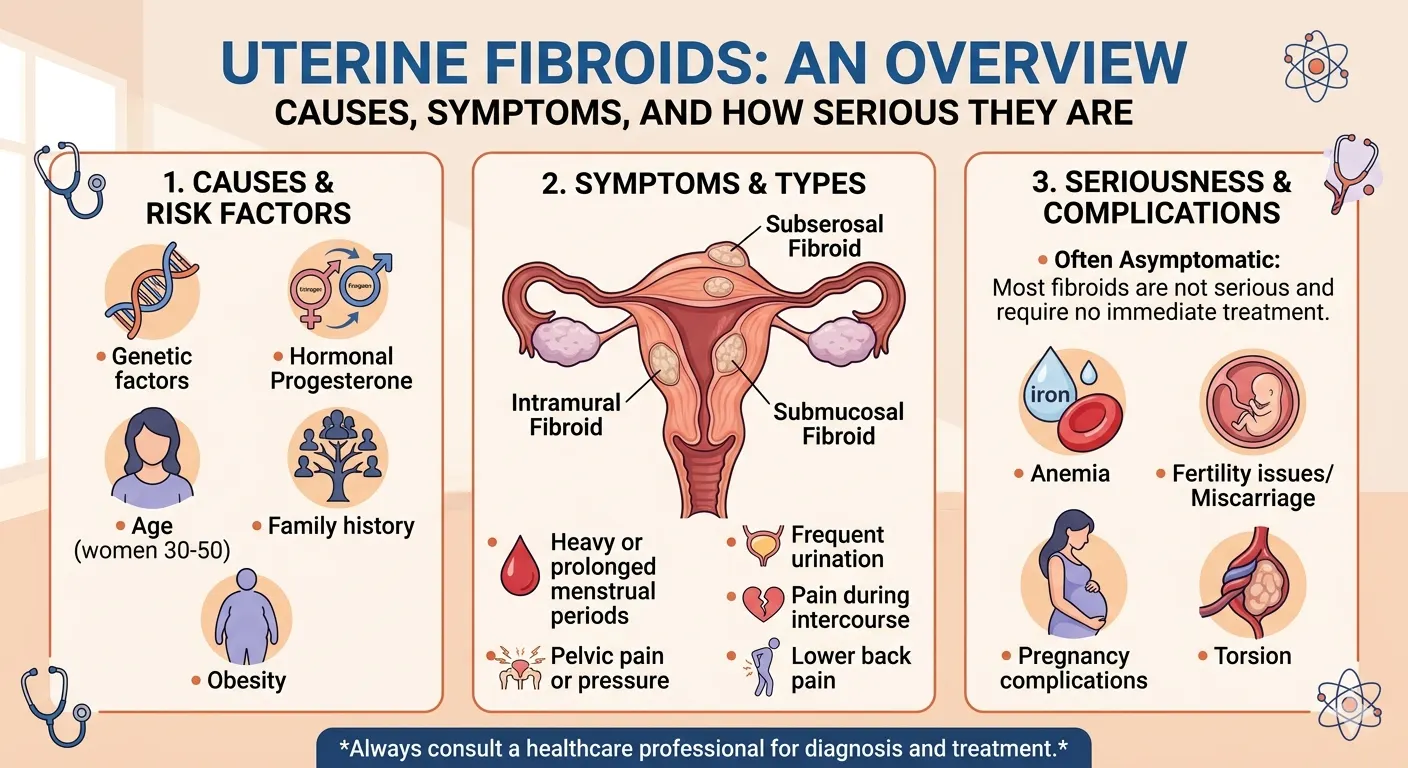
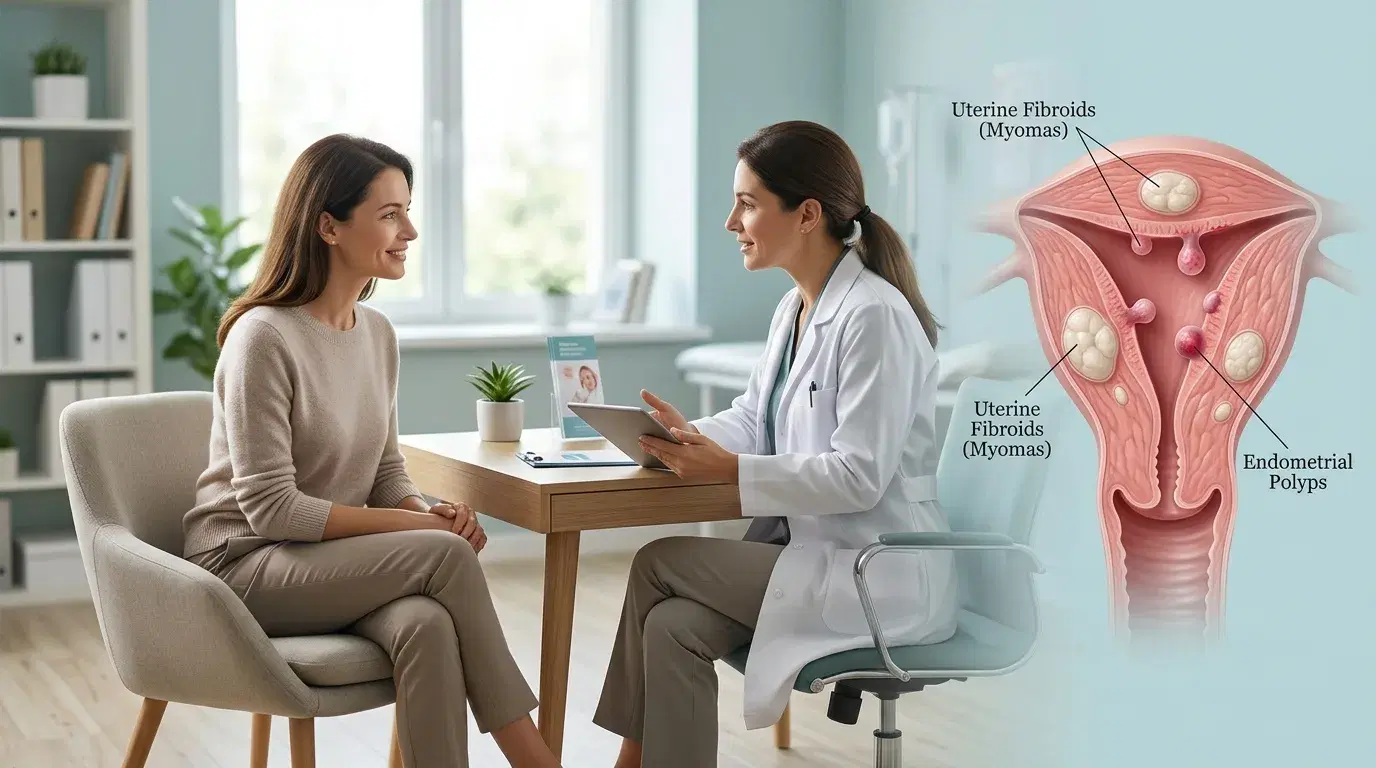
Uterine fibroids are non-cancerous growths of muscle and fibrous tissue that develop in or on the walls of the uterus. Between 70–80% of women will have at least one fibroid by age 50 (RCOG). Only about 30% have symptoms serious enough to need treatment.
Fibroids range in size from a few millimeters to the size of a grapefruit. Their location matters more than their size. Fibroids inside the uterine cavity (submucosal) cause the heaviest bleeding. Fibroids within the uterine wall (intramural) cause pressure and bulk. Those outside the uterus (subserosal) often cause no symptoms at all.
Fibroid Symptoms — What to Watch For
Heavy menstrual bleeding (menorrhagia) lasting longer than 7 days
Painful periods (dysmenorrhoea — pain during menstruation)
Pelvic pressure or a feeling of fullness below the navel
Frequent urination when fibroids press on the bladder
Abdominal bloating or visible distension with larger fibroids
Pain during sex, especially with fibroids near the cervix
Anemia (fatigue, shortness of breath) from ongoing blood loss
How Serious Are Uterine Fibroids?
Fibroids are always non-cancerous. But if they cause heavy bleeding, they can lead to iron deficiency anemia. Large submucosal fibroids can reduce the chance of IVF success. They should be removed before trying to get pregnant. Fibroids are rarely dangerous on their own. But leaving them untreated can affect both quality of life and the ability to have children.
Uterine Polyps: How Serious Are They and Should They Be Removed?
Uterine polyps are soft, finger-like growths from the lining of the uterus (endometrium). They grow into the uterine cavities and are almost always benign. They form from too much endometrial tissue. Estrogen often drives this growth. Polyps show up in 10–24% of women going through fertility testing (Journal of Minimally Invasive Gynecology, 2021).
Polyp Symptoms and When to Treat
Many polyps cause no symptoms at all. When they do, symptoms can include:
Irregular spotting between periods
Unusually heavy periods
Bleeding after menopause — always investigate this
Difficulty conceiving or failing IVF cycles
Should polyps always be removed? Not necessarily. Small polyps with no symptoms may be watched rather than removed right away. But if polyps cause bleeding, affect fertility, or look suspicious on ultrasound, hysteroscopic polypectomy is the standard treatment. This uses a tiny camera and small tools. No abdominal incision is needed. Most patients in India go home the same day or after one night in the hospital.
How Are These Uterine Conditions Diagnosed?
Accurate diagnosis needs a specialist. You can’t rely on symptoms alone. That’s because fibroids, polyps, endometriosis, and ovarian cysts can all cause similar symptoms. Your evaluation in India will typically include:
Pelvic examination and detailed medical history
Transvaginal or abdominal ultrasound — first-line imaging for fibroids and polyps
3T MRI — for mapping multiple or large fibroids before surgery
Hysteroscopy — a camera inserted into the uterine cavity; can diagnose and treat polyps in one procedure
Blood tests — to identify anemia and check hormone levels
A full diagnostic workup in India costs about ₹15,000–₹35,000 ($180–$420). This includes ultrasound, MRI where needed, blood tests, and a specialist consultation. That’s often less than a single private scan in Australia or the UK.
Treatment Options Available in India
Non-Surgical Options
Non-surgical options work well for mild symptoms, or when surgery isn’t yet needed:
Hormonal therapy — progesterone-releasing IUDs, combined oral contraceptives, or GnRH agonists (medicines that temporarily shrink fibroids by reducing estrogen)
Tranexamic acid — reduces heavy bleeding without hormones
NSAIDs (e.g., ibuprofen) can help control pain and bleeding during periods
Iron supplements — treat anemia caused by ongoing blood loss
Physiotherapy and pelvic floor exercises — for round ligament and pelvic pain
Watchful waiting — appropriate for small asymptomatic fibroids or polyps
Surgical Options
When symptoms are severe or fertility is affected, surgery gives the best results. India’s leading hospitals offer all major procedures using minimally invasive techniques:
Procedure | What It Does | India Cost (USD) | Hospital Stay | Recovery |
Laparoscopic Myomectomy | Removes fibroids, preserves uterus | $2,400–$4,800 | 2–4 nights | 4–6 wks |
Hysteroscopic Polypectomy | Removes polyps, no incision | $960–$1,800 | 0–1 night | 3–7 days |
Adhesionolysis | Removes scar tissue, fixing the uterus | $1,800–$3,600 | 1–3 nights | 2–3 wks |
Hysterectomy | Removes uterus (definitive) | $2,400–$5,400 | 3–5 nights | 4–6 wks |
Fibroid Embolization (UFE) | Shrinks fibroids via blood vessel occlusion | $2,000–$4,000 | 1–2 nights | 1–2 wks |
All costs are approximate. Actual costs depend on hospital tier, surgeon seniority, fibroid size, and complexity. Individual outcomes vary. Consult your specialist for personalized advice.
Cost of Uterine Treatment in India vs Australia, UK and Nigeria
The cost gap between India and private care in Australia or the UK is large. NHS and Medicare wait-lists for non-emergency surgery regularly run 6–12 months. India’s JCI-accredited hospitals can usually schedule surgery within 2–4 weeks of your first consultation.
Procedure | India (₹ / USD) | Australia (AUD) | UK (GBP) | Nigeria (NGN) |
Laparoscopic Myomectomy | ₹2,00,000–₹4,00,000 / $2,400–$4,800 | AUD 12,000–20,000 | GBP 5,000–12,000 | NGN 3,000,000–6,000,000 |
Hysteroscopic Polypectomy | ₹80,000–₹1,50,000 / $960–$1,800 | AUD 3,000–6,000 | GBP 2,500–5,000 | NGN 1,000,000–2,500,000 |
Hysterectomy | ₹2,00,000–₹4,50,000 / $2,400–$5,400 | AUD 15,000–25,000 | GBP 7,000–15,000 | NGN 3,500,000–7,000,000 |
Adhesionolysis | ₹1,50,000–₹3,00,000 / $1,800–$3,600 | AUD 8,000–15,000 | GBP 4,000–8,000 | NGN 2,000,000–4,000,000 |
All figures are approximate private-healthcare ranges (2025–2026). NHS and Medicare costs may be lower or free, with significant waiting times. Verify costs with your Divinheal coordinator before booking.
Australian patients typically save 75–85% compared to private clinic costs in Sydney or Melbourne. UK patients save 70–85% compared to private UK care. For Nigerian patients, India offers both competitive pricing and access to advanced techniques. These include robotic myomectomy, UFE, and combined adhesionolysis with fibroid surgery. These may not be easy to find locally.
Why Australian, UK, and Nigerian Patients Choose India for Gynecological Care
Accreditation and Surgeon Credentials
Over 70 Indian hospitals hold JCI (Joint Commission International) accreditation. This is the same patient safety standard as major private hospitals in Sydney or London. Many Indian surgeons hold FRCS qualifications earned in the UK. FRCS stands for Fellow of the Royal Colleges of Surgeons. Others completed fellowships in Germany, Australia, and the US.
Key Divinheal partner hospitals for gynecological care:
Apollo Hospitals, Chennai and Delhi — JCI-accredited, performing 1,000+ gynecological procedures monthly
Fortis Healthcare, Bengaluru and Delhi — leading minimally invasive gynecological surgery unit
Fortis Healthcare, Bengaluru and Delhi — leading minimally invasive gynecological surgery unit
Max Healthcare, Delhi — Da Vinci robotic surgery for complex fibroids and hysterectomies
Manipal Hospital, Bengaluru — advanced reproductive medicine and laparoscopic specialists
Technology
Max Healthcare in Delhi and Apollo Hospitals in Chennai use Da Vinci robotic systems. This allows complex fibroid surgery through incisions of just 1–2 cm. These centers also offer 3T MRI for fibroid mapping before surgery. High-definition hysteroscopy and fluoroscopy-guided UFE are available, too. This technology matches or exceeds what many private hospitals in Australia and the UK offer.
Real Patient Stories: Australia, UK and Nigeria
Amara, 41 — Melbourne, Australia
Amara, a teacher from Melbourne, was told she had multiple intramural fibroids. They were causing heavy bleeding and severe iron deficiency anemia. Her local gynecologist quoted AUD 18,000 for a laparoscopic myomectomy. Her private health insurer would only cover part of that cost. Medicare waits for a public procedure: 9 months. She found Divinheal and was connected to Dr. Priya Ramesh at Apollo Hospitals, Chennai. Dr. Ramesh is an FRCS-trained specialist in fibroid surgery that preserves fertility.
Amara’s laparoscopic myomectomy cost ₹3,20,000 ($3,800 / AUD 5,900). She was discharged on day 3 and cleared up to fly home on day 11. “The care was exceptional. I felt informed at every step. My hemoglobin is back to normal, and I’m feeling better than I have in three years.
The Story is an illustrative composite based on typical patient journeys. Name changed for privacy.
Sarah, 38 — London, United Kingdom
Sarah, a teacher from London, was told she needed surgery for large uterine fibroids. They were causing debilitating dysmenorrhoea (severe menstrual pain) and heavy bleeding. The NHS estimates: 8 months on a waiting list. Private cost in London: GBP 9,000. She chose Max Healthcare, Delhi. Her laparoscopic myomectomy was done by a team with FRCS qualifications.
Total cost: ₹3,80,000 ($4,500 / GBP 3,500). Divinheal’s coordinator arranged her medical visa letter, airport transfer, and recovery accommodation near the hospital. “The surgical team explained everything clearly. My recovery was smooth. I saved almost GBP 5,500 compared to what I’d been quoted in London.”
The Story is an illustrative composite based on typical patient journeys. Name changed for privacy.
Funmi, 44 — Lagos, Nigeria
Funmi, a businesswoman from Lagos, had a severely retroverted uterus fixed by adhesions alongside a large fibroid. Locally, no center could do both operations together in one session. She came to Manipal Hospital, Bengaluru, where both were done in one operation.
The combined package — including Divinheal’s visa letter, accommodation, and airport transfer — was ₹2,80,000 ($3,300 / NGN 5,500,000). “The team handled everything. I was nervous about travelling alone for surgery, but I had a Divinheal coordinator with me at every step. I’m finally pain-free.”
The Story is an illustrative composite based on typical patient journeys. Name changed for privacy.
Your Treatment Journey with Divinheal
Getting started takes one conversation. Here is how the process works:
Free consultation — Submit your medical reports and scan results. Divinheal’s medical team reviews them within 48 hours and provides a written response.
Treatment plan — You receive a written plan with procedure details, cost estimate, and curated hospital options based on your condition.
Hospital and surgeon selection — Choose from JCI-accredited hospitals. Direct communication with your surgeon is arranged before you book.
Visa and travel — Divinheal provides an official invitation letter from the partner hospital for your medical visa application. Step-by-step documentation guidelines follow.
Arrival in India — A dedicated Divinheal representative meets you at the airport and transfers you to pre-booked accommodation near the hospital.
Procedure and recovery — Your coordinator stays in contact throughout your hospital stay and recovery period. All post-operative appointments are arranged.
Return home — You leave with complete English-language discharge records, follow-up instructions, and access to remote consultations at 4 and 8 weeks.
For Nigerian patients, step-by-step visa support is included at no extra cost. Initial consultations are usually arranged within 3–5 working days.
Cost Calculator
I know my treatment — show me cost from 3 hospitals
Recovery and Returning Home
Most minimally invasive procedures need a total stay of 7–14 days in India before it’s safe to fly home. The first 2–5 days are in the hospital. The rest is rest and follow-up appointments at or near your accommodation.
At-home recovery guidelines:
No heavy lifting for 4-6 weeks after laparoscopic surgery (ICMR postoperative guidelines)
Walking can begin after 1-2 days of keyhole surgery
Office work will resumed in 2-3 weeks
Full physical activity usually resumes at 6 weeks
Follow-up with your local GP within 2 weeks of returning home
All Divinheal partner hospitals provide discharge summaries in English. They share records electronically with your home GP or specialist. Remote video consultations are scheduled for 4 and 8 weeks after discharge, at no extra charge.
Uterine fibroids, polyps, and pelvic pain are common — but they go untreated for too long in too many women. Long NHS and Medicare wait-lists mean months of delay. High private costs add to the problem. Tens of thousands of women now seek care abroad. India’s JCI-accredited hospitals and FRCS-trained surgeons often deliver better outcomes. And they cost 70–85% less than private care back home. Divinheal makes it simple. Every step is handled — from visa letter to airport pick-up to remote follow-up. Your first step is a free consultation. Send your reports, and Divinheal’s team will respond within 48 hours.
Quick Answer — At a Glance
Skim this if you’re short on time.
Uterine fibroids affect 70–80% of women by age 50 (RCOG); only about 30% have symptoms needing treatment.
Anteverted and retroverted uterus positions are normal anatomical variations — neither affects fertility on its own
Uterine polyps are usually benign; hysteroscopic removal is recommended when they cause bleeding or reduce fertility.
Laparoscopic myomectomy (fibroid removal) costs $2,400–$4,800 at JCI-accredited hospitals in India — vs AUD 12,000–20,000 in Australia or GBP 5,000–12,000 in the UK.
Round ligament pain associated with pregnancy is treated with mild stretching exercises and heat applications; whereas chronic pelvic pain outside of pregnancy should be assessed by specialists.
In India, most uterine operations entail a stay of 7-14 days; patients receive their discharge documents in English, and follow-ups are done at 4 and 8 weeks post-discharge.
Plan My Journey
Tell us your condition and budget — our AI matches the right destination, hospital and doctor and visa pathway
Cost Calculator
I know my treatment — show me cost from 3 hospitals
Recommended Article

Best In Vitro Fertilization (IVF) Doctors in Hyderabad
Doctors for Nephrology: Find Kidney Care Specialists
Doctors in Chennai: Find Medical Specialists in India
Best Embryo Freezing Hospitals in Hyderabad: Care Guide
Hospitals for reproductive surgery: Compare options
Hospitals in Gurugram: Guide to Quality Facilities
IVF Treatment in Haryana | Cost, Hospitals & Doctors
TAVR (Transcatheter Aortic Valve Replacement) cost in New Delhi
Tonsillectomy & Adenoidectomy Success Rate in Mumbai
Facelift & Anti-Aging Procedures in Chennai for Ethiopia Patients | Cost, Hospitals
Written by DivinHeal Editorial Contributor, Rahul Kumar, Embryologist | Medically Reviewed by Dr Indu Priya, Gynecologist(MD) Published on: 2026-05-20
Plan My Journey
Tell us your condition and budget — our AI matches the right destination, hospital and doctor and visa pathway
Cost Calculator
I know my treatment — show me cost from 3 hospitals
Booking With DIVINHEAL
Get a free consultation to understand your treatment options
Recommended Article
Best In Vitro Fertilization (IVF) Doctors in Hyderabad
Doctors for Nephrology: Find Kidney Care Specialists
Doctors in Chennai: Find Medical Specialists in India
Best Embryo Freezing Hospitals in Hyderabad: Care Guide
Hospitals for reproductive surgery: Compare options
Hospitals in Gurugram: Guide to Quality Facilities
IVF Treatment in Haryana | Cost, Hospitals & Doctors
TAVR (Transcatheter Aortic Valve Replacement) cost in New Delhi
Tonsillectomy & Adenoidectomy Success Rate in Mumbai
Facelift & Anti-Aging Procedures in Chennai for Ethiopia Patients | Cost, Hospitals
From Consultation to Recovery,
Step by Step
Expert Specialist Matching
Connecting you with the world's top-rated medical experts.
Accredited Hospital Network
Access to JCI & NABH certified healthcare facilities.
Complete Travel Coordination
Hassle-free visa, stay, and local transport assistance.
24/7 Personal Care
Dedicated patient advisors supporting you at every step.
Journey Guidance
Full guidance from start to end of the patient treatment journey.
Expert Specialist Matching
Connecting you with the world's top-rated medical experts.
Everything you
need to know today
Browse through these common inquiries to better understand our patient-focused medical platform.
The anteriorly positioned uterus will tilt forward towards the bladder. This is actually the most common uterus position; it is normal and does not pose any problems or health risks. It will not give rise to any pain; it will not affect the menstrual period or fertility.
The worst fibroid symptoms are heavy bleeding that lasts more than 7 days and iron deficiency anemia from ongoing blood loss. Anemia causes fatigue and breathlessness. You may also have severe pelvic pain or pressure. Some women get a visibly enlarged lower abdomen when fibroids grow large. If symptoms affect your daily life or fertility, treatment is usually recommended.
Fibroids are always non-cancerous. They’re rarely life-threatening. But they’re serious when they cause anemia, infertility, or severe pain. Not all fibroids need surgery — mild symptoms can often be managed with hormonal medication. Surgery is advised when fibroids are large, numerous, inside the uterine cavity, or directly affecting fertility. The two main options are myomectomy and hysterectomy.
Polyps that cause irregular bleeding, heavy periods, or fertility problems should be removed. The standard treatment is hysteroscopic polypectomy. This is a day treatment with no abdominal cut. Small polyps with no symptoms may be monitored without surgery. In India, hysteroscopic polypectomy starts from $960 (₹80,000) and most patients go home the same day.
Yes, completely normal. An anteverted uterus is a standard position. It has no effect on conception, pregnancy, or delivery. Women with anteverted or retroverted uteruses conceive at the same rates. They follow the same fertility treatment protocols.
A retroverted uterus is usually symptom-free. When symptoms do occur, they can include pain during sex, painful periods, or occasional urinary problems. These symptoms most often come from an underlying condition. Endometriosis, adhesions, or fibroids are the usual causes — not the tilt itself.
Non-surgical options include progesterone-releasing IUDs, GnRH agonists, tranexamic acid, and iron supplements for anemia. GnRH agonists reduce estrogen and temporarily shrink fibroids. Uterine fibroid embolization (UFE) is another option. It blocks the blood supply to fibroids and can shrink them without open surgery. UFE is available in India for $2,000.
Polypectomy: outpatient procedure or overnight stay; resume normal activities within 3 to 7 days. Myomectomy: 2 to 4 nights stay in hospital; resume desk work at 2 to 3 weeks, and fully recovered within 6 weeks. Hysterectomy: 3 to 5 nights' stay; resume light duties after 4 to 6 weeks. Recovery periods may vary as directed by your surgeon.
Please allow for a total time span of 7-14 days based on the operation performed. This time span will include the period before surgery for medical tests (1-2 days), surgery itself in the hospital (1-5 days), and the time after surgery before being permitted to travel (flying). Accommodation will be provided by Divinheal near the hospital in most cases.
All Divinheal partner hospitals provide remote consultations at 4 and 8 weeks post-discharge. If you have a complication, your coordinator sets up a video call with your surgical team within 24 hours. Your discharge records are in English. Your local GP or emergency team can read them right away to know what was done and what care is needed.
Nigerian patients need a medical visa for India. Divinheal gives you an official letter from the partner hospital. This is the key document for your visa application. You’ll also need your passport, a passport photo, medical reports, and proof of financial capacity. Standard processing takes 3–7 working days. Divinheal’s Nigeria coordinator guides you through each step at no extra cost.
The waiting time list for a surgery such as myomectomy in the NHS is between 6 months to one year. In Australia, the Medicare waiting list for similar surgeries may take up to 9 months to 18 months. Divinheal will help you arrange for surgery in India in 2-4 weeks from your initial consultation. Cost analysis: UK private £5,000-£12,000 versus India $2,400-$4,800 (70-85% savings); Australia private $12,000–20,000 vs India $2,400–$4,800 (savings: 75–85%).
Still have more questions?
Book a call with our friendly team to learn how DivineHeal simplifies your healthcare journey.