
Does Hair Grafting Actually Work? The Honest Answer

Written by DivinHeal Editorial Contributor, Rahul Kumar, Embryologist | Medically Reviewed by Dr Indu Priya, Gynecologist(MD) Published on: 2026-10-01
Plan My Journey
Tell us your condition and budget - our AI matches the right destination, hospital and doctor and visa pathway
Cost Calculator
I know my treatment - show me cost from 3 hospitals
Recommended Article

Written by DivinHeal Editorial Contributor, Rahul Kumar, Embryologist | Medically Reviewed by Dr Indu Priya, Gynecologist(MD) Published on: 2026-10-01
Plan My Journey
Tell us your condition and budget - our AI matches the right destination, hospital and doctor and visa pathway
Cost Calculator
I know my treatment - show me cost from 3 hospitals
Booking With DIVINHEAL
Get a free consultation to understand your treatment options
Recommended Article
From Consultation to Recovery,
Step by Step
Expert Specialist Matching
Connecting you with the world's top-rated medical experts.
Accredited Hospital Network
Access to JCI & NABH certified healthcare facilities.
Complete Travel Coordination
Hassle-free visa, stay, and local transport assistance.
24/7 Personal Care
Dedicated patient advisors supporting you at every step.
Journey Guidance
Full guidance from start to end of the patient treatment journey.
Expert Specialist Matching
Connecting you with the world's top-rated medical experts.
Everything you
need to know today
Browse through these common inquiries to better understand our patient-focused medical platform.
Yes. Graft survival rates in experienced hands are commonly 85 to 95% or higher. The transplanted follicles integrate, establish a new blood supply and continue growing hair long-term. The key nuance: graft survival is the technical measure of success. The visual density of the finished result depends separately on the number of grafts, hairline design, angle of placement, and blending with existing hair. A good surgeon plans for both technical survival and aesthetic outcome.
Yes, and it is one of the most common sources of unnecessary panic. Shock loss (temporary shedding of transplanted hairs) commonly occurs between roughly 2 and 8 weeks after the procedure. This is a normal part of the growth cycle. The follicles themselves remain healthy underneath. New visible growth usually begins around 3 to 4 months. Visible density builds through 6 to 12 months, with final results at 12 to 18 months.
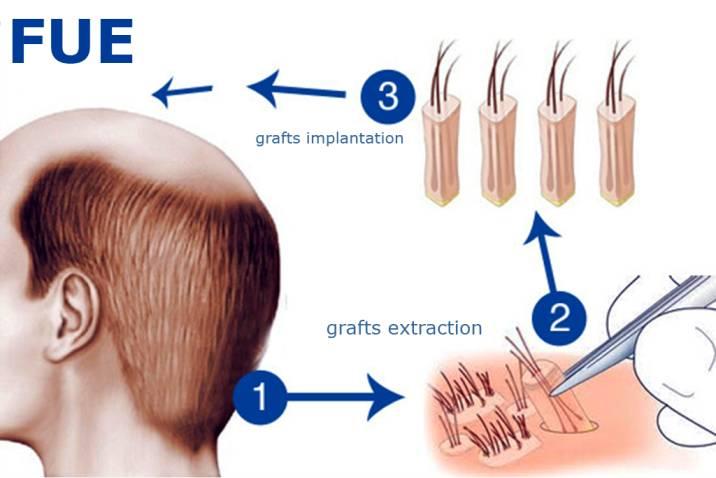
In experienced hands, both FUE and FUT can deliver equally high graft survival and natural-looking results. The choice between them is driven by your specific case (donor supply, extent of loss, hairstyle preference, scar visibility priorities) and the each surgeon's expertise. Neither technique is inherently superior to the other. FUE leaves small dot-like scars from each follicle extraction; FUT leaves a single linear scar from strip harvesting. Both are usually well concealed with appropriate hair length.
Transplanted hairs usually shed at weeks 2 to 8, followed by dormancy through months 2 to 3, then new growth from month 3 to 4. Visible density builds through months 6 to 12. Final, true results are assessed at 12 to 18 months once the full growth cycle has completed. Judging outcome before month 12 is judging incomplete regrowth, which is the single most common cause of premature dissatisfaction.
Still have more questions?
Book a call with our friendly team to learn how DivineHeal simplifies your healthcare journey.