
Written by DivinHeal Editorial Contributor, Rahul Kumar, Embryologist | Medically Reviewed by Dr Indu Priya, Gynecologist(MD) Published on: 2026-06-24
Varicocele Treatment in India: Costs, Options & How to
Get Started
Varicocele affects around 15% of men and is one of the
most common causes of male infertility. In India, treatment at JCI-accredited
hospitals typically costs ₹60,000–₹2,50,000 (USD 633–2,637), making it far more
affordable than private treatment in Australia or the UK. This guide covers
your treatment options, expected costs, and how Divinheal can help with
everything from travel arrangements to follow-up care.
Take James from Melbourne, 34. He waited
11 months just to see a specialist through Medicare. Then he was quoted AUD
12,000 for a private varicocelectomy. He flew to Chennai and had microsurgical
varicocelectomy at Apollo Hospitals with Dr. Ramesh Iyer, MCh (Urology).
He was home 10 days later. Total spend, including flights and accommodation:
under AUD 5,000.
The story is an illustrative composite
based on typical patient journeys. Name changed for privacy.
Plan My Journey
Tell us your condition and budget — our AI matches the right destination, hospital and doctor and visa pathway
What Is a Varicocele?
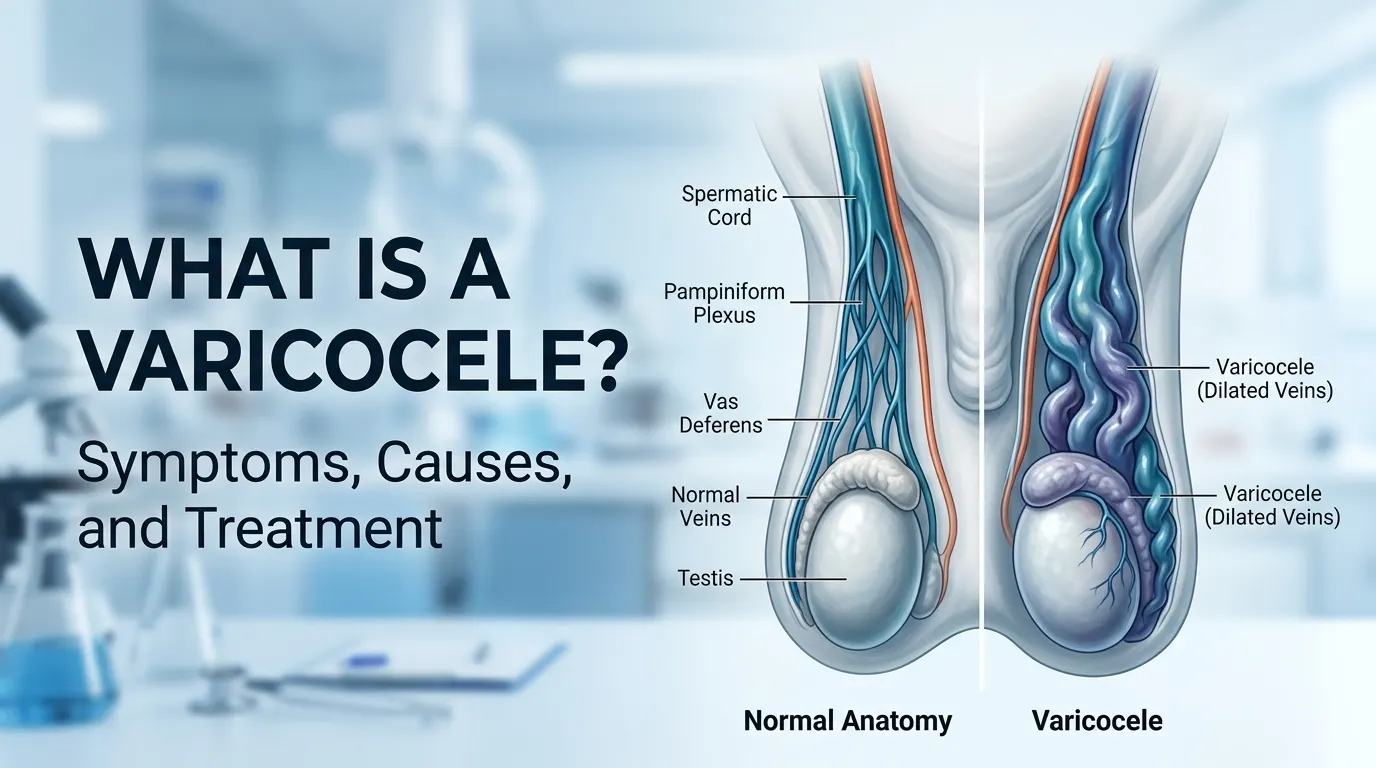
A varicocele is an enlargement of the veins inside your scrotum —
the loose pouch of skin that holds your testicles. Think of it like varicose
veins in the legs, but located in the scrotum. These veins are part of the
spermatic cord, which carries blood to and from the testicles. When the one-way
valves inside these veins stop working, blood pools instead of draining back to
the heart. This raises pressure and temperature inside the scrotum. That is
what causes the “bag of worms” sensation you can sometimes feel.
Varicoceles are most common on the left side — about 90% of cases.
That is because the left spermatic vein connects to the left renal vein at a
sharp angle, making backflow more likely. Varicoceles that affect both sides
happen in 10–20% of cases. About 15% of all men have a varicocele. That figure
rises to 40% among men checked for infertility (WHO, 2023).
Varicocele
Symptoms — When Should You See a Specialist?
Many men with a varicocele have no symptoms. They find out only
during a fertility check or routine exam. When symptoms do appear, they
include:
• A dull, aching pain in the
testicle, often worsening after standing, exercise, or sitting for long periods
• A feeling of heaviness or
dragging in the scrotum
• Visible swelling or bulging of
the scrotal veins
• A noticeably smaller testicle
on the affected side (testicular atrophy)
See a specialist if scrotal pain lasts more than a few weeks. Also
see one if you notice a change in testicular size or if you are having trouble
with fertility. Diagnosis is confirmed with a physical exam and scrotal
ultrasound. The appointment takes under 30 minutes.
Is
Sitting or Standing Worse for a Varicocele?
Standing is worse. When you are upright, gravity pushes down on the
blood in your scrotal veins and slows its return to the heart — the same reason
varicose veins ache more at the end of a long day. Symptoms ease when you lie
down because gravity no longer fights the drainage. Sitting for a long time can
also worsen the ache, especially if your posture squeezes the groin area.
Neither position causes lasting damage, but both can make the pain worse for a
while.
How Does
a Varicocele Affect Fertility and Testosterone?
A
varicocele can make the area around the testicles warmer than normal, which can
affect sperm production. Since sperm develop best at a slightly lower
temperature than the rest of the body, this extra heat may reduce sperm count,
movement, and quality. Varicoceles are one of the most common causes of male
infertility and are found in up to 40% of men undergoing fertility evaluation.
Varicoceles can also lower testosterone. They do this by harming the
Leydig cells in the testicle — the cells that make testosterone. Lower
testosterone can cause tiredness, reduced sex drive, and over time, bone loss.
Treatment improves sperm quality in 60–70% of men, according to the Journal of
Urology (2021). You can expect to see measurable improvements 3–6 months after
treatment. That is because the sperm production cycle takes 72 days.
Varicocele
Treatment Options in India
India’s top hospitals offer two main treatments: varicocele
embolisation and microsurgical varicocelectomy. Both work well. Your specialist
will pick the best one based on your varicocele grade, your symptoms, and your
fertility goals.
Varicocele
Embolisation — The Minimally Invasive Option
Varicocele
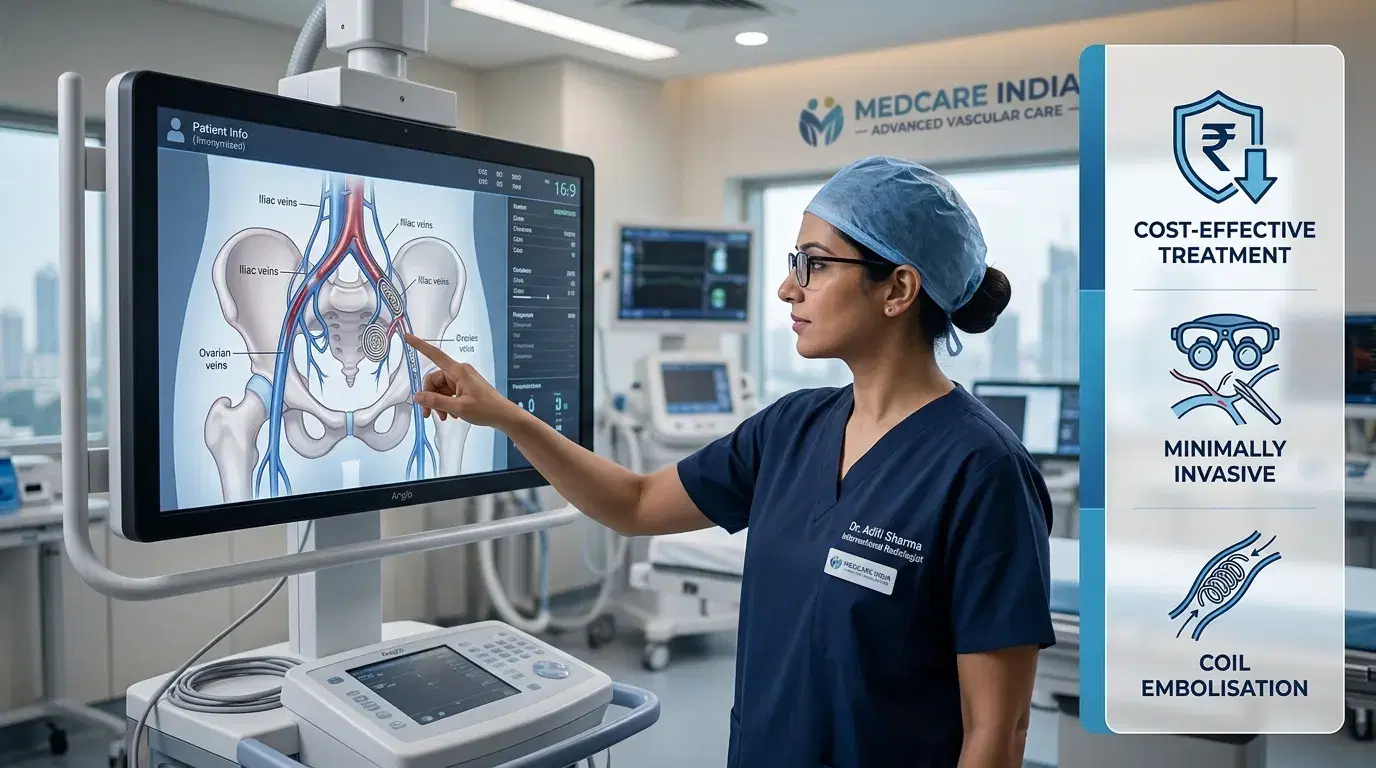
embolisation is done through a thin tube (catheter) under local anaesthesia and
mild sedation. No scalpel. No general anaesthesia. A specialist makes a 2–3 mm
nick in the groin or neck, then guides the catheter through the vein using
X-ray imaging. Small platinum coils or a liquid agent are released to block the
faulty veins and redirect blood to healthy ones.
Procedure time: 30–45 minutes
Hospital stay: Day procedure (same-day
discharge)
Return to light activity: 24–48 hours
Return to full activity: 5–7 days
Success rate: 90–95% for symptom relief
(ICMR guidelines, 2022)
Recurrence rate: 5–10%
Recovery is
usually straightforward, with most men experiencing only mild soreness for a
few days and occasional bruising at the catheter site. Serious complications
are rare, and the risk of coil migration is extremely low. Many patients choose
this option because it is minimally invasive, avoids general anaesthesia, and
allows them to get back to work and normal activities more quickly.
Microsurgical
Varicocelectomy — The Surgical Option
Varicocelectomy
means surgically tying off the enlarged veins through a small cut in the groin
or abdomen. The microsurgical version uses a high-powered microscope. This is
standard at India’s top centres. It lets surgeons protect key blood vessels and
tissues with much greater precision. It also lowers the risk of hydrocele —
fluid collecting around the testicle — compared to standard open surgery.
Urologists
like Dr. Rohan Gupta, FRCS, at Apollo Hospitals, Chennai, and
Dr. Pradeep Bansal, MCh (Urology), at Fortis Healthcare, Gurugram, perform
hundreds of these procedures every year.
Procedure time: 45–90 minutes
Hospital stay: 1–2 nights
Return to light activity: 3–5 days
Return to full activity: 2–4 weeks
Success rate: 90–98% for symptom relief
(European Association of Urology, 2023)
Recurrence rate: 2–5%
Risks
include infection (less than 2%), hydrocele formation (under 1% with the
microsurgical technique), and a longer recovery than embolisation. For patients
who want the most durable long-term result, microsurgical varicocelectomy has
the lowest recurrence rate available.
Embolisation
vs. Surgery — Quick Comparison
|
Feature |
Varicocele Embolisation |
Microsurgical Varicocelectomy |
|
Invasiveness |
Minimally invasive (2–3 mm nick, no scalpel) |
Small surgical incision (groin/abdomen) |
|
Anaesthesia |
Local + mild sedation |
General or spinal anaesthesia |
|
Hospital Stay |
Day procedure (same-day discharge) |
1–2 nights |
|
Return to Work |
2–3 days |
7–14 days |
|
Success Rate |
90–95% symptom relief |
90–98% symptom relief |
|
Recurrence Rate |
5–10% |
2–5% |
|
Cost in India |
₹70,000–₹2,50,000 ($738–$2,637) |
₹60,000–₹1,80,000 ($633–$1,900) |
|
Best For |
Faster recovery, no general anaesthesia |
Higher precision, lower recurrence |
Costs are approximate and depend on hospital tier, surgeon
seniority, and individual case complexity.
Is
Varicocele Surgery Serious? What Are the Risks?
Varicocele surgery is a routine operation, not a high-risk one. It
is similar in complexity to a hernia repair. At JCI-accredited Indian
hospitals, complication rates are below 5%. Serious complications — like blood
clots, major bleeding, or nerve injury — are very rare.
Embolisation carries even less risk. There is no cut, no general
anaesthesia, and no stitches. Recovery from embolisation is often faster than
recovery from wisdom tooth surgery.
Specific risks to discuss with your specialist before you proceed:
• Hydrocele formation (fluid
around the testicle): 3–5% with standard surgery, under 1% with microsurgical
technique
• Infection: less than 2%
• Recurrence: 2–5% with
microsurgery, 5–10% with embolisation
• Temporary scrotal aching
post-embolisation: very common, resolves in 2–5 days
Will a
Varicocele Go Away on Its Own?
No. Once a varicocele develops in an adult, the enlarged veins
do not close or shrink on their own. About 20% of teenagers develop
varicoceles. A small number clear up in younger teens — but this is very rare
in adult men (Hopkins Medicine, 2023).
A few
simple measures can help relieve discomfort, although they won’t fix the
varicocele itself:
• Wear supportive underwear or a jockstrap, particularly when exercising.
• Use an ice pack if you have pain or a heavy, aching feeling.
• Take anti-inflammatory pain relief, such as ibuprofen, if needed and appropriate for you.
If your varicocele causes no pain and no fertility problems,
watchful waiting is a fair choice. Your urologist will advise based on your
case. Treatment is usually recommended when there is confirmed infertility,
worsening testicular shrinkage, or ongoing pain that gets in the way of daily
life.
Varicocele
Treatment Costs in India vs. Australia, UK, and Nigeria
Varicocele treatment in India costs ₹80,000–₹2,50,000 ($960–$3,000)
depending on the type and hospital. That is 75–90% less than private clinics in
Australia or the UK. In Australia, costs run from AUD 8,000 to AUD 18,000. In
the UK, they run from £3,000 to £6,000.
|
Country |
Varicocele Embolisation |
Microsurgical Varicocelectomy |
Potential Savings vs India |
|
India |
₹70,000–₹2,50,000 ($738–$2,637) |
₹60,000–₹1,80,000 ($633–$1,900) |
— |
|
Australia |
AUD 4,000–15,000 (~$2,764–$10,365) |
AUD 5,000–15,000 (~$3,455–$10,365) |
75–90% saved |
|
UK |
£2,500–£5,500 ($3,299–$7,258) |
£3,000–£7,500 ($3,958–$9,894) |
70–85% saved |
|
Nigeria |
₦1,500,000–₦4,000,000 ($1,094–$2,918) |
₦1,500,000–₦5,000,000 ($1,094–$3,648) |
Better tech & specialists |
The costs shown are approximate and can vary based on the hospital you choose, your surgeon’s experience, and your individual treatment needs.
For Australian Patients
For many Australians, private
varicocele treatment can be costly, and public healthcare waiting times may be
long. India has become a popular option, offering high-quality care at
significantly lower prices. With Divinheal, patients receive support throughout
the journey, from treatment planning and travel arrangements to follow-up care
after returning home.
For UK Patients
NHS wait-lists for
non-emergency varicocele treatment run 6–12 months. Private treatment in the UK
costs £3,000–£6,000. Indian hospitals offer surgeons with GMC-recognised
qualifications and the same microsurgical skills as top UK private clinics — at
70–85% less. All medical records come in English for easy handover to your NHS
GP or private consultant.
For Nigerian Patients
Outside Lagos and
Abuja, it can be hard to find microsurgical varicocelectomy or embolisation in
Nigeria. India offers better technology, more specialists, and full logistics
support. Divinheal’s Nigeria-experienced team has helped hundreds of men from Lagos,
Abuja, and Port Harcourt — covering every step from visa to post-op care.
How
Divinheal Supports Your Treatment Journey
Divinheal connects you with JCI-accredited hospitals — including
Apollo Hospitals, Fortis Healthcare, Max Healthcare, and Artemis Hospital. We
take care of the logistics so you can focus on your health.
Here is what Divinheal includes:
• Hospital shortlisting based on
your condition, budget, and preferred city (Delhi, Chennai, Mumbai, Bengaluru)
•,Medical visa invitation letter
from your chosen hospital — essential for Australian, UK, and Nigerian
applicants
• Accommodation booked near the
hospital — serviced apartment or hotel, per your preference
• Airport transfer from arrival
to discharge
• Interpreter support for
Nigerian patients (French, Hausa, Yoruba, and Igbo dialects available on
request)
• Post-op telehealth follow-up at
4 weeks, 3 months, and 6 months with your treating specialist
• Medical records in English,
formatted for your home GP or specialist
Adewale from Lagos, 31, was worried about going to India alone for a varicocelectomy. Divinheal set up his medical visa letter and a translator for his pre-op consultation. They also arranged a direct flight plan via Chennai. He had microsurgical varicocelectomy at Fortis Healthcare and was back in Lagos 12 days later — with a 3-month semen analysis showing sperm count up by 38%.
The story is an illustrative composite based on typical patient journeys. Name changed for privacy.
Planning
Your Trip — Visa, Timeline, and What to Expect
Typical India stay: 7–12 days for either
embolisation or varicocelectomy.
Standard
timeline:
• Day 1: Arrive and settle into your
hotel or serviced apartment.
• Day 2: Meet your specialist and
complete any necessary tests.
• Day 3: Have your procedure.
Embolisation patients usually go home the same day, while varicocelectomy
patients may stay in the hospital for a night or two.
• Days 4–8: Take it easy and focus on
recovery.
• Day 9 or 10: Return for a final check-up and
fit-to-fly clearance.
• Day
10–12: Travel home and continue recovering at your own pace.
If
you're travelling from Australia or the UK, obtaining a medical visa for India
is usually a straightforward process. Divinheal can assist by providing the
hospital invitation letter and other documents required for your application.
Nigerian visas: The paperwork is more
detailed. Divinheal has an in-house team that manages Nigerian medical visa
applications step by step.
Recovery
After Varicocele Treatment — What to Expect
After Varicocele
Embolisation
• You may have some mild aching or
discomfort for a few days, which is typically relieved with standard pain
medication.
• Most people are back to light everyday
activities within a day or two.
• It's best to avoid heavy lifting, gym
workouts, and strenuous exercise for about a week.
• Sexual
activity can usually be resumed after 5–7 days, or as advised by your doctor.
• Flying home: typically safe
from Day 7–10 post-procedure
After Microsurgical
Varicocelectomy
• Moderate pain for 3–5 days
(managed with prescribed medication from the hospital)
• Light activities: resume in 3–5
days
• Heavy lifting: avoid for 2–4
weeks
• Sexual activity: avoid for 2–3
weeks
• Flying home: typically safe
from Day 8–12 post-procedure
Sleep Position After
Treatment
Sleep on
your side during the first week. This takes pressure off the scrotum and helps
blood drain naturally from the testicular veins. Placing a pillow between your
knees helps align your pelvis and reduces strain on the groin. Avoid sleeping
on your stomach — it adds direct pressure to the scrotum.
When Will Fertility Improve?
It takes about
three months for new sperm to be produced, so improvements don't happen
overnight. Most doctors recommend repeating a semen analysis around 3 months
after treatment to check your progress. Many men start to see improvements in
sperm count and motility within 3–6 months, which can improve their chances of
achieving a pregnancy.
Results vary from person to person. Your specialist can give you the most accurate advice based on your individual condition and treatment goals.
Cost Calculator
I know my treatment — show me cost from 3 hospitals
Quick Answer — At a
Glance
Skim this if you’re short on time.
Varicocele treatment in India costs ₹60,000–₹2,50,000 ($633–$2,6370)
at JCI-accredited hospitals — 75–90% less than private clinics in Australia or
the UK. Two options are available: varicocele embolisation (a day procedure,
90–95% success, 30–45 min) and microsurgical varicocelectomy (1–2 nights,
90–98% success). Fertility improvements typically appear within 3–6 months.
Divinheal includes visa support, hospital shortlisting, accommodation, and
post-op telehealth follow-up from your home country.
The
table below gives an overview of typical private treatment costs in 2026.
|
Country |
Embolisation (USD) |
Surgery (USD) |
Savings |
|
India |
$738–$2,637 |
$633–$1,900 |
— |
|
Australia |
$2,764–$10,365 |
$3,455–$10,365 |
75–90% |
|
UK |
$3,299–$7,258 |
$3,958–$9,894 |
70–85% |
|
Nigeria |
$1,094–$2,918 |
$1,094–$3,648 |
Better tech |
These
figures are intended as a guide only. Actual costs may vary depending on the
hospital, your surgeon, and the complexity of your treatment.
Written by DivinHeal Editorial Contributor, Rahul Kumar, Embryologist | Medically Reviewed by Dr Indu Priya, Gynecologist(MD) Published on: 2026-06-24
Plan My Journey
Tell us your condition and budget — our AI matches the right destination, hospital and doctor and visa pathway
Cost Calculator
I know my treatment — show me cost from 3 hospitals
Booking With DIVINHEAL
Get a free consultation to understand your treatment options
From Consultation to Recovery,
Step by Step
Expert Specialist Matching
Connecting you with the world's top-rated medical experts.
Accredited Hospital Network
Access to JCI & NABH certified healthcare facilities.
Complete Travel Coordination
Hassle-free visa, stay, and local transport assistance.
24/7 Personal Care
Dedicated patient advisors supporting you at every step.
Journey Guidance
Full guidance from start to end of the patient treatment journey.
Expert Specialist Matching
Connecting you with the world's top-rated medical experts.
Everything you
need to know today
Browse through these common inquiries to better understand our patient-focused medical platform.
Sleep on your side. This reduces direct pressure on the scrotum and helps blood drain from the testicular veins. Placing a pillow between your knees helps align your pelvis and eases groin strain. Avoid sleeping on your stomach — it adds direct pressure to the scrotum.
Sexual arousal and ejaculation increase blood flow in the genital area. This can make varicocele discomfort worse for a short time. After treatment, most specialists advise avoiding sexual activity for 5–7 days (embolisation) or 2–3 weeks (surgery) to let the area heal. In the long run, treatment tends to improve sexual function, not harm it.
Most varicoceles are not dangerous, and many men never notice any symptoms. The main concern is that, over time, a varicocele can affect sperm quality and fertility. In some cases, it may also cause discomfort or shrinkage of the affected testicle. If you're planning to have children or are experiencing symptoms, it's worth getting checked by a specialist.
No. Once formed in adults, varicocele veins do not close or shrink without treatment. About 20% of teenagers develop varicoceles. A small number clear up on their own — but this is very rare in adult men (Hopkins Medicine, 2023). Supportive underwear can ease symptoms, but it does not cure the condition.
The procedure takes 30–45 minutes. After a 2-hour observation period, most patients go home the same day. You will need someone to drive you because sedation is used. You can get back to light activities within 24–48 hours.
Most men recover quite quickly after treatment. You can usually get back to light everyday activities within a day or two, but it's a good idea to take things easy for the first week. Avoid heavy lifting, intense exercise, and sexual activity for several days to give your body time to heal. Most patients are comfortable travelling home within 7–10 days, depending on their recovery and their specialist’s advice.
Many men find that standing for long periods makes their varicocele feel worse. This is because blood tends to collect in the enlarged veins when you're upright, which can cause aching, heaviness, or discomfort. Lying down often helps ease these symptoms. Sitting for long stretches can also be uncomfortable for some men, particularly if there's pressure on the groin area. Although these positions can make symptoms more noticeable, they aren't usually harmful.
Yes. A varicocele can harm the Leydig cells in the testicle. These cells make testosterone. Lower testosterone may cause tiredness, reduced sex drive, and weaker bones over time. Studies show that successful treatment can partly or fully restore testosterone levels — especially if treated before serious damage occurs.
The pain can come and go — it gets worse with standing, exercise, or heat, and eases with rest or lying down. The varicocele itself does not come and go. The veins stay enlarged. The changing pain just reflects shifts in venous pressure, not the condition resolving.
Yes. Many specialists at JCI-accredited hospitals in India have extensive experience and internationally recognised qualifications, with some having trained or worked in countries such as the UK, Australia, and the United States. Divinheal carefully checks each surgeon’s credentials and the hospital’s accreditation before recommending a treatment centre.
Divinheal works only with JCI-accredited hospitals. These are checked against international patient safety standards by an independent body. Recommended surgeons have proven qualifications and at least 10 years of experience in their specialty. Divinheal also tracks patient feedback after treatment and shares outcome data with its clinical advisors every quarter.
Plan for 7–12 days. Day 2 is your pre-op workup. Day 3 is the procedure. Days 4–8 are recovery at your accommodation. Day 9–10 is your final specialist check. After that, you get clearance to fly home. Embolisation patients are usually ready in 7–8 days. Varicocelectomy patients may need the full 10–12 days. Divinheal plans the full schedule.
Still have more questions?
Book a call with our friendly team to learn how DivineHeal simplifies your healthcare journey.








