
Written by DivinHeal Editorial Contributor, Rahul Kumar, Embryologist | Medically Reviewed by Dr Indu Priya, Gynecologist(MD) Published on: 2026-06-10
Cervical Ectropion: Symptoms & Treatment Options in India
Cervical ectropion is quite common, affecting around 1
in 3 women at some point, but getting it checked isn’t always quick in public
systems like the NHS or Medicare, where waiting times can stretch to 3–6
months. The actual examination usually takes less than 15 minutes, but access
to that appointment is often the harder part. In India, a colposcopy at a
JCI-accredited hospital typically costs about AUD 180–450. In comparison,
private care can range from AUD 200–600 in Sydney and GBP 600–1,200 in London.
Many hospitals in India can also arrange appointments within 72 hours.
This guide answers the questions women
most often search for. It covers ectropion cervix symptoms, polyps on the
cervix, and a bruised cervix. It explains how your cervix changes before your
period and in early pregnancy. It also covers the cervix score used in labour.
Nigerian patients will find visa and travel guidance here. The cost table shows
exactly what you would save at each stage of care.
Divinheal connects patients from
Australia, the UK, and Nigeria to gynaecology doctors at NABH- and
JCI-accredited hospitals in Delhi, Chennai, and Mumbai.
Plan My Journey
Tell us your condition and budget — our AI matches the right destination, hospital and doctor and visa pathway
Cervix
Before Period vs Pregnant: How to Tell the Difference
The
cervix is the lower part of the uterus that sits at the top of the vagina. It
naturally changes during the menstrual cycle and early pregnancy—shifting in
position, firmness, and openness as hormones fluctuate. Some women notice these
changes, but they aren’t a reliable way to confirm pregnancy. They can be
helpful for general body awareness, but only a pregnancy test can give a
definite answer.
How Your Cervix
Feels Before Your Period
In
the days before your period (the luteal phase), your cervix drops lower in the
vagina. It firms up to feel like the tip of your nose. It also closes tightly.
This low-firm-closed mix is the clearest sign your period is coming. The
cervical mucus drops and may feel dry or sticky.
How Your Cervix
Feels in Early Pregnancy
If
you have conceived, the cervix often rises higher. It softens to feel like an
earlobe or the inside of your lip. It stays firmly closed to protect the
growing embryo. More blood flow from progesterone can also cause a bluish
discolouration (Chadwick’s sign). This is only visible on medical examination.
Cervical
position in early pregnancy is not the same for all women. Only a urine
pregnancy test and a medical check can confirm pregnancy reliably.
Key Differences at a Glance
|
Feature |
Before
Period (Luteal Phase) |
Early
Pregnancy |
|
Position |
Low — easy
to reach |
High — may
be harder to reach |
|
Firmness |
Firm — like
tip of nose |
Soft — like
an earlobe |
|
Opening |
Closed,
slightly open before flow |
Firmly
closed to protect the uterus |
|
Texture |
Dry to
sticky — mucus decreasing |
Moist —
increased cervical secretions |
If you
notice unusual discharge, bleeding, or pelvic pain, book a pelvic exam. These
symptoms are worth checking, not Googling.
Ectropion
Cervix: Symptoms, Causes & What Happens Next
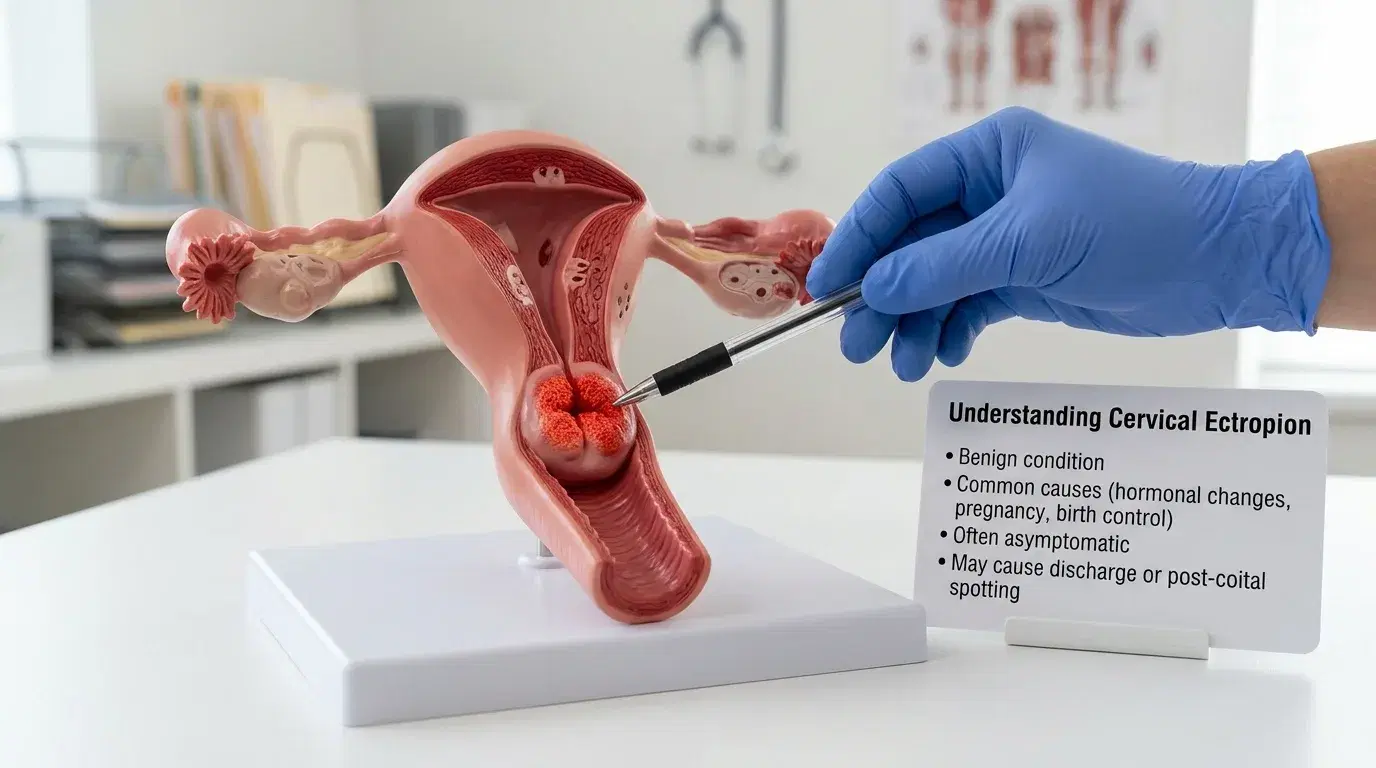
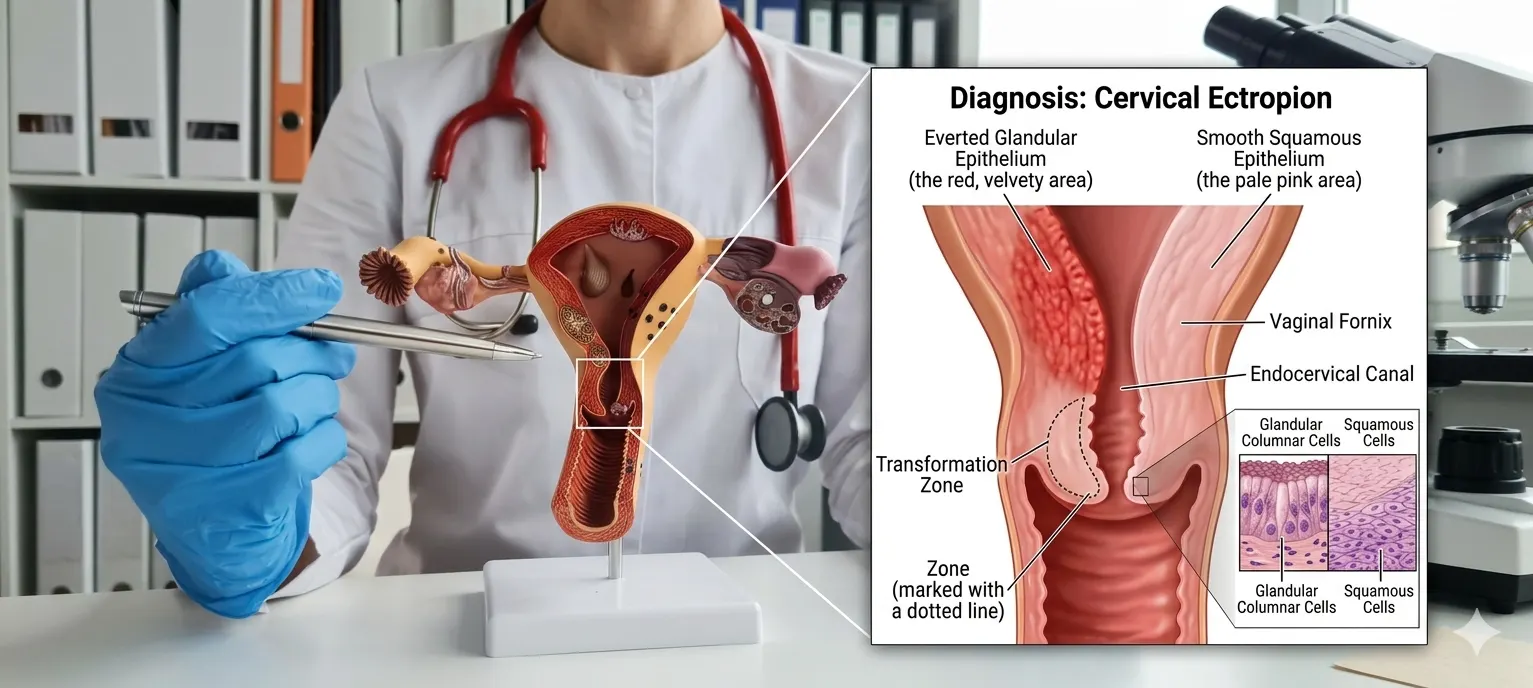
Cervical ectropion (also called cervical erosion) is a benign
condition. Soft glandular cells that line the inside of the cervical canal
spread onto the outer surface. The outer surface normally has tougher cells. So
the exposed area looks red and raw during examination. But this is a normal
cell change — not a sign of damage, infection, or cancer.
Ectropion of the cervix affects about 30% of women in their
childbearing years. It is not an infection, is not sexually transmitted, and
does not raise your cervical cancer risk.
Symptoms of Ectropion Cervix
Many women
find out they have ectropion only during a routine Pap smear — they had no
symptoms at all. When symptoms do happen:
• Post-sex spotting or light
bleeding (most commonly reported symptom — glandular cells bleed easily when
touched)
• Increased vaginal discharge —
clear or slightly yellow, caused by excess mucus from the glandular cells
• Mild pelvic sensitivity or
discomfort during penetration
• Occasional spotting between
periods
Cervical
ectropion does not cause pain as a main symptom. Significant pelvic pain with
these findings needs a check for other conditions.
What Causes Ectropion
of the Cervix?
Oestrogen
is the main driver. It is most common when oestrogen levels are high. This
happens during adolescence (studies suggest up to 60% of girls may show
ectropion at first gynaecological examination), during pregnancy, and while
using the combined oral contraceptive pill.
Oestrogen
drops at menopause. Because of this, ectropion often goes away on its own after
menopause, without treatment. Switching from the combined pill to a
progestogen-only pill (under your doctor’s guidance) can sometimes reduce
symptoms within 3–6 months.
How Is Ectropion Diagnosed?
A doctor looks
at the cervix during a speculum exam. If there is any doubt, a colposcopy is
done. This is a 10–20 minute clinic examination using a magnifying instrument.
A small biopsy may be taken. Both are standard, low-pain clinic procedures.
How Do You Treat
Ectropion of the Cervix?
Ectropion
with no symptoms needs no treatment. For ongoing symptoms, there are two
standard options. The first is cryotherapy — freezing the glandular cells with
liquid nitrogen. This takes 10–15 minutes and needs no numbing. The second is
electrocautery — removing cells with heat, for a similar length of time. Most
women need only one session. You need to wait 4 weeks before penetrative sex
after treatment. Ectropion treatment in India costs INR 10,000–70,000 ($104–732)
as a day procedure.
Polyp on
Cervix: What It Is, Symptoms & Treatment
A
cervical polyp is a small, usually non-cancerous growth that develops on the
cervix or inside the cervical canal. It often looks like a soft, red or purple
bump and may hang on a thin stalk, a bit like a tiny finger or teardrop.
Cervical polyps are relatively uncommon, affecting around 2–5% of women, and
are most commonly seen between the ages of 40 and 50 (NCBI, 2023.
Less than 1% of removed cervical polyps are found to be malignant
(ACOG, 2022). Routine removal and biopsy confirms this — it is standard
practice, not a sign of alarm.
Symptoms of a Polyp on
the Cervix
Most
polyps cause no symptoms and are found during a routine pelvic exam or Pap
smear. When symptoms happen:
• Irregular vaginal bleeding —
spotting between periods, after sex, or post-menopause
• Unusual vaginal discharge —
clear, white, or slightly yellow
• In rare cases, a feeling of
pressure if the polyp is large
Cervical
polyps and ectropion can look alike on visual examination — both appear red on
the outer cervix. A polyp is a raised growth. Ectropion is a flat cell change.
Your gynaecologist tells them apart on examination.
What Causes Cervical Polyps?
The exact cause of
cervical polyps isn’t fully understood. They may be linked to ongoing
inflammation of the cervix, higher oestrogen levels, or changes in the small
blood vessels in cervical tissue (NCBI, 2023). Importantly, they are not
sexually transmitted and are not usually caused by infection.
Treatment for a
Cervical Polyp: Polypectomy
Polypectomy
is the standard treatment. The polyp is gently removed at its base. It takes
5–10 minutes at the clinic, often without numbing. Most women go back to normal
activities within 1–2 days. The removed polyp is always sent for biopsy.
At
JCI-accredited hospitals in India — Apollo Hospitals Chennai, Fortis Healthcare
Delhi — polypectomy costs INR 10,000–40,000 (about USD 104–418 / AUD 149–596 /
GBP 78–313 / NGN 1,42,445–5,69,782). In Australia, the same procedure costs AUD
1,000–3,000. In the UK, it costs GBP 1,000–3,500. That is a saving of 70–80%.
Bruised
Cervix: Causes, Symptoms & How Long It Takes to Heal
A bruised cervix (cervical contusion) happens when an injury causes
micro-damage to the delicate cervical tissue. It is common and self-limiting.
It heals without treatment in most cases — but the symptoms can be alarming if
unexpected.
How Does a Cervix Get
Bruised?
The most
common cause is deep or forceful penetration during sex, which can irritate the
sensitive tissue of the cervix. Cervical tenderness can also occur after
procedures such as an IUD insertion, colposcopy, polyp removal, or a thorough
pelvic exam. If you've recently had a colposcopy or polypectomy, some mild
soreness or tenderness is normal and usually improves on its own as the cervix
heals.
What Happens When the Cervix Is Hit Too Hard?
Forceful
deep contact with the cervix causes sharp pain that fades quickly. This is
followed by a dull pelvic ache lasting several hours. Light spotting (pink or
brown) may appear within 1–2 hours. These are normal injury responses. The
cervix may feel tender to the touch for 24–48 hours.
Symptoms of a Bruised Cervix
• Dull deep pelvic ache during or
after sex
• Light spotting — usually pink
or brown, rarely heavy red bleeding
• Lower back discomfort —
referred pain from the cervical area
• Cramping similar to mild
menstrual cramps
• Sensitivity or pain on deep
palpation during examination
Symptoms
start within hours of injury and go away within 1–7 days.
How Long Does a
Bruised Cervix Take to Heal?
Most
bruised cervices heal within 1–7 days. Rest and avoiding penetrative sex are
the main treatments. Ibuprofen helps with pain. Use pads instead of tampons to
reduce irritation.
It’s a good idea
to see a doctor if you have heavy bleeding (like soaking through more than one
pad an hour), pain that’s getting worse instead of improving, symptoms that
haven’t settled after 7–10 days, or a fever or foul-smelling discharge. While
mild irritation or bruising often settles on its own, these signs can sometimes
point to an infection or another issue that needs treatment.
Distinguishing a
Bruised Cervix from Other Conditions
Cervical bruising
usually happens after something like deep penetration during sex or a recent
gynaecological procedure, and it tends to improve on its own with rest. A UTI
feels different—it more often causes burning when urinating, frequent urges to
pee, and bladder discomfort rather than deep pelvic pain after sex. Ovarian
cyst pain is usually felt on one side of the pelvis and isn’t typically linked
to sex. Early pregnancy spotting is generally light and painless, and not
caused by physical impact. If you’re unsure what’s going on, a pelvic exam can
help clarify things.
Cervix
Score (Bishop Score): What It Means and Why It Matters
A cervix score is a medical check of how ready the cervix is for
labour. The most widely used system is the Bishop Score. Doctors use it mainly
when thinking about inducing labour. It helps predict the chance of a
successful vaginal delivery after induction.
What Is the
Bishop Score and How Is It Calculated?
The
Bishop Score checks five features of the cervix during an internal (vaginal)
examination:
• Dilation — how open the
cervical os is, measured in centimetres (0 cm closed to 10 cm fully dilated)
• Effacement — how thin the
cervix has become (0% thick to 100% fully thinned)
• Consistency — whether the
cervix feels firm (like cartilage), medium, or soft (like lips)
• Position — whether the cervix
points posteriorly (backward) or anteriorly (forward toward the pubic bone)
• Fetal station — how far the
baby’s head has descended into the pelvis, measured in centimetres
Each
feature scores 0–3. The total Bishop Score maximum is 13. A score of 8 or above
means the cervix is ready. Labour is likely to go well with induction (NICE
Guidelines, 2021). Scores of 6–7 are borderline. A score of 5 or below means
the cervix is not ready. Cervical ripening is often needed before active
induction.
Is a Bishop Score of 7 Good?
A score of 7
is borderline. Some hospitals start induction at 7. Others first use cervical
ripening (prostaglandin gel or a Foley catheter balloon) to reach a score of 8
before starting. Protocols vary by hospital and each patient. Ask your
obstetrician which threshold your hospital uses.
Other Uses of Cervical
Assessment
Doctors
use cervical assessment for other reasons too:
• Check cervical length in women
at risk of early labour
• Look for cervicitis
(infection-related swelling)
• Check healing after LEEP or
polypectomy
• Identify ectropion during
routine examination
Cervical
Ectropion vs Cancer, Polyps vs Cancer: Key Differences
An abnormal-looking cervix on examination is almost always benign.
Here’s what each finding means and how to tell them apart.
Cervical Ectropion
vs Cervical Cancer
Cervical
ectropion is a normal cell-type change on the outer cervix — not abnormal
cells, not precancerous cells. Cervical cancer is the uncontrolled growth of
genuinely abnormal cells, linked to persistent HPV (human papillomavirus)
infection.
Both cervical
ectropion and cervical cancer can cause bleeding after sex, so it’s important
not to ignore ongoing symptoms. With ectropion, bleeding happens because the
softer cells on the cervix are more sensitive and can bleed easily when
touched. cervical cancer, is due to abnormal changes in the cervical tissue. If
needed, a colposcopy and sometimes a biopsy can clearly tell the difference.
Reassuringly, cervical ectropion is common, harmless, and does not increase the
risk of cervical cancer (NHS, 2023).
Cervical Polyps vs
Cervical Cancer
Cervical
polyps are smooth, mobile, and soft. Cervical cancer lesions are typically
irregular, firm, and bleed easily on touch. At later stages, they often come
with pelvic pain or unexplained weight loss. Any removed polyp is sent for
biopsy to confirm it is benign — this is standard, not a cause for worry.
Cervical cancer is
now relatively uncommon in Australia, affecting about 4 in every 100,000 women
each year (AIHW, 2023). Most cases are found in women who haven’t kept up with
regular cervical screening. That’s why routine HPV testing and cervical screening
are so important—they can pick up abnormal cell changes early, often before
cancer develops.
Bruised Cervix vs
Cervicitis (Infection)
Cervicitis
is an infection of the cervix, often from chlamydia or gonorrhoea. Both
cervicitis and bruising can cause cervical redness and tenderness on
examination. The difference: bruising follows a physical event and gets better
on its own. Cervicitis persists or gets worse and needs antibiotics. Cervicitis
also causes discharge with an unusual odour and may come with fever. These are
not typical of simple bruising.
Normal Cervix vs
Tilted (Retroverted) Cervix
About
20–30% of women have a retroverted uterus (Mayo Clinic). This puts the cervix
at a different angle. It is a normal body variation. It doesn’t cause health
problems, doesn’t affect most women’s fertility, and doesn’t look abnormal on
examination. Women with a retroverted uterus sometimes feel deeper pain during
sex. This can occasionally result in minor cervical contact.
Supporting
Cervical Health Naturally (Alongside Medical Treatment)
Natural
approaches can't make cervical ectropion, polyps, or bruising go away on their
own—those conditions need proper medical evaluation and, sometimes, treatment.
What natural measures can do is support your body's healing process, help
reduce inflammation, and ease mild discomfort alongside the care recommended by
your doctor.
Dietary Choices That Help
•,Include plenty of folate-rich foods in
your diet, such as leafy greens, lentils, and chickpeas, to support healthy
cell repair and maintenance.
• Foods rich in omega-3 fatty acids,
including oily fish, flaxseeds, and walnuts, may help keep inflammation in
check.
• Staying well hydrated helps support
overall tissue health throughout the body.
• It’s best to avoid douching, as it can
disrupt the vagina’s natural balance and irritate sensitive cervical tissue.
• If you smoke, consider quitting.
Smoking doesn't cause ectropion, but it is linked to abnormal cervical cell
changes and can affect overall cervical health.
These steps are
best viewed as supportive measures alongside, not instead of, medical care. After Procedure Recovery Tips.
After colposcopy,
polypectomy, or LEEP, your care team will give you specific aftercare
instructions. General rules: avoid penetrative sex for 4 weeks post-LEEP, use
pads not tampons for 4 weeks, avoid baths and swimming pools for 2 weeks
(showers are fine). Contact your doctor if you develop fever, heavy bleeding,
or foul-smelling discharge — all signs of infection rather than normal healing.
Real Patient Experiences: Cervical Health Treatment in India
The examples below are based on real patient experiences and are shared for illustration purposes only. Names and some details have been changed to protect privacy.
Sarah, 34, Sydney — Ectropion with Post-Sex Bleeding
Sarah had been dealing with light spotting after sex for more than a year. Her GP referred her for a colposcopy, but the waiting time through Medicare in her area was around four months. Wanting answers sooner, she travelled to India through Divinheal and was able to see a specialist at Apollo Hospitals Chennai within just three days. The colposcopy confirmed that the cause was straightforward cervical ectropion, with no signs of anything more serious. She didn't need treatment—just reassurance and routine monitoring. The consultation and colposcopy cost about AUD 220 in total, compared with the AUD 600 she had been quoted at a private clinic in Sydney.
Chiamaka, 42, Lagos — Cervical Polyp Removal
Chiamaka was told she had a cervical polyp. She was advised to watch and wait — there were few local facilities for outpatient polypectomy. She travelled to Fortis Healthcare Delhi through Divinheal. The polypectomy took 8 minutes under local anaesthesia. Biopsy returned benign. Total stay: 5 days. Divinheal coordinated her e-Medical Visa, airport transfer from Indira Gandhi International, and accommodation 800 metres from the hospital.
James & Grace, Birmingham — Bruised Cervix Post-Colposcopy
Grace had a routine NHS colposcopy followed by 10 days of pelvic pain. Her GP follow-up appointment was 8 weeks away. She arranged a private follow-up examination in Chennai through Divinheal during a family visit to India. The examination confirmed temporary post-procedure cervical sensitivity with no complications. Cost: GBP 50 equivalent, versus GBP 380 for a UK private appointment.
Cervical
Treatment Costs: India vs Australia, UK & Nigeria Compared
India offers JCI-accredited hospital care. Cervical treatment costs
are 60–85% lower than private care in Australia, the UK, and Nigeria. Most
procedures need a total stay of 3–7 days.
|
Procedure |
India (INR / USD) |
Australia (AUD) |
UK (GBP) |
Nigeria (NGN) |
|
Colposcopy |
INR 12,000–25,000 / $125–261 |
AUD200–600 |
GBP 600–1,200 |
NGN 350,000–450,000 |
|
LEEP Procedure |
INR 30,000–70,000 / $314–732 |
AUD 800–2,000 |
GBP 2,000–3,500 |
NGN 100,000–350,000 |
|
Cervical Polypectomy |
INR 10,000–40,000 / $104–418 |
AUD 1,000–3,000 |
GBP 1,000–3,500 |
NGN 80,000–400,000 |
|
Ectropion Treatment (cryo/cautery) |
INR 10,000–70,000 / $104–732 |
AUD 1,000–3,000 |
GBP 300–1,000 |
NGN 50,000–150,000 |
|
Pap Smear + HPV Screening |
INR 3,000–5,000 / $31–52 |
AUD 150–400 (private) |
GBP 200–500 (private) |
NGN 30,000–100,000 |
The
figures shown are approximate private healthcare costs for 2025–2026 and should
be used as a general guide. The final price can vary depending on the hospital,
the specialist performing the procedure, and the complexity of the case. While
many gynaecological procedures in Australia and the UK are available through
the public healthcare system at little or no cost, non-urgent cases often
involve longer waiting times, which can range from a few months to up to a year
in some areas.
|
Country |
Typical Saving vs India |
Public Wait (Non-Urgent) |
Key Trust Signal |
|
Australia |
75–85% |
3–12 months (Medicare) |
JCI-accredited hospitals + FRCS surgeons |
|
United Kingdom |
70–85% |
6–12 months (NHS) |
GMC/FRCS-trained surgeons + JCI |
|
Nigeria |
40–65% |
Limited advanced local facilities |
End-to-end logistics + visa support |
Divinheal partner hospitals:
• Apollo Hospitals Chennai — NABH + JCI accredited
• Fortis Healthcare Delhi — JCI accredited, 650+ beds
• Manipal Hospitals Bengaluru — NABH accredited
• Max Super Speciality
Hospital Delhi — JCI accredited
All have English-speaking coordinators for overseas patients.
Cost Calculator
I know my treatment — show me cost from 3 hospitals
Quick Answer — At a
Glance
Skim this if you’re short on time.
|
Cervical ectropion is a benign
condition affecting up to 30% of women in which glandular cells from inside
the cervical canal appear on the outer cervix — not cancer, not infectious. Symptoms
of ectropion cervix include post-sex spotting and increased discharge. A
polyp on the cervix affects 2–5% of women and is removed by a
10-minute outpatient polypectomy (INR 10,000–40,000 at JCI-accredited
hospitals in India). A bruised cervix heals within 1–7 days with
rest. The Bishop Score (cervix score) measures cervical readiness for
labour on a 0–13 scale — a score of 8 or above is favourable for induction.
Before your period, your cervix is low and firm. In early pregnancy, the cervix
naturally softens and shifts position as the body begins to change. In
India, cervical treatments are often significantly more affordable—usually
around 70–85% less than private care in Australia or the UK. At NABH- and
JCI-accredited hospitals, appointments are typically available within about
72 hours. |
Book a free consultation with Divinheal to get a cost estimate,
hospital recommendation, and appointment within 72 hours. Our team works with
patients from Sydney, London, and Lagos — and the first step takes under 5
minutes.
Written by DivinHeal Editorial Contributor, Rahul Kumar, Embryologist | Medically Reviewed by Dr Indu Priya, Gynecologist(MD) Published on: 2026-06-10
Plan My Journey
Tell us your condition and budget — our AI matches the right destination, hospital and doctor and visa pathway
Cost Calculator
I know my treatment — show me cost from 3 hospitals
Booking With DIVINHEAL
Get a free consultation to understand your treatment options
From Consultation to Recovery,
Step by Step
Expert Specialist Matching
Connecting you with the world's top-rated medical experts.
Accredited Hospital Network
Access to JCI & NABH certified healthcare facilities.
Complete Travel Coordination
Hassle-free visa, stay, and local transport assistance.
24/7 Personal Care
Dedicated patient advisors supporting you at every step.
Journey Guidance
Full guidance from start to end of the patient treatment journey.
Expert Specialist Matching
Connecting you with the world's top-rated medical experts.
Everything you
need to know today
Browse through these common inquiries to better understand our patient-focused medical platform.
Polypectomy in India costs about INR 10,000–40,000 (USD 104–418 / AUD 149–596). Ectropion treatment (cryotherapy or electrocautery) costs INR 10,000–70,000 ($104–732). Both are day procedures. This compares with AUD 1,000–3,000 for polypectomy in Australia and GBP 1,000–3,500 in the UK — a saving of 70–80%.
A bruised cervix causes a dull, deep pelvic ache that starts within hours of an injury. It also causes light spotting (pink or brown, not heavy red) and sensitivity to touch. The key sign is that symptoms follow a physical event — such as sex with deep penetration or a gynaecological procedure. Symptoms get better steadily with rest and go away within 1–7 days.
Deep or forceful penetration that touches the cervix can cause a sharp pain at the time, which usually settles fairly quickly. After that, some people may notice a dull, period-like ache in the pelvis for a few hours, sometimes with light spotting or mild lower back discomfort. This is often called cervical bruising (or a cervical contusion) and is usually a minor injury that heals on its own with rest. Simple pain relief like ibuprofen can help if needed. If bleeding is heavy, pain is getting worse, or symptoms don’t improve within about a week, it’s important to see a doctor.
Cervical ectropion usually doesn’t need any treatment if it isn’t causing symptoms. When it does, simple outpatient treatments like cryotherapy (freezing the area with liquid nitrogen) or electrocautery (using heat) can be used to remove the exposed glandular cells. These procedures are quick, and most people only need one session. After treatment, the cervix needs a few weeks to heal, so doctors usually recommend avoiding tampons and penetrative sex during that time. In some cases, symptoms may also improve by changing hormonal contraception—for example, switching from a combined pill to a progestogen-only option—but this should always be done with medical advice.
The combined oral contraceptive pill is the main aggravating factor — it raises oestrogen, which drives glandular cell growth. Pregnancy also makes ectropion worse. Sex and internal examinations irritate the exposed cells and cause spotting. Stopping the pill or switching contraception (under medical review) can clear symptoms within 3–6 months without any procedure needed.
No. Cervical ectropion is not precancerous and does not raise your cancer risk (NHS, 2023). Cervical cancer is caused by an ongoing HPV infection. HPV creates genuinely abnormal cells — a different process from ectropion. If there’s any doubt after examination, colposcopy with biopsy confirms the diagnosis.
A Bishop score of 7 is borderline favourable. Some hospitals proceed with induction at this score. Others first apply cervical ripening (prostaglandin gel or a Foley catheter balloon) to reach 8 before starting active induction. A score of 8 or above is considered favourable — labour is likely to progress well. Below 6, the cervix is unfavourable, and ripening is often recommended first.
Most cervical polyps don’t affect fertility. Small polyps rarely block the cervical canal. Larger polyps — those extending into the canal — can sometimes block sperm transport. Your gynaecologist checks this on examination. Removal before trying to conceive is often advised as a precaution and to get a biopsy result (ACOG, 2022).
Yes — about 10–25% of women have a recurrence after cryotherapy or electrocautery. It comes back most often in women still using the combined pill, during pregnancy, or with high oestrogen levels. A second treatment session is simple and equally effective. A follow-up check at 3–6 months is routine.
A colposcopy with biopsy usually takes about 2–4 days, including the consultation, the procedure, and getting the initial results. A polypectomy is often around 3–5 days once the biopsy report is included. A LEEP procedure generally takes about 5–7 days, including a short follow-up check after treatment. Divinheal usually schedules everything around the quickest lab turnaround at the hospital. Most patients also stay a few extra days afterwards just to rest and recover before flying home.
Colposcopy with biopsy: flying after 24 hours is safe for most patients. Polypectomy: most patients fly after 48–72 hours. LEEP: your surgeon advises based on recovery, but most patients fly 3–5 days post-procedure. Avoid long-haul flights if you have active spotting. Bring your discharge summary and treatment-team contact details — your home GP may want to liaise with the Indian hospital.
Divinheal provides a hospital treatment letter for the Indian e-Medical Visa (e-MV) application — the standard document required. Visa processing takes 3–5 working days online. Divinheal also books airport transfers from Lagos or Abuja, arranges flights to Delhi or Chennai, organises accommodation within 2 km of the treating hospital, and provides an English-speaking coordinator at the hospital throughout your stay.
Still have more questions?
Book a call with our friendly team to learn how DivineHeal simplifies your healthcare journey.








