Survival Rate of Stage 4 Tongue Cancer: What Stats Mean

Written by DivinHeal Editorial Contributor, Rahul Kumar, Medical Expert | Medically Reviewed by Dr Indu Priya, MBBS,MD Published on: 2026-09-25
Plan My Journey
Tell us your condition and budget - our AI matches the right destination, hospital and doctor and visa pathway
Stage 4 Tongue Cancer Survival Rate: What
the Statistics Actually Mean
If you or
someone close to you has just heard the words "Stage 4 tongue
cancer", the first search is often about numbers. This guide explains what
the survival rate of stage 4 tongue cancer really measures. It covers why
online figures look different. It sets out what Stage IVA, IVB and IVC mean.
And it shows how prognosis is shaped by more than a single number.
|
Key Takeaways • Stage 4 tongue cancer is not one condition.
Stage IVA and IVB can be advanced local or lymph-node disease. Stage IVC
means distant spread. • NCI SEER 5-year relative survival for tongue
cancer is 87.6% localized, 69.9% regional and 39.1% distant. These are population estimates, not
individual predictions. • SEER groups (localized, regional, distant) are
not the same as AJCC stages (IVA, IVB, IVC).
Comparing them directly is misleading. • Oral tongue (front) and base of tongue (throat
area) are treated as different cancer types with different data. • Only your head-and-neck oncology team can give
an outlook shaped by your exact stage, tumour type, health and treatment
plan. |
|---|
What Does Stage 4 Tongue Cancer Actually
Mean?
Stage 4 Does Not Mean the Same Thing for
Every Patient
"Stage
4" describes how far a cancer has spread when it is staged. It does not
describe how a person will do. Two people with Stage 4 tongue cancer can have
very different cases. One may have advanced local disease that can still be
treated with curative intent. Another may have cancer that has spread to
distant organs and needs a different approach. Exact TNM stage (tumour size,
node involvement, metastasis) matters far more than the "Stage 4"
label alone.
Stage IVA vs Stage IVB vs Stage IVC
The NCI splits
Stage IV oral-cavity cancer into three subgroups:
• Stage IVA: advanced local or regional
disease. The cancer has grown into nearby structures or spread to lymph nodes,
but not to distant organs.
• Stage IVB: very advanced local disease,
or extensive regional lymph-node disease, still without distant spread.
• Stage IVC: distant metastasis. The cancer
has spread to organs such as the lungs, liver or bones.
This
distinction matters. IVA and IVB are often treated with curative intent. IVC is
usually treated with a different set of goals. Reading a "Stage 4 survival
rate" online without knowing the substage can be misleading. That number
may not apply to your case at all.
Oral Tongue vs Base of Tongue
The tongue has
two parts, staged and treated as different cancers:
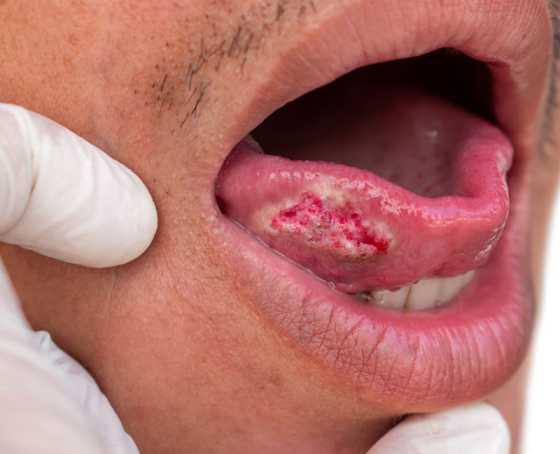
• Oral tongue: the front, mobile part you
see when you stick your tongue out. Cancers here are grouped as oral-cavity
cancer.
• Base of tongue: the back part that sits
in the throat. Cancers here are grouped as oropharyngeal cancer.
Survival data,
treatment approaches and even HPV relevance differ between the two. A single
"tongue cancer" number may combine both or refer to only one. When
looking at a number, the first question is: which part of the tongue is it
about?
What Is the Survival Rate of Stage 4 Tongue
Cancer?
What Current Survival Statistics Show
There is no
single accurate "survival rate of stage 4 tongue cancer" that applies
to every patient. The most quoted figures come from the NCI SEER database,
which groups cancers not by AJCC stage but by how far they have spread:
|
SEER stage |
What it means |
5-year relative survival (tongue cancer)1 |
Share of cases at diagnosis10 |
|
Localized |
Confined to the tongue |
87.6% |
28% |
|
Regional |
Spread to nearby structures or lymph nodes |
69.9% |
57% |
|
Distant |
Spread to distant parts of the body |
39.1% |
10% |
|
Unstaged |
Stage not recorded |
57.8% |
5% |
NCI SEER 21,
2015-2021, all races, both sexes. Population estimates only.
AJCC Stage IVA
and IVB cases usually fall within the SEER "regional" group. Stage
IVC falls within "distant". The overlap is not exact, and no direct
substitution should be made.
Why Stage 4 Statistics Online Can Look Very
Different
You will see
very different Stage 4 numbers across websites, and there are honest reasons
for this:
• Different countries and populations. US
SEER, UK Cancer Research UK, and hospital cohort data vary.
• Different cancer sites. Oral tongue and
base of tongue are often reported separately.
• Different staging systems. AJCC TNM
stages and SEER stage groups are not the same.
• Different diagnosis periods. Newer
datasets may show different outcomes than older ones.
• HPV status. Current SEER data are not
split by HPV (p16) status, which can strongly affect outlook for oropharyngeal
cancer7.
None of these
are errors. They are reasons a "Stage 4" number seen without context
is hard to apply to a real case.
What Does "5-Year Relative
Survival" Mean?
A 5-year
relative survival rate is the percentage of people with a cancer who are alive
five years after diagnosis. It compares them with people of the same age who do
not have that cancer. It is a group estimate. It is not a life expectancy. It
cannot predict what will happen for one person.
SEER states plainly that these figures cannot be used to predict what will
happen to any one patient. No two patients are alike. Treatment responses vary
greatly. Older datasets also may not reflect newer treatments. In fact, 5-year
relative survival for oral cavity and pharynx cancers has risen a lot. About
58% in the mid-1990s. Nearly 70% recently.
What Factors Affect Stage 4 Tongue Cancer
Prognosis?
Exact Stage and Extent of Spread
Substage (IVA
vs IVB vs IVC), tumour size, and distant-organ spread all shape the outlook.
They matter more than the "Stage 4" label alone. IVA/IVB without
distant spread are often approached differently from IVC.
Tumour Location
Oral tongue and
base-of-tongue cancers have different behaviour, treatment paths and data. Grouping them into one number loses that
difference.
Lymph-Node Involvement
The number of
involved nodes matters. So does which side of the neck they are on. So does
whether the cancer has broken through the node capsule (extranodal extension).
All of these feed into how prognosis is judged.
HPV Status
HPV status is
mostly right to oropharyngeal cancers, including some base-of-tongue cancers.
HPV-positive oropharyngeal cancer often has a more favourable outlook than
HPV-negative. HPV status does
not carry the same weight for oral-tongue cancer, so it should not be assumed
to apply the same way to every case.
Overall Health and Treatment Response
General health,
other medical conditions, ability to tolerate treatment, and how the tumour
responds to therapy all factor in. Individual tumour features (tumour grade,
depth of invasion, margin status after surgery) also matter.
Why Age Alone Does Not Determine Prognosis
Age can
influence overall health and shape which treatments are practical. But age by
itself is not a good predictor of cancer prognosis stage 4. A younger person in
poor health may tolerate treatment less well than an older person in good
health. Age is one factor among many, never the whole picture.
How Can Treatment Influence the Outlook?
Treatment for Locally Advanced Stage 4
Disease
For tongue
cancer stage four without distant spread (IVA or IVB), treatment often involves
a combination of:
• Surgery to remove the tumour and involved
lymph nodes
• Radiation therapy, often after surgery
• Chemotherapy given alongside radiation
(chemoradiation) in some cases
• Reconstruction to restore speech,
swallowing and appearance where needed
The exact plan
is set by a multidisciplinary head-and-neck team based on tumour size,
location, node status, tumour type and the patient's overall health.
Treatment When Cancer Has Spread Distantly
For Stage IVC
(distant metastasis), the mix commonly includes:
• Systemic therapy: chemotherapy, targeted
therapy or immunotherapy
• Radiation for disease control at specific
sites or symptom relief
• Clinical trials where eligible, giving
access to newer treatments
• Best supportive care running alongside
cancer-directed treatment
Can Stage 4 Tongue Cancer Be Treated
Successfully?
The honest
answer: Stage 4 covers very different clinical cases. Some Stage IVA and IVB
cases can still be treated with curative intent.
Distant metastatic disease uses a different framework. Meaningful periods of
disease control and quality of life are common goals. Outcomes vary widely from
person to person. Individual prognosis needs an oncology assessment on your
actual case, not a website estimate.
Treatment Goals Matter
Every treatment
plan has a stated goal. Understanding which one applies to your case is one of
the most useful things you can ask your oncologist:
• Curative intent: aim to eliminate the
cancer.
• Disease control: slow or shrink the
cancer where cure is not the current goal.
• Symptom control: ease symptoms and
support quality of life.
• Quality-of-life support: care alongside
any of the above, including nutrition, speech, pain and emotional support.
Cost Calculator
I know my treatment - show me cost from 3 hospitals
How We Can Help: Getting the Right
Specialist Guidance for Stage 4 Tongue Cancer
An advanced
diagnosis is disorienting. A single number found in a search cannot answer what
you actually need to know about your own case. DivinHeal helps patients and
families reach the right head-and-neck cancer team. You get clear staging
information. You understand what the numbers do and do not mean for you.
How
DivinHeal helps:
• Personalised prognosis guidance. Exact
stage, tumour location, lymph-node status, distant-spread status, HPV where
right, and overall health. All mapped against what your oncology team is
actually saying.
• Clear reading of survival numbers.
Population data vs personal prognosis, without misleading direct comparisons.
• Access to skilled specialists.
Head-and-neck surgical oncologist, medical oncologist, radiation oncologist,
and a multidisciplinary tumour board. DivinHeal works with partner hospitals in
India for patients from the Gulf, Africa, South Asia and the UK.
• Support with staging and treatment planning.
Imaging review, pathology review, biopsy reading, TNM staging, and second
opinions where you want them.
Why choose
DivinHeal: individual guidance instead of survival numbers alone.
Coordinated access to the right cancer specialists. Help weighing up treatment
pathways and specialist opinions with no pressure.
Questions
worth asking your oncologist:
• What is my exact TNM stage, and is this IVA, IVB
or IVC?
• Is the cancer in the oral tongue or the base of
the tongue?
• Has it spread outside the head and neck?
• What is the treatment goal: curative intent,
disease control, or symptom control?
• What is my HPV (p16) status, and does it apply
to my type of cancer?
Understand your diagnosis and treatment options with the right specialist. Speak with the DivinHeal care team to be matched with a head-and-neck cancer specialist.
Medical disclaimer
This article is for general information only and is not medical advice. It is not a diagnosis, a prognosis, or a substitute for care from your own oncology team. Cancer statistics describe groups, not individuals. Survival numbers cannot predict what will happen to one person. Please talk to a head-and-neck surgical oncologist, medical oncologist or radiation oncologist about your own case. DivinHeal is a medical tourism coordination company. It does not provide medical treatment itself.
Plan My Journey
Tell us your condition and budget - our AI matches the right destination, hospital and doctor and visa pathway
Cost Calculator
I know my treatment - show me cost from 3 hospitals

Written by DivinHeal Editorial Contributor, Rahul Kumar, Medical Expert | Medically Reviewed by Dr Indu Priya, MBBS,MD Published on: 2026-09-25
Plan My Journey
Tell us your condition and budget - our AI matches the right destination, hospital and doctor and visa pathway
Cost Calculator
I know my treatment - show me cost from 3 hospitals
Booking With DIVINHEAL
Get a free consultation to understand your treatment options
From Consultation to Recovery,
Step by Step
Expert Specialist Matching
Connecting you with the world's top-rated medical experts.
Accredited Hospital Network
Access to JCI & NABH certified healthcare facilities.
Complete Travel Coordination
Hassle-free visa, stay, and local transport assistance.
24/7 Personal Care
Dedicated patient advisors supporting you at every step.
Journey Guidance
Full guidance from start to end of the patient treatment journey.
Expert Specialist Matching
Connecting you with the world's top-rated medical experts.
Everything you
need to know today
Browse through these common inquiries to better understand our patient-focused medical platform.
No. Stage 4 covers a wide range of cases. Advanced local disease (IVA and IVB) may still be treated with curative intent. Distant metastatic disease (IVC) is usually treated with different goals. A "Stage 4" label alone does not decide the outcome. Substage, tumour location, tumour details, overall health and treatment response all shape what happens next. Only your oncology team can give an outlook that matches your actual case.
Yes, some people do. Outcomes vary widely. SEER 5-year relative survival is 69.9% for regional-stage tongue cancer and 39.1% for distant-stage. These are population estimates and cannot predict what will happen to any one person. The exact substage, HPV status where it applies, overall health, tumour biology and treatment response all matter. Your oncologist can explain your outlook far more accurately than any general number.
No. In the AJCC staging system, Stage IVA and IVB oral-cavity cancers can be locally or regionally advanced without distant metastasis. Only Stage IVC involves distant spread4. This is a common source of confusion. "Stage 4" often carries an assumption of widespread cancer, but for tongue cancer that is not always the case.
Substage (IVA, IVB or IVC) matters most. Then tumour location (oral tongue vs base of tongue). Then lymph-node status and any distant spread. HPV status where it applies. Tumour biology. General health. Treatment response. Age is a factor but not on its own. No single number captures all of this. That is why your head-and-neck oncology team's assessment matters far more than any online number.
Still have more questions?
Book a call with our friendly team to learn how DivineHeal simplifies your healthcare journey.