
Written by DivinHeal Editorial Contributor, Rahul Kumar, Embryologist | Medically Reviewed by Dr Indu Priya, Gynecologist(MD) Published on: 2026-05-20
Vaginal Dilators for Vaginismus: Treatment, Exercises & India Costs 2026
Amara, 28, traveled from Lagos to Delhi after two years of thinking the pain was “just in her head.” At Apollo Hospitals, she began guided dilator therapy along with pelvic floor physiotherapy, taking things slowly and step by step. Over time, what once felt overwhelming started to feel manageable. Six weeks later, she went back home pain-free and feeling like herself again.
Vaginismus affects an estimated 5-17% of women worldwide (World Health Organization). Most people go years without a diagnosis. Stigma and silence keep many women from speaking up. If penetration — during sex, a gynecological exam, or tampon insertion — feels impossible, you are not alone. You are not broken. This condition is treatable.
India has become a top destination for vaginismus treatment. JCI-accredited hospitals in Delhi, Mumbai, and Chennai offer the same clinical standard as private clinics in Dubai or London — at 60-80% less cost. A full program in India, including therapy, physiotherapy, and follow-up, typically costs INR 80,000-3,00,000 (about $826-$3,125). The same care costs $3,000-$10,000 in the UK or UAE.
Individual outcomes vary. Consult a specialist for personalized medical advice.
Plan My Journey
Tell us your condition and budget — our AI matches the right destination, hospital and doctor and visa pathway
What Is Vaginismus? Symptoms, Causes and Types
Vaginismus is classified under pelvic floor dysfunction. The International Society for the Study of Women’s Sexual Health (ISSWSH) recognizes it as a diagnosable and treatable condition. Without treatment, it can affect your relationships, your self-esteem, and your well-being.

Symptoms — How Do You Know If You Have Vaginismus?
The main symptom is ongoing difficulty or complete inability to achieve vaginal penetration. Many women describe it as “hitting a wall.” Others feel a sharp, burning sensation when penetration is tried. Other common symptoms include:
• Sharp pain or burning during attempted intercourse, tampon insertion, or pelvic examination
• A sensation of tightening at the vaginal opening before any contact occurs
• Strong anxiety or dread at the thought of penetration — even if you want to have sex
• Avoidance of sexual activity or routine gynecological appointments
• Shortness of breath or involuntary breath-holding during attempted penetration
These symptoms can start from your very first attempt at penetration. This is called primary vaginismus. Or they can develop after a period of pain-free sex. That is called secondary vaginismus — and it often follows trauma, surgery, childbirth, or infection. Recognizing the pattern is the first step toward finding the right treatment.
Causes — Physical and Psychological
Vaginismus often develops for different reasons, and sometimes there is not one clear cause. For some women, it begins with fear, anxiety, stress, or a painful experience connected to sex. For others, it may be linked to infections, endometriosis, surgery, hormonal changes, or childbirth. And in many cases, nothing physically “wrong” is found. The body has simply gone into a protective pattern, tightening the muscles automatically — even when there is no danger anymore.
How Common Is Vaginismus?
Between 5% and 17% of women worldwide have vaginismus (WHO). The real number is probably higher. Many women never seek a diagnosis. A large proportion go years without knowing that what they feel has a name, a cause, and — crucially — an effective treatment.
How Vaginal Dilators Work — and Why They Are the First-Line Treatment
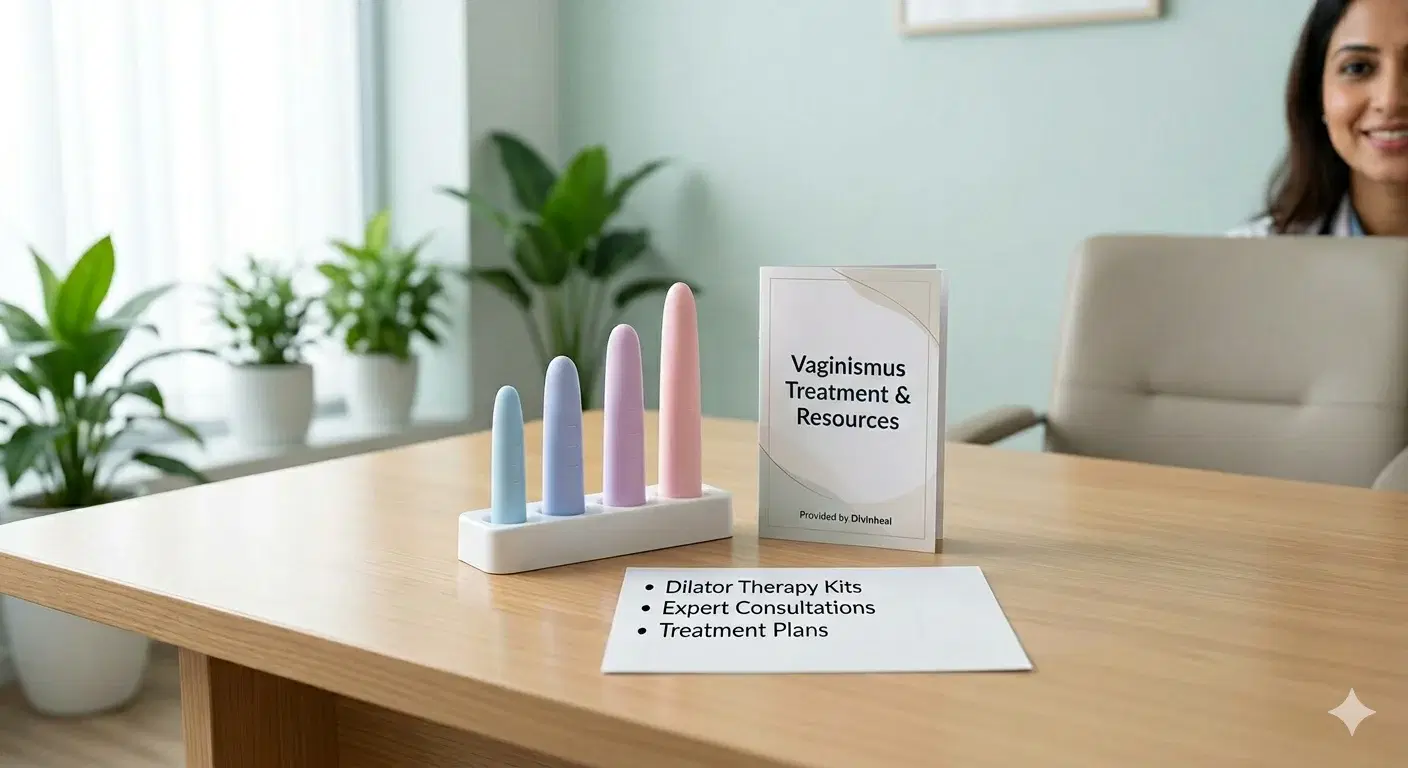
A 2020 clinical study (PubMed ID: 32052704) compared finger dilation to dilator therapy. Women in the dilator group improved much more in sexual function. They also completed treatment at a higher rate. That evidence matters. This is why most JCI-accredited hospitals in India use graduated dilatators as the core of their treatment. This includes Apollo Hospitals Delhi, Fortis Healthcare Mumbai, and Max Healthcare.
Step-by-Step Guide — Using Vaginal Dilators Safely and Without Pain
Most specialists at leading Indian clinics will walk you through your first dilator sessions in person. Here is the standard guided approach:
• Set aside quiet, private time with no time pressure — there is never a rush.
• Apply a generous water-based lubricant to both the dilator and your vaginal opening.
• Start with the smallest dilator in the set. Lie on your back with knees bent and feet flat.
• the rounded end gently, breathing slowly and deeply to encourage pelvic floor relaxation. Never force it.
• Keep the dilator in place for 10-15 minutes, maintaining slow, steady breathing.
• Remove gently when the session ends. Begin with 2-3 sessions per week.
• Progress to the next size only when the current size feels genuinely comfortable — not merely tolerable.
Your physiotherapist in India will supervise at least two sessions before you move to home practice. They adjust your program week by week based on your progress.
How Long Do You Leave a Dilator In?
Most specialists advise keeping the dilator in for about 10–15 minutes each session. This gives your muscles time to slowly relax and understand that penetration is not something they need to fight against. A little pressure or discomfort can be normal in the beginning, but sharp pain means you should stop and take a gentler approach. Going down a size and moving more slowly is completely okay. Healing with vaginismus is usually step by step.
Can I Use Fingers Instead of Dilators?
Fingers can help with early body awareness. They are useful for getting to know your anatomy before starting dilator therapy. But they are not a substitute for dilators. Dilators have smooth, consistent surfaces and an exact size progression. The 2020 clinical study (PubMed: 32052704) found that the dilator group improved much more in sexual function than the finger dilation group. Pelvic floor physiotherapists at JCI-accredited hospitals in India regularly recommend dilators for this reason.
Vaginismus Exercises That Complement Dilator Therapy
Dilators are most effective when used alongside simple, guided exercises and proper support. This combination helps you gradually understand your pelvic floor muscles, learn how to relax them, and rebuild confidence at a steady pace. Here are two of the most commonly recommended, evidence-based techniques.
Kegel and Reverse Kegel Techniques
A Kegel means contracting your pelvic floor muscles — the same ones you use to stop the flow of urine. Hold for 3-5 seconds, then fully release. The reverse Kegel is more important for vaginismus. It means consciously relaxing and gently bearing down with those same muscles. Think of it as learning to push out and open, rather than hold and close. Practice 10-15 repetitions of each daily. This helps you feel the difference between a tensed and a relaxed pelvic floor — exactly the awareness that dilator use requires.
Biofeedback for Vaginismus
Body awareness exercises round out the program. These include guided breathing, progressive muscle relaxation, and getting familiar with your body using a mirror. They help you build a calm, non-fearful relationship with your body. That groundwork is what makes physical treatment work.
Full Vaginismus Treatment Options Available in India
Beyond dilators and exercises, a full vaginismus treatment plan in India includes three more clinical pillars. When a team delivers all of these together, success rates of 80-90% are regularly achieved — as reported in peer-reviewed literature.
Behavioral Therapy and Cognitive Behavioral Therapy (CBT)
CBT and sex therapy work on the mental side of vaginismus. They tackle the anxiety that builds before sex. They address the avoidance habits that form over months or years. They also help with the fearful thinking that keeps the muscle cycle locked. A 2021 review in the British Medical Journal confirmed this. CBT-based treatment regularly reduced pain-related fear and improved sexual function in women with vaginismus. Sessions typically run over 6-12 weeks — either during your stay in India or via secure telemedicine once you are home.
Pelvic Floor Physiotherapy
A specialist pelvic floor physiotherapist uses four main tools: manual therapy, guided dilation, myofascial release, and muscle re-education. Together, they treat the muscle tension at the root of vaginismus. This is specialized women’s health work — not general physiotherapy. Physiotherapists at Fortis Healthcare Mumbai and Apollo Hospitals Delhi have typically earned postgraduate certification in pelvic floor rehabilitation. They regularly treat international patients.
Botox Injections for Severe or Refractory Cases
When dilator therapy and physiotherapy have not made enough progress, Botox can help. Botulinum toxin (Botox) injections into the pelvic floor muscles can temporarily reduce the reflex spasm. This creates a window — typically 3-6 months — in which dilator therapy and physiotherapy can go deeper. The Royal College of Obstetricians and Gynecologists (RCOG) includes Botox as a recognized option for severe vaginismus. It is not a standalone fix. It works best alongside a structured physiotherapy program. Surgery is almost never required, as vaginismus is a muscular and mental condition, not a structural one.
Vaginismus Treatment Cost in India vs UAE, Nigeria and UK (2026)
For many women, vaginismus treatment in India feels more affordable and easier to access compared to private care in places like the UAE, UK, or Nigeria. At the same time, they still receive care from experienced doctors, pelvic floor physiotherapists, and well-equipped hospitals. In cities like Delhi and Mumbai, most hospitals offer complete treatment plans that include guided dilator therapy, pelvic floor physiotherapy, and follow-up support, so patients feel guided and supported throughout the process.
Why India Offers Better Value for International Patients
The cost advantage comes from lower running costs and a favorable exchange rate — not lower quality of care. India has more JCI-accredited hospitals than any other country in Asia. Many senior gynecologists and physiotherapists trained in the UK, US, or Australia before returning to practice. For Nigerian patients, India typically costs 60-70% less than private clinics in Lagos — and offers treatments that may not be available locally. For UK patients, the alternative is an NHS waiting list of 6-12 months for psychosexual services. Private CBT fees in the UK start at GBP 2,000 for one course alone. For UAE patients, the same JCI standard available in Dubai is available in Delhi at roughly one-third of the cost.
Treatment | India (INR / USD) | UAE (AED / USD) | Nigeria (NGN / USD) | UK (GBP / USD) |
Dilator Therapy Package (assessment + dilator set + guided sessions) | INR 15,000-40,000 (~$156-$413) | AED 3,000-10,000 (~$817-$2,723) | NGN 200,000-800,000 (~$145-$583) | GBP 600-2,000 (~$803-$2,677) |
Comprehensive Programe (8-12 weeks: therapy + physio + CBT) | INR 80,000-300,000 (~$826-$3,125) | AED 40,000-100,000 (~$10,891-$27,229) | NGN 800,000-20,00,000 (~$583-$1,457) | GBP 3,000-10,000 (~$ 4,016-13,389) |
Costs are approximate. Actual figures depend on hospital tier, specialist seniority, and program length. Request a personalized estimate via Divinheal.
The numbers are stark. A UK patient might pay GBP 3,000-10,000 privately for a 12-week CBT and physiotherapy course. The same treatment in Delhi costs under GBP 1,500 all in — including flights and housing near the hospital. Savings of 60-75% are typical.
How Long Does Vaginismus Treatment Take? Setting Realistic Expectations
Many women see a big improvement within 8–12 weeks of regular treatment, and for some, the condition resolves completely over time. Recovery is different for everyone. It usually depends on how severe the vaginismus is, how regularly you practice between sessions, and whether emotional support or therapy is also part of the healing process.
For women travelling from Nigeria, the UAE, or the UK, treatment in India often starts with an intensive 1–2 week programe. During this period, they attend daily therapy sessions, pelvic floor physiotherapy, and guided dilator practice with specialist support. Before they return home, they’re given a clear, step-by-step plan to continue on their own. Most clinics also offer online follow-ups over the next few months, so progress can continue smoothly from cities like Lagos, London, or Dubai without needing another trip.
Many women with vaginismus start noticing real improvement within a few weeks of regular treatment. Over time, the pain and tightness gradually become easier to manage, and many recover fully within a few months. In more severe cases, treatments like Botox may also help relax the muscles and make the early stages of recovery easier.
Why Choose India for Your Vaginismus Treatment?
JCI-Accredited Hospitals With Specialist Women’s Health Teams
Apollo Hospitals Delhi, Fortis Healthcare Mumbai, and Max Healthcare all have dedicated women’s health units. Under one roof, you get gynecologists, pelvic floor physiotherapists, psychologists, and sex therapists working together. JCI accreditation is the gold standard in international hospital certification. More than 40 hospitals across India currently hold it. It ensures patient safety, infection control, and strong clinical standards. Many senior specialists at these hospitals are highly qualified. They hold fellowships from the Royal College of Obstetricians and Gynecologists (RCOG), the American Board of Obstetrics and Gynecology (ABOG), or equivalent bodies.
Privacy, Confidentiality and Cultural Sensitivity
Vaginismus is a very personal condition. All hospitals Divinheal works with keep your information private. Medical records are encrypted and held under strict data protection laws. You check in separately as an international patient. Your consultation room is private. Your diagnosis is never posted publicly. For UAE patients, Arabic-speaking coordinators are available at Apollo Delhi and Max Healthcare. For Nigerian patients, Divinheal’s team provides full visa paperwork support, airport pickup, and ground logistics. UK patients will find the clinical formats familiar. Most senior Indian specialists speak fluent English and hold UK or US specialist qualifications.
Planning Your Medical Trip to India — Visa, Travel and Accommodation
For UAE Patients
For women traveling from the UAE, the process of coming to India for treatment is usually quite straightforward. Medical e-Visas are often processed within about 72 hours, and patients typically need a confirmation letter from their hospital in India before applying. There are several direct flights from Dubai to Delhi every day, with a travel time of around 3 hours. Companies like Divinheal also help arrange airport transfers and accommodation near hospitals such as Apollo Hospitals or Max Healthcare.
Accommodation near major hospitals usually costs around INR 3,000–7,000 per night (about AED 114–266). Many international patients are also supported by dedicated coordinators, including Arabic-speaking staff, to help make their stay and treatment smoother and more comfortable.
For Nigerian Patients
For many Nigerian patients, traveling to India for treatment is often simpler than it first seems. You usually need a valid passport, a doctor’s referral letter, and an invitation letter from the Indian hospital to apply for a Medical Visa, which can be valid for up to 6 months and may allow multiple entries. Companies like Divinheal also help with paperwork and travel arrangements. Many patients choose India because treatment can cost around 60–70% less than private care in Lagos, while budget accommodation near Delhi hospitals is usually around INR 1,500–4,000 per night (about USD 15–41 or NGN 21,262–56,703).
For UK Patients
For many UK patients, traveling to India for treatment often turns out to be easier than they first expect. After getting an invitation letter from the hospital, they can apply for an Indian Medical Visa through the High Commission. There are multiple direct flights every day from London Heathrow to Delhi, taking around 8–9 hours. Many people choose India because treatment is much more affordable than private care in the UK, while staying near hospitals in Delhi or Mumbai usually costs about INR 3,500–8,000 per night (roughly GBP 27–61). Companies like Divinheal also help patients stay in touch with their India-based doctors through online follow-ups after they return home.
The Emotional Side — Relationships, Confidence and Recovery
Vaginismus not only affects physical intimacy. It shapes how you feel about your body, your relationships, and your sense of self. Feelings of shame, isolation, frustration, and inadequacy are common — and they are a recognized part of the condition, not a character flaw.
Fatima, 31, from Dubai, spent three years avoiding gynecological appointments and quietly explaining her pain to her husband. “I thought something was permanently wrong with me,” she said. After six weeks of CBT and pelvic floor physiotherapy at a Delhi hospital, she describes the change as “not just physical — it was the first time in years I did not feel broken.”
Sarah, 34, from London, had spent two years on an NHS waiting list for psychosexual therapy. She flew to Delhi for a two-week intensive program include counseling include counseling that included daily dilator-guided sessions and CBT. “Doing it in a concentrated way, away from home and daily stress, made a huge difference. I came back a different person.”
Many hospitals in India take a more complete approach to vaginismus treatment. Along with physical therapy, they often include counseling and couples sessions to help with fear, anxiety, and the emotional side of the condition. For many women, healing becomes easier when they feel emotionally supported as well as physically treated.
Stories are illustrative composites based on typical patient journeys. Names changed for privacy.
Life After Treatment — Sustaining Your Progress Long-Term
After your intensive program, recovery continues at home. You will need to keep using dilators regularly — typically for 3-6 months. You then taper gradually to a weekly maintenance schedule. Continue your pelvic floor exercises alongside this. Follow-up appointments at 3 and 6 months are conducted via secure telemedicine for international patients. These consultations allow your physiotherapist or therapist to spot any early regression and adjust your home program before small setbacks become bigger ones.
For most women, vaginismus treatment is not just about quick relief. With steady support, follow-up care, and a mix of physical and emotional treatment, the results usually hold up over time. As things improve, many women are able to move past the fear and pain and gradually feel more relaxed, confident, and comfortable with intimacy again.
Recovery can look different for every woman, so it’s important to follow the aftercare plan recommended by your specialist.
Cost Calculator
I know my treatment — show me cost from 3 hospitals
Quick Answer — At a Glance
Skim this section if you are short on time.
Vaginismus is an involuntary vaginal muscle spasm that makes penetration painful or impossible, affecting 5-17% of women worldwide (WHO). Vaginal dilators for vaginismus are the first-line treatment — graduated medical-grade devices that progressively retrain pelvic floor muscles, with 80-90% success rates when combined with pelvic floor physiotherapy and CBT (ISSWSH). Treatment at JCI-accredited hospitals in India, including Apollo Hospitals Delhi and Fortis Healthcare Mumbai, costs $156-$3,125 depending on program type — saving 60-80% compared to private clinics in the UK, UAE, or Nigeria.
Key Fact | Detail |
Global prevalence | 5-17% of women (WHO) |
First-line treatment | Vaginal dilators + physiotherapy + CBT |
Success rate (full program) | 80-90% (ISSWSH) |
India dilator therapy cost | INR 15,000-60,000 (~$156-$413) |
India comprehensive program | INR 80,000-3,00,000 (~$826-$3,125) |
Saving vs UK / UAE private care | 60-80% |
Typical medical stay in India | 1-2 weeks (+ telemedicine follow-up) |
JCI hospitals available | Apollo Delhi, Fortis Mumbai, Max Healthcare |
Written by DivinHeal Editorial Contributor, Rahul Kumar, Embryologist | Medically Reviewed by Dr Indu Priya, Gynecologist(MD) Published on: 2026-05-20
Plan My Journey
Tell us your condition and budget — our AI matches the right destination, hospital and doctor and visa pathway
Cost Calculator
I know my treatment — show me cost from 3 hospitals
Booking With DIVINHEAL
Get a free consultation to understand your treatment options
From Consultation to Recovery,
Step by Step
Expert Specialist Matching
Connecting you with the world's top-rated medical experts.
Accredited Hospital Network
Access to JCI & NABH certified healthcare facilities.
Complete Travel Coordination
Hassle-free visa, stay, and local transport assistance.
24/7 Personal Care
Dedicated patient advisors supporting you at every step.
Journey Guidance
Full guidance from start to end of the patient treatment journey.
Expert Specialist Matching
Connecting you with the world's top-rated medical experts.
Everything you
need to know today
Browse through these common inquiries to better understand our patient-focused medical platform.
Yes. Vaginismus is highly treatable, and many women recover fully with the right support. Treatment works best when it combines physical therapy, gradual dilator use, and emotional support as well. Progress usually happens step by step, with consistency and proper aftercare making a big difference over time.
The clearest sign is ongoing difficulty or a complete inability to achieve vaginal penetration. This can happen during sex, a gynecological exam, or tampon insertion — even when you want penetration. Other signs include a burning or stinging feeling. You may sense hitting a wall. You might feel strong anxiety before any attempt. You may also start avoiding intimate activity. A gynecologist can confirm the diagnosis with a clinical assessment.
Yes. Dilators work by gradually increasing the flexibility and elasticity of the vaginal muscles through repeated, gentle stretching. According to the Cleveland Clinic, dilators improve pelvic floor function so that penetration becomes more comfortable over time. They help with vaginismus in particular. They also treat pelvic floor tightness from other causes, such as menopause or pelvic radiotherapy.
Many women using dilators as part of a structured treatment program start noticing meaningful progress within 2–4 weeks. With regular practice, comfortable penetration often becomes possible within 2–4 months. How quickly recovery happens usually depends on the severity of the vaginismus, how consistently exercises are practiced, and whether emotional support or therapy is also included in treatment. Most specialists recommend practicing around 2–3 times per week. Some women progress faster, while others simply need more time — both are completely normal.
Start with the smallest size and use plenty of water-based lubricant so everything stays comfortable. Go slowly and avoid forcing anything. Slow, steady breathing can help your body relax as you go. If you feel sharp pain, stop, take a break, and try again later or switch back to a smaller size. The main goal isn’t to push through discomfort, but to move at a pace that feels safe and comfortable for your body.
Fingers can be useful for initial body-awareness exercises, but they are not a substitute for dilator therapy. A 2020 clinical study (PubMed ID: 32052704) found that the dilator therapy group improved much more in sexual function. They also completed treatment at a higher rate than the finger dilation group. Dilators have consistent smooth surfaces, an exact size progression, and they stay in position more easily during a session.
Dilators are usually the main treatment because they help the body slowly relearn relaxation and build steady, long-term progress. Botox is sometimes used in more severe cases — it temporarily relaxes the muscles, especially when progress with dilators has become difficult or stuck. In some cases, both are combined so that Botox reduces the initial tightness and dilator therapy can work more smoothly for lasting results.
Rarely. Vaginismus is usually a functional condition — more about muscle tightness and protective response than anything structural. Because of that, most women improve with non-surgical treatment like dilator therapy, pelvic floor physiotherapy, and emotional or psychological support. Surgery is not a standard treatment and is very rarely used or recommended by specialists.
Most medical tourists usually complete the main treatment phase in about 1–2 weeks. During this time, they attend daily sessions that include physiotherapy, guided dilator practice, and psychological support. After returning home, they continue with a structured plan and regular telemedicine follow-ups. Some people also choose to stay 2–3 weeks if they feel they need more time at the start. A Divinheal coordinator helps plan the duration based on individual needs and comfort.
A dilator therapy package at a JCI-accredited hospital in India typically costs INR 15,000-40,000 (about $156-$413). A full program — including 8-12 weeks of combined therapy, physiotherapy, and CBT — costs INR 80,000-3,00,000 (about $826-$3,125). These figures do not include travel and housing. Contact Divinheal for a personalized cost estimate based on your treatment plan and preferred hospital.
Divinheal provides structured post-treatment support, including telemedicine consultations at 3 and 6 months after discharge. You get direct access to your physiotherapist and therapist through secure messaging. You also receive a personalized home exercise program and a dedicated case manager for any questions after you return. For UAE patients, Arabic-speaking support continues post-discharge. For Nigerian and UK patients, all follow-up are conducted in English via encrypted video call.
Yes. Hospitals partnered with Divinheal follow strict international privacy standards. Your medical records and personal information are kept fully confidential, securely stored, and only shared with your consent. International patients are managed discreetly, with private consultation rooms and separate check-in processes. Your diagnosis is never displayed publicly, and your privacy is respected at every stage of care.
Still have more questions?
Book a call with our friendly team to learn how DivineHeal simplifies your healthcare journey.