
Written by DivinHeal Editorial Contributor, Rahul Kumar, Embryologist | Medically Reviewed by Dr Indu Priya, Gynecologist(MD) Published on: 2026-06-10
Hydrosalpinx: Meaning, Symptoms, Ultrasound Diagnosis and Treatment in India
Hydrosalpinx cuts IVF success rates by up to 50%. Yet thousands of women travel to India each year for this treatment. They have the blocked tube removed laparoscopically. Then they return home ready for their next fertility cycle — at a fraction of what they would pay in the UK, Australia, or Nigeria.
This guide covers what hydrosalpinx means and how it looks on ultrasound (USG). It also explains how it is treated and what the procedure costs at a JCI-accredited Indian hospital.
Stories are illustrative composites based on typical patient journeys. Names changed for privacy.
Plan My Journey
Tell us your condition and budget — our AI matches the right destination, hospital and doctor and visa pathway
What Is Hydrosalpinx?
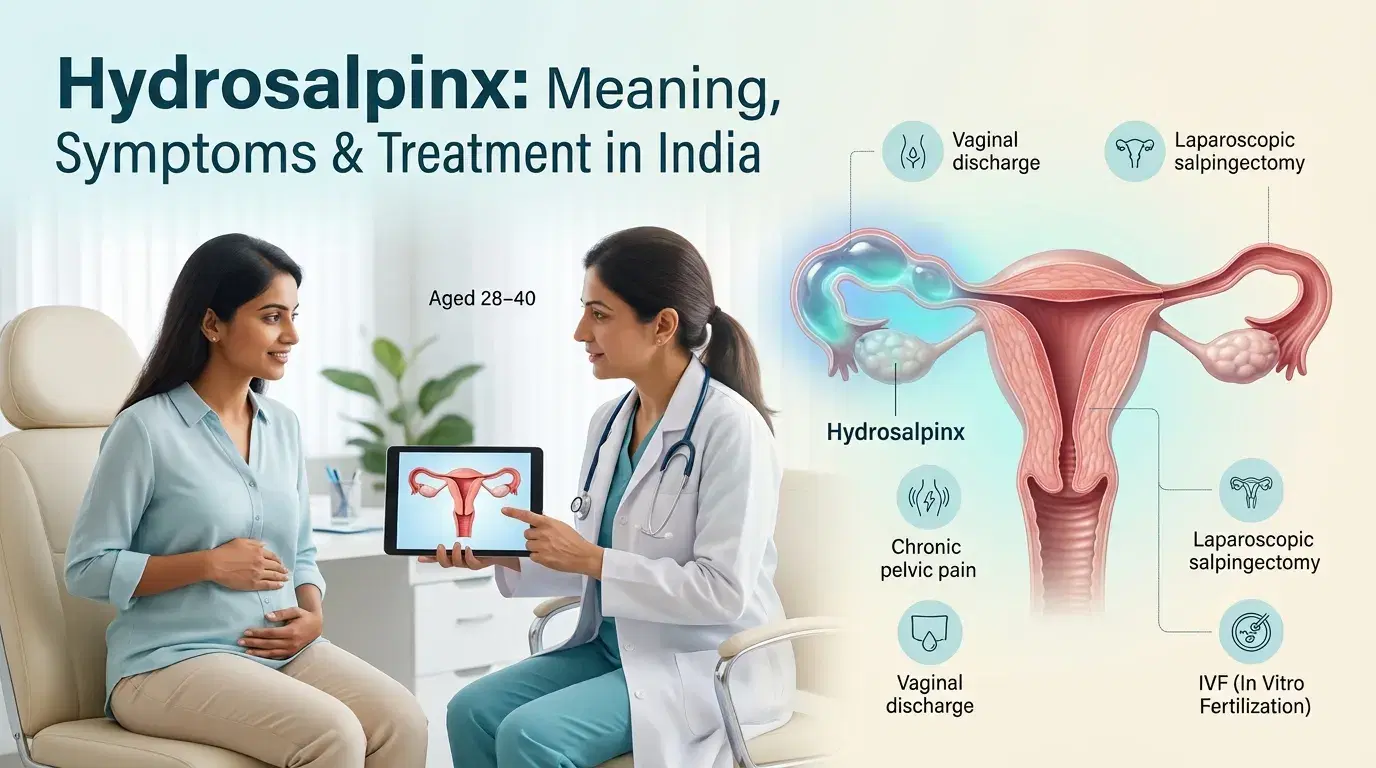
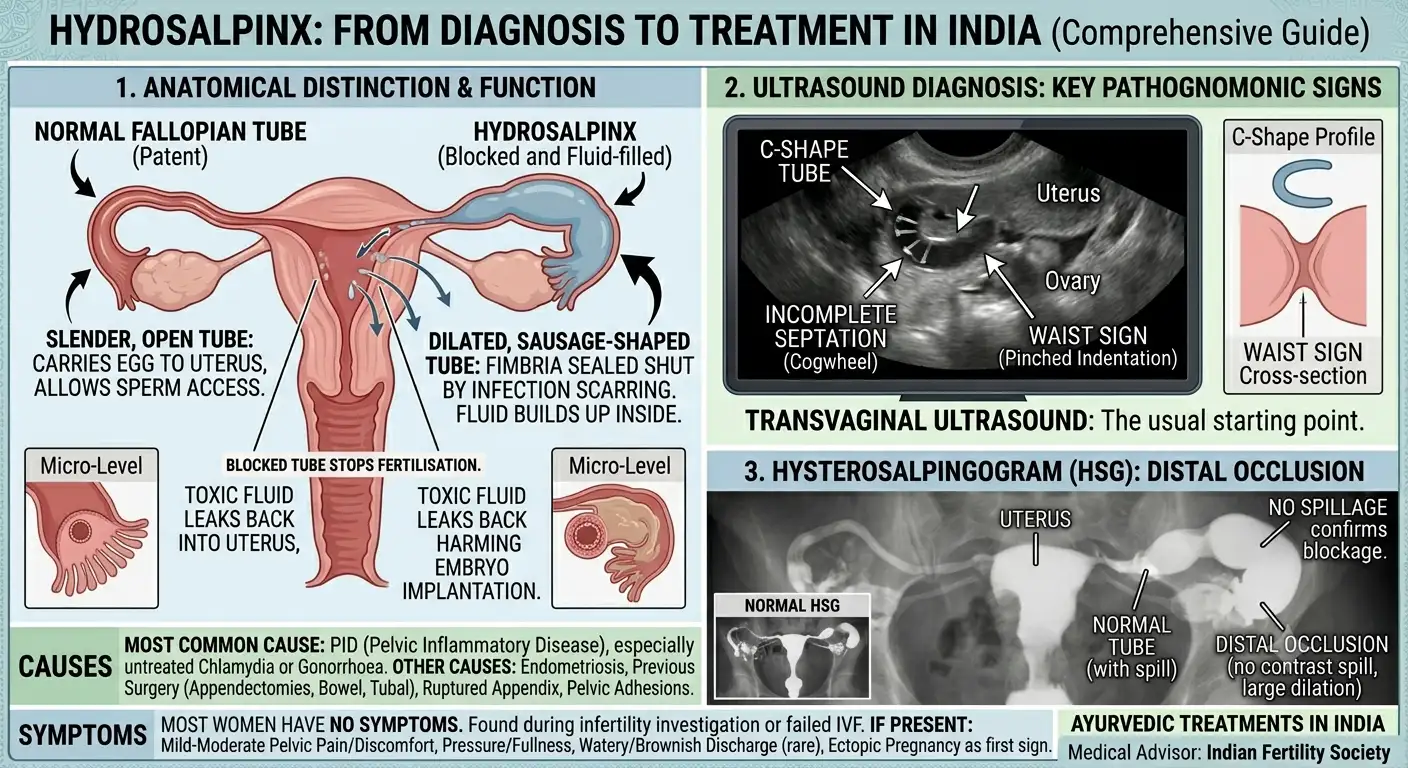
Hydrosalpinx is a blocked fallopian tube that fills with fluid and swells. The name comes from Greek: hydro (water) and salpinx (tube). When the open end of a tube seals shut — usually because of infection scarring — fluid builds up inside. One tube can be affected, or both (bilateral hydrosalpinx).
The fallopian tubes carry eggs from the ovaries to the uterus. A fluid-filled blocked tube stops fertilisation. The toxic fluid can also leak back into the uterus. This creates an environment that harms embryo implantation. That is why this condition can silently wreck IVF cycles — even when the rest of your fertility picture looks normal.
What Are the Symptoms of Hydrosalpinx?
Most women with hydrosalpinx have no symptoms at all. The condition is often found only when investigating unexplained infertility or failed IVF cycles.
When symptoms do occur, they typically include:
Mild to moderate pelvic pain or lower abdominal discomfort, often worse before or during a period
A feeling of pressure or fullness in the lower abdomen
Watery or brownish vaginal discharge (less common)
Ectopic pregnancy as a first sign of undiagnosed tubal damage
If you have any of these symptoms and trouble conceiving, ask your doctor about fallopian tube testing. A transvaginal ultrasound is the usual starting point.
What Causes Hydrosalpinx?
Pelvic inflammatory disease (PID) — most often caused by untreated chlamydia or gonorrhoea — is the most common cause. The World Health Organization reports that STI-related PID makes up a large share of tubal damage cases globally.
Other causes include:
Endometriosis — uterine tissue growing outside the uterus can form adhesions that block the tubes
Previous abdominal or pelvic surgery — appendectomies, bowel surgery, or earlier tube operations
Ruptured appendix — infection can spread directly to the nearby fallopian tubes
Pelvic adhesions — scar tissue from any source that seals the tube’s fimbriated end
Is Hydrosalpinx Serious? What Happens If Left Untreated?
Yes — hydrosalpinx is a serious fertility concern. Natural pregnancy rates for affected women are generally below 5% per cycle. For IVF patients, untreated hydrosalpinx cuts implantation rates by up to 50%. This is compared to women without the condition (American Society for Reproductive Medicine, 2020 guidelines).
Leaving hydrosalpinx untreated also raises the risk of:
Repeated implantation failure in IVF
Miscarriage
Ectopic pregnancy
For women planning IVF, most fertility specialists recommend treating or removing the hydrosalpinx first. This should be done before the first embryo transfer. The evidence for this is strong and consistent across multiple guidelines.
How Is Hydrosalpinx Diagnosed?
Diagnosis starts with a transvaginal ultrasound (TVS/USG). More tests follow if the picture is not clear. At JCI-accredited hospitals in India, this first scan is usually done within 1–2 days of arrival. In the NHS or Australian public healthcare, you may wait 6–8 weeks.
Hydrosalpinx on Ultrasound (USG): What Does It Look Like?
On transvaginal ultrasound, a hydrosalpinx has several clear features. Knowing these helps you understand your scan report before your consultation.
USG Feature | What It Means |
Anechoic (black) fluid | Fluid inside the dilated tube appears black on the scan |
Sausage or C-shaped structure | The swollen tube beside the ovary — separate from it |
“Cogwheel” sign | Cross-sectional view showing folds of the tube’s inner lining projecting inward |
Incomplete septa | Tubular cystic mass with partial internal dividers — the most common pattern |
If the tube appears enlarged, this points to a more severe hydrosalpinx (ASRM). Sonographers at Indian diagnostic centres use high-resolution probes to see these features well. This supports an accurate read of tube size, wall thickness, and internal detail.
Can You Miss Hydrosalpinx on Ultrasound?
Yes. A 2022 meta-analysis in Human Reproduction Open studied transvaginal ultrasound for detecting hydrosalpinx. It found a pooled sensitivity of about 84%. Smaller or early-stage tubes can be missed. A fluid-filled tube can also be confused with other masses near the ovary.
If the ultrasound is not clear, your doctor may recommend:
Hysterosalpingogram (HSG) — an X-ray dye test with ~85–90% diagnostic accuracy for tubal patency
HyCoSy — a contrast ultrasound alternative to HSG
Diagnostic laparoscopy — direct visualisation of the tubes; the definitive test
Hydrosalpinx and Fertility: Can You Still Get Pregnant?
Yes — pregnancy is possible. But it depends on whether one or both tubes are affected and how damaged the tube is.
Impact on Natural Conception
In case your only problem is a blockage in one tube, then you will be able to conceive through the other unblocked tube naturally. However, your chances will be lowered. If the condition affects both fallopian tubes (bilateral hydrosalpinx), then the chances of conceiving naturally are extremely slim. Natural pregnancy rates for women with untreated hydrosalpinx are generally below 5% per cycle.
Hydrosalpinx and IVF Success Rates
Unattended hydrosalpinx directly affects the outcome of assisted reproduction treatment. The studies prove that hydrosalpinx may reduce the implantation rate by 50 percent (according to the NICE guideline; ASRM 2020). If a woman has two tubes suffering from the disease, her chances of conceiving drop by one-third to half.
This is why leading fertility centres — including India’s JCI-accredited hospitals — recommend salpingectomy or proximal tubal occlusion before an IVF cycle. After the affected tube is removed, IVF success rates improve by 50–70% in eligible patients.
Sarah, 35, Melbourne: Two failed IVF cycles before a hydrosalpinx was found on re-scan. After a salpingectomy at Apollo Hospitals, Chennai, she had a successful embryo transfer 10 weeks later. Her total trip cost was AUD 4,800 — versus the AUD 13,500 private quote she’d received in Sydney.
Illustrative composite based on typical patient journeys. Name changed for privacy.
Treatment Options for Hydrosalpinx: Surgical and Non-Surgical
Salpingectomy — The Gold Standard
Salpingectomy is the full surgical removal of the affected fallopian tube. It is the most effective treatment for hydrosalpinx. It is strongly recommended before IVF. Removing the tube eliminates the toxic fluid permanently — recurrence after full removal is below 2% (RCOG guidelines).
The procedure is done by keyhole surgery in most cases. It takes less than 60 minutes under general anaesthesia. JCI-accredited hospitals — including Apollo Hospitals Chennai, Fortis Healthcare Delhi, and Max Healthcare Delhi — perform hundreds of these procedures each year. Many surgeons hold FRCS or MCh qualifications. These are equal to Western standards.
Salpingostomy — When Is It an Option?
Salpingostomy creates a new opening at the blocked end of the tube to drain fluid and preserve the tube. It is sometimes chosen for younger women with mild, early-stage hydrosalpinx who want to try natural conception after surgery. The downside: re-blockage rates are higher than with salpingectomy. The risk of ectopic pregnancy stays elevated too.
Can Hydrosalpinx Be Treated Without Surgery?
Non-surgical options can manage symptoms or treat an active infection. But they cannot remove fluid from a structurally damaged tube.
Antibiotics: Doxycycline is the most common antibiotic when active infection is suspected alongside hydrosalpinx. If the infection clears, antibiotics may prevent progression — but doxycycline will not drain a tube that is already filled with fluid (ICMR, 2022). Antibiotics are a precaution before surgery, not a cure.
Natural remedies: Anti-inflammatory diets and acupuncture are sometimes used to manage pelvic pain. There is no strong clinical evidence that these approaches unblock fallopian tubes or reverse fluid build-up. Discuss any complementary approach with your specialist before you start it.
Treatment | Goal | Efficacy for Fertility | Recovery | Recurrence Risk |
Salpingectomy | Remove the blocked tube | High — significantly improves IVF | 4–6 weeks full | < 2% |
Salpingostomy | Drain and repair the tube | Moderate — re-blockage risk | 4–6 weeks full | Higher |
Antibiotics (doxycycline) | Treat active infection | Low — does not clear established fluid | Days to weeks | N/A |
Diet/acupuncture | Symptom management | No unblocking evidence | Ongoing | N/A |
Individual outcomes vary. Consult your specialist for personalised advice.
Hydrosalpinx Treatment Cost: India vs Australia, the UK and Nigeria
Laparoscopic salpingectomy in India costs roughly ₹1,50,000 – ₹3,00,000 ($1,800 – $3,600). That is about 40–90% less than private-healthcare costs in Australia, the UK, or Nigeria. Quality at JCI-accredited centres is not compromised.
The table below shows approximate private-healthcare costs. NHS and Medicare care may be free or subsidised. But wait-lists for elective surgery often run 6–12 months.
Country | Approx. Cost (local currency) | USD equivalent | Savings vs India | Wait-list (public) |
India | ₹1,50,000 – ₹3,00,000 | $1,800 – $3,600 | — | Days to 2 weeks |
Australia (private) | AUD 9,000 – 22,000 | $5,800 – $14,500 | 75–90% | 6–12 months |
UK (private) | £5,000 – £10,000 | $6,200 – $12,500 | 70–85% | 6–12 months |
Nigeria (private) | NGN 3,000,000 – 6,000,000 | $2,000 – $4,000 | 40–60% | Variable |
All figures are approximate private-healthcare ranges. Actual costs depend on hospital tier, surgeon seniority, and individual case complexity. Verify against current hospital quotes before booking.
For Australian patients: India costs roughly 75–90% less than Sydney or Melbourne private clinics. You also skip the Australian public wait-list for non-urgent gynaecological procedures. That wait often runs 6–12 months.
For UK patients: India costs 70–85% less than private UK clinics. FRCS-trained surgeons at JCI-accredited Indian hospitals hold the same qualification you would look for in London or Manchester.
For Nigerian patients: Advanced keyhole fertility surgery is not widely available in all Nigerian cities. India offers 40–60% savings versus the highest-tier private clinics in Lagos or Abuja. You also get access to surgical volume and equipment that may not be locally available. Divinheal provides step-by-step visa and travel support for patients from Nigeria.
Chidinma, 32, Lagos: Spent four months looking for a Lagos specialist with enough laparoscopic salpingectomy experience. Through Divinheal, she had surgery at Fortis Hospital, Delhi, within 10 days of her first enquiry. Total cost including flights: approximately $3,400.
Illustrative composite. Name changed for privacy.
Why Choose India for Hydrosalpinx Treatment?
India’s top fertility hospitals offer quality that truly matches leading Western private clinics — at a much lower price. Here is what that means in practice:
JCI Accreditation: Apollo Hospitals, Fortis Healthcare, Max Healthcare, and Manipal Hospitals are JCI-accredited. This is the same international safety and quality standard used by major insurers and healthcare regulators worldwide. JCI accreditation is not a marketing claim. It requires an on-site inspection every three years.
Surgical volume: India’s leading fertility centres perform hundreds of laparoscopic salpingectomies each year. Higher surgical volume is linked to better outcomes (NICE clinical guidance). This is a real advantage over lower-volume private clinics in many Western cities.
Speed: First consultation within days, surgery within 1–2 weeks of booking. Compare that to 6–12 months on NHS or Australian public healthcare wait-lists.
International patient support: Major hospitals have dedicated international departments. They handle visa letters, airport transfers, and accommodation. Interpreter services are available in English, French, Arabic, and other languages.
Emma, 38, Manchester: Had been on the NHS wait-list for 8 months with no surgery date. Her private UK quote was £8,200. Through Divinheal, she booked at Max Healthcare, Delhi, had surgery 9 days after her first call, and flew home 5 days post-op. Total spend including flights and serviced apartment: £2,400.
Illustrative composite. Name changed for privacy.
What to Expect: Recovery After Salpingectomy
Laparoscopic salpingectomy is keyhole surgery. Most patients are discharged within 1–2 nights in the hospital.
Days 1–3: Mild soreness at laparoscopic port sites, some bloating. Rest recommended.
Week 1–2: Most patients can walk comfortably and carry out light activities.
Week 4–6: Return to normal activities, including exercise.
8–12 weeks post-op: Most fertility specialists recommend waiting at least 8 weeks before beginning an IVF cycle.
Your post-operative report — including surgical notes, pathology results, and a follow-up plan — is sent by the Indian hospital to your fertility specialist at home. This keeps your care continuous. There is no gap in your records.
Individual outcomes vary. Consult your specialist for personalised advice.
Cost Calculator
I know my treatment — show me cost from 3 hospitals
Planning Your Trip: Visas, Accommodation and Divinheal Support
Visa: Patients from Australia, Nigeria, and the UK need a medical visa for India. Processing takes 5–10 business days once you have a letter from your treating hospital. Divinheal prepares your hospital invitation letter and guides you through each step of the application.
Accommodation: Major fertility hospitals in Delhi, Mumbai, and Chennai have partner guest houses and hotels nearby. Most are within 10–15 minutes of the hospital. Most Divinheal packages include 2 nights in hospital post-surgery and 3–4 nights in nearby serviced accommodation.
Divinheal’s end-to-end support: Divinheal handles your online consultation, hospital booking, visa letter, airport transfer, accommodation, interpreter services, and post-treatment follow-up plan. You have one dedicated patient coordinator. They are your single point of contact from first inquiry to departure.
Always check the official Indian Government visa website for current requirements before applying.
Quick Answer — At a Glance
Skim this if you’re short on time.
What is a hydrosalpinx? A blocked, fluid-filled fallopian tube is most often caused by pelvic inflammatory disease. It reduces natural pregnancy rates to below 5% per cycle and cuts IVF success by up to 50%. How is it diagnosed? By transvaginal ultrasound (USG). Key signs: anechoic fluid, sausage/C-shape, “cogwheel” cross-section. Sensitivity ~84%; HSG or laparoscopy used if inconclusive. Best treatment? Laparoscopic salpingectomy — complete removal of the blocked tube. Takes < 60 minutes. Full recovery in 4–6 weeks. Recurrence < 2% after complete removal. Cost in India vs source countries: India: ₹1,50,000 – ₹3,00,000 ($1,800 – $3,600) Australia: AUD 9,000 – 22,000 — save 75–90% in India UK: £5,000 – £10,000 — save 70–85% in India Nigeria: NGN 3,000,000 – 6,000,000 — save 40–60% in India |
All costs are approximate private healthcare ranges. Actual figures depend on hospital tier, surgeon seniority, and case complexity.
Written by DivinHeal Editorial Contributor, Rahul Kumar, Embryologist | Medically Reviewed by Dr Indu Priya, Gynecologist(MD) Published on: 2026-06-10
Plan My Journey
Tell us your condition and budget — our AI matches the right destination, hospital and doctor and visa pathway
Cost Calculator
I know my treatment — show me cost from 3 hospitals
Booking With DIVINHEAL
Get a free consultation to understand your treatment options
From Consultation to Recovery,
Step by Step
Expert Specialist Matching
Connecting you with the world's top-rated medical experts.
Accredited Hospital Network
Access to JCI & NABH certified healthcare facilities.
Complete Travel Coordination
Hassle-free visa, stay, and local transport assistance.
24/7 Personal Care
Dedicated patient advisors supporting you at every step.
Journey Guidance
Full guidance from start to end of the patient treatment journey.
Expert Specialist Matching
Connecting you with the world's top-rated medical experts.
Everything you
need to know today
Browse through these common inquiries to better understand our patient-focused medical platform.
Pelvic inflammatory disease (PID) — most often triggered by untreated chlamydia or gonorrhoea — is the most common cause. Other causes include endometriosis, previous abdominal or pelvic surgery, ruptured appendix, and adhesions. These adhesions seal the fallopian tube’s open end.
Most women feel nothing at all. When symptoms do appear, they can include mild to moderate pelvic or lower abdominal pain. This is often worse before or during a period. Some women also feel fullness or pressure in the lower abdomen. Sometimes there is a watery or brownish vaginal discharge. For many women, a failed IVF cycle or a diagnosis of unexplained infertility is the first sign.
Yes — if one tube is mildly affected, natural conception via the other tube is still possible. Monthly chances are reduced, though. With both tubes blocked, a natural pregnancy is very unlikely. IVF is often recommended. Removing the affected tube first greatly improves IVF implantation rates.
Most reproductive experts will agree with this. There is up to a 50% decrease in implantation rates in the case of hydrosalpinx. The likelihood of being successful in achieving pregnancy with IVF is reduced by one-third to one-half when both tubes are affected. Prior to embryo transfer, the removal of the tube eliminates the toxic fluid around the embryo. This greatly improves implantation rates (NICE guidelines; ASRM 2020). Salpingectomy is the gold standard pre-IVF step.
Antibiotics — usually doxycycline — can treat an active pelvic infection. This may help if an infection is making the condition worse. But antibiotics cannot drain a tube that is already blocked and filled with fluid. They also cannot repair structural tube damage. Surgery is needed to fully treat hydrosalpinx.
Hardly ever. Mild inflammation of the fallopian tubes can sometimes be treated with antibiotics in the early stages. However, once damage has occurred and there is fluid buildup in the tubes, they are rarely self-limiting. For women who want to conceive, this often results in delayed treatment.
In a transvaginal ultrasound (USG), hydrosalpinx appears as a dilated anechoic (black) tubular fluid-filled structure adjacent to the ovary. It is typically sausage- or C-shaped. The main features are the “cogwheel” sign (cross-section of folds of the inner lining of the tube) and incomplete septation. The tube is not attached to the ovary, and this helps to distinguish it from an ovarian cyst.
A hydrosalpinx is fluid in a closed fallopian tube, while an ovarian cyst is a fluid-filled sac-like structure growing on or within an ovary. Both appear on the ultrasound image. Hydrosalpinx appears away from the ovary and is elongated, while the ovarian cyst moves together with the ovary and looks like a circle.
Most patients can do light activities within 1–2 weeks. Full normal activities return within 4–6 weeks. The surgery takes less than 60 minutes under general anaesthesia. Most patients stay in the hospital for 1–2 nights. Fertility specialists generally recommend waiting 8–12 weeks after surgery before starting an IVF cycle.
Laparoscopic salpingectomy in India costs roughly ₹1,50,000 – ₹3,00,000 ($1,800 – $3,600). In Australia, private cost is AUD 9,000 – 22,000. In the UK it is about £5,000 – £10,000. In Nigeria, private specialist care runs NGN 3,000,000 – 6,000,000. India offers 40–90% savings depending on the source country, without any drop in quality at JCI-accredited centres.
Divinheal handles every step: online specialist consultation, hospital selection at a JCI-accredited centre, visa invitation letter, airport transfer, serviced accommodation near your hospital, interpreter services, and a post-treatment care summary for your doctor at home. You have one dedicated coordinator. They manage the whole process from your first call to your return flight.
After complete salpingectomy (removal of the whole tube), recurrence is very rare. The source of the problem has been removed. If a salpingostomy (drainage without full removal) was done instead, there is a higher chance of the tube re-filling over time. Divinheal’s partner hospitals perform complete salpingectomy as standard, where clinically appropriate.
Still have more questions?
Book a call with our friendly team to learn how DivineHeal simplifies your healthcare journey.