
Written by DivinHeal Editorial Contributor, Rahul Kumar, Embryologist | Medically Reviewed by Dr Indu Priya, Gynecologist(MD) Published on: 2026-01-26
Embryo Biopsy & PGT Testing in IVF: What Patients from the UK and Australia Pay in India
Embryo biopsy for PGT (preimplantation genetic testing) in India costs ₹1,50,000–₹3,00,000 - roughly $1,800 to $3,600. The same test costs £2,500–£5,000 in the UK and AUD 4,000–8,000 in Australia. You save 40–60% for the same procedure. The doctors and labs meet the same world-class standards at NABH-accredited hospitals.
This guide explains what embryo biopsy and PGT testing in IVF involves. It covers costs in each country and how success rates compare. It also shows how Divinheal helps you plan your full trip - from your first video call to your flight home.
Plan My Journey
Tell us your condition and budget — our AI matches the right destination, hospital and doctor and visa pathway
What Is Preimplantation Genetic Testing (PGT)?
PGT stands for preimplantation genetic testing. It screens embryos before they are put into the womb during an IVF cycle. A specialist called an embryologist takes a tiny sample of cells from each embryo. They check the cells for problems with genes or chromosomes. Only embryos that pass this test - called euploid, or chromosomally normal - go forward for transfer.
PGT does not change the embryo's genes. It just finds which embryos are most likely to lead to a healthy pregnancy. A 2022 review in Fertility and Sterility found that using tested embryos cuts miscarriage rates by up to 50% versus untested ones.
The Role of Embryo Biopsy in PGT
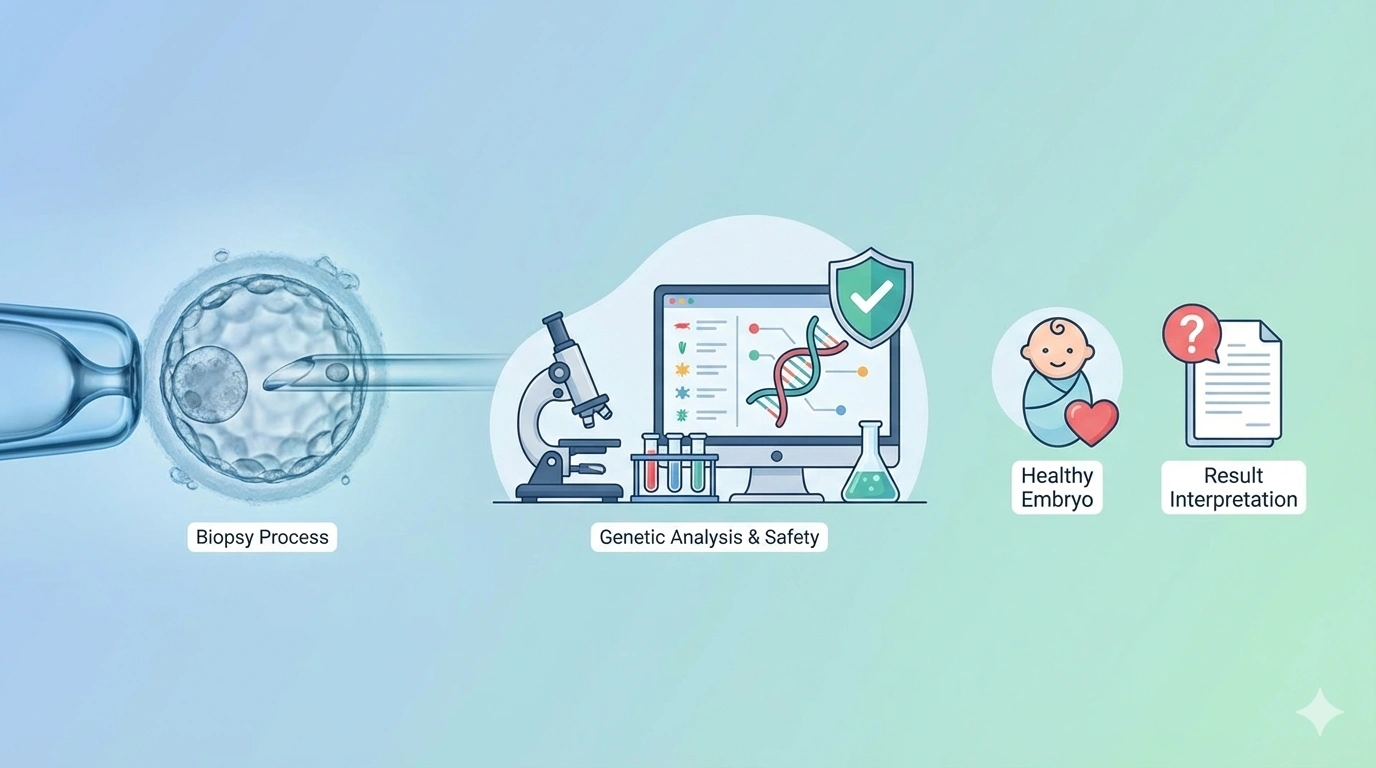
The embryo biopsy is what makes PGT possible. A trained embryologist removes 5–7 cells from the trophectoderm - the outer shell of the embryo at 5–6 days old - that later forms the placenta. These cells go to a genetics lab. Meanwhile, the embryo is flash-frozen (vitrified) and stored safely. The inner part that becomes the baby is never touched.
Types of PGT: PGT-A, PGT-M, and PGT-SR
PGT covers three different tests. Each one checks for a different genetic problem:
PGT-A (Aneuploidy screening): The most common type. It checks if an embryo has the wrong number of chromosomes - for example, the extra chromosome that causes Down syndrome (trisomy 21). Using PGT-A normal embryos greatly improves the chance of implantation.
PGT-M (Monogenic disorders): Tests for specific single-gene conditions such as cystic fibrosis, sickle cell anaemia, or BRCA mutations. Doctors use it when one or both partners carry a heritable condition.
PGT-SR (Structural rearrangements): Used when one partner carries a chromosome rearrangement - such as a translocation or inversion - that raises the risk of miscarriage or chromosome problems in children.
Who Should Consider PGT?
PGT is not right for everyone. But it helps some groups a lot. Your doctor may suggest it if you match one or more of these:
Women aged 35 and over (the rate of abnormal embryos rises with age)
Couples with two or more unexplained miscarriages
Patients who've had two or more failed IVF cycles with no clear cause
Couples where one or both partners carry a known genetic condition
Patients using donor eggs who want extra peace of mind before transfer
How Is an Embryo Biopsy Done?
The embryo biopsy is a very precise procedure. Knowing each step can calm your nerves. It also helps you ask the right questions at your clinic.
When Is the Biopsy Performed?
The biopsy happens on Day 5 or 6 of embryo growth. By then, the embryo has reached the blastocyst stage. It has two layers: the inner cell mass (which becomes the baby) and the outer shell (which becomes the placenta). Waiting until Day 5–6 is safer. There are more cells to take from the outer layer without touching the inner mass.
The biopsy itself takes about 30 seconds per embryo. With prep and paperwork, each case takes around 15 minutes (Spring Fertility Clinic, 2022).
Is Embryo Biopsy Safe?
When a trained embryologist does the biopsy, the risk of embryo damage is very low. A 2021 study in JBRA Assisted Reproduction found no real difference in live birth rates between biopsied and non-biopsied normal embryos.
Risks to know about:
A small chance the embryo gets damaged and can't be used for transfer
A slightly higher chance of identical twinning - a more complex pregnancy than fraternal twins (University of Michigan Health, 2023)
Unclear or “not diagnostic” results, which may need a re-biopsy or more discussion with your team
NABH-accredited clinics in India follow ICMR (Indian Council of Medical Research) protocols. Embryologists meet world-class standards. Labs go through regular quality checks by outside groups.
What Happens After the Biopsy?
Right after the biopsy, the embryo is flash-frozen (vitrified) and stored in liquid nitrogen. The 5–7 cells go to a specialist genetics lab. Most top Indian clinics send samples to outside labs rather than testing in-house. This means better focus and more accurate results.
Results come back in 5–7 working days. While you wait, your body recovers from egg retrieval. This is good timing. A rest before the frozen embryo transfer (FET) often improves the womb's readiness.
Interpreting PGT Results: What Comes Next?
Your results put each embryo into one of three groups:
Euploid: the right number of chromosomes - recommended for transfer
Aneuploid: wrong chromosome count - not recommended for transfer
Mosaic: a mix of normal and abnormal cells - your doctor will talk through options with you, since mosaic embryo outcomes vary a lot by type and degree
If you have more than one euploid embryo, your doctor helps you pick the best one based on size and shape. Any unused euploid embryos can stay in storage for future cycles.
PGT Cost Comparison: India vs UK vs Australia
The numbers below cover PGT-A costs only - that means the biopsy plus the genetic analysis. They do not include your base IVF cycle, medicines, or accommodation. A later section covers full-cycle costs.
Service | India (₹) | UK (£) | Australia (AUD) |
PGT-A per cycle | ₹1,50,000–₹3,00,000 | £2,500–£5,000 | AUD 4,000–8,000 |
USD equivalent | $1,800–$3,600 | $3,100–$6,300 | $2,600–$5,300 |
GBP equivalent | £1,500–£3,000 | £2,500–£5,000 | £2,100–£4,300 |
Saving vs India | - (baseline) | 40–55% more | 30–50% more |
Sources: Max Healthcare, Create Fertility (UK), Genea Fertility (AU). Costs are approximate ranges for 2024–2025 and may vary. Always request an itemised quote.
Cost Breakdown in Australia
In Australia, a PGT-A cycle (biopsy plus lab analysis) costs AUD 4,000–8,000 ($2,600–$5,300; £2,100–£4,300) on top of your base IVF cycle. Medicare rarely pays for PGT unless specific medical conditions apply. You also pay for embryo biopsy, genetic counselling, and storage. Medicines are extra - they can add AUD 2,000–5,000 per cycle.
PGT Costs in the UK
UK private clinics usually charge £2,500–£5,000 ($3,100–$6,300; ₹2,50,000–₹5,00,000) for PGT-A per cycle. This covers the biopsy and genetic analysis for a set number of embryos. Extra embryos may cost more per lab test. NHS funding for PGT is very rare. It only applies to specific cases like a known heritable condition. Always ask for a full itemised quote first.
PGT Costs in India
A full PGT-A cycle in India - including trophectoderm biopsy, sample handling, and genetic analysis - typically costs ₹1,50,000–₹3,00,000 ($1,800–$3,600; £1,500–£3,000). The lower price reflects India’s operating cost structure, not lower quality. Clinics like Apollo Fertility, Nova IVF, and Indira IVF use the same technology as Western labs. Their embryologists hold international certifications. They regularly treat patients from the UK, Australia, and the Middle East.
PGT Success Rates: India, UK and Australia Compared
PGT success rates are counted per embryo transfer, not per egg retrieval. This matters. PGT-A only transfers normal embryos. So transfer success rates are usually higher than in regular IVF.
Country | PGT live birth rate (per transfer) | Notes |
Australia | 45–55% | RTAC annual data; varies by age and clinic |
UK | 40–50% | HFEA 2022 registry data |
India | 40–55% | High-volume NABH centres; comparable to international benchmarks |
Individual outcomes vary significantly with maternal age, embryo quality, and clinic lab standards. These are indicative ranges, not guarantees.
PGT Success Rates in Australia
Australia tracks IVF results through its Reproductive Technology Accreditation Committee (RTAC). Live birth rates for PGT cycles typically run 45–55% per transfer. These are high because PGT removes abnormal embryos before transfer. Each attempt uses only the best embryos.
PGT Success Rates in the UK
The Human Fertilisation and Embryology Authority (HFEA) publishes yearly data for each clinic. For PGT-M cycles, about 1 in 2 transfers leads to a pregnancy when good embryos are available (HFEA, 2023). For PGT-A, clinical pregnancy rates range from 40–50% per transfer at leading centres.
PGT Success Rates in India
Top fertility centres in India report PGT live birth rates of 40–55% per transfer. These numbers match Western standards. India’s high case volume matters. Centres like Nova IVF do thousands of cycles every year. That repetition sharpens skills and directly improves biopsy results.
Why India for PGT? 5 Reasons Beyond Cost
1. NABH-Accredited and JCI-Certified Clinics
India’s top fertility hospitals hold NABH certification - the Indian version of the UK’s CQC or Australia’s ACHS. Major centres like Apollo and Max Healthcare also hold JCI accreditation. JCI is the global gold standard for patient safety. All IVF clinics in India must also be certified by the ICMR. That is an extra layer of oversight.
2. Experienced Embryology Labs
India’s busiest fertility centres do thousands of IVF cycles each year. More cases means better skills. The biopsy takes just 30 seconds - but there is a big learning curve. High volume means less risk from an inexperienced hand. Many senior embryologists at Indian centres trained in Europe or North America. Many hold ESHRE (European Society of Human Reproduction and Embryology) certification.
3. Advanced Technology: AI and Time-Lapse Imaging
Leading Indian fertility clinics use AI to help pick the best embryos. They also use time-lapse incubation systems like EmbryoScope+ that watch the embryo grow all day without disturbing it. These are the same tools used by top clinics in Australia and the UK. They come included in standard PGT packages in India.
4. Dedicated Support for International Patients
Divinheal’s partner hospitals have staff just for international patients. They speak English and handle everything - visas, airport pickups, hospital bookings, accommodation, and follow-up care. Many UK and Australian patients say the personal attention here is far better than at their home clinics.
5. Shorter Waiting Times
NHS IVF cycles in the UK can take 12–18 months to start. Private clinics in the UK and Australia can also have waits of weeks or months. In India, Divinheal’s partner clinics can usually see you within 2–4 weeks of your first contact. When every month matters, this is a big deal.
Patient Stories: Families Who Chose India for PGT
Priya and James, Sheffield (UK)
Priya and James had two failed IVF cycles at a private clinic in Sheffield. Their doctor then suggested PGT-A. The UK clinic quoted £4,200 for PGT on top of the next cycle. A friend suggested India. Divinheal arranged a video call with a Delhi fertility specialist. They booked a combined IVF + PGT-A cycle at a JCI-certified centre. Their total cost - including flights and 18 days’ accommodation - was £8,400. That was less than their previous UK IVF cycle alone. Two healthy embryos were found. The first frozen embryo transfer led to a confirmed pregnancy.
This is an illustrative composite based on a typical patient journey. Names changed for privacy.
Emma and David, Melbourne (Australia)
Emma, 39, had a healthy baby at 36 and had been trying for a second child for two years. Her Melbourne doctor suggested PGT-A because of her age. The quoted cost was AUD 7,500 for PGT on top of a full IVF cycle. Divinheal set up a video call with a Mumbai centre. Emma and David travelled to India for 3 weeks. Three of four embryos tested were euploid. Emma is currently 18 weeks pregnant after a frozen embryo transfer.
This is an illustrative composite based on a typical patient journey. Names changed for privacy.
Fatima and Hassan, Dubai / India-based patients
Fatima, based in Dubai with family roots in India, and Hassan carry the sickle cell anaemia (HbSS) gene. Their fertility specialist in the UAE suggested PGT-M before any IVF transfer. Divinheal connected them with a certified Chennai centre. PGT-M needs a custom probe - a prep phase that takes 6–8 weeks. Most of this was handled remotely before they travelled for the embryo transfer. Three disease-free embryos were found from their cycle.
This is an illustrative composite based on a typical patient journey. Names changed for privacy.
Is PGT Right for You?
Is PGT Controversial?
PGT-A has sparked real scientific debate. A widely cited 2021 commentary in Human Reproduction raised a key question: does removing mosaic embryos take away ones that could lead to healthy pregnancies?
The current view from ESHRE, ASRM (American Society for Reproductive Medicine), and ICMR is clear. PGT-A helps specific groups - older women, those with recurrent miscarriage, or repeated IVF failure. But it is not for every IVF patient.
PGT-P scores embryos for complex traits like intelligence or disease risk. It is still experimental and ethically disputed. ASRM’s Ethics Committee said in 2024 that PGT-P is “not ready for clinical use” due to concerns about equity, incomplete risk modelling, and potential misuse.
Do You Need PGT for Every IVF Cycle?
No. PGT-A is not required. For younger patients - usually under 35 with no prior miscarriages or failed cycles - the extra benefit may not be worth the added cost and time. Younger women naturally make more normal embryos. So screening adds less value.
Talk with your fertility specialist before deciding. They will look at your age, health history, past cycle results, and whether you carry any genetic condition. Divinheal can set up a free video call with a specialist before you commit to anything.
Your PGT Journey in India: Step by Step
A PGT-IVF cycle in India usually takes 3–4 weeks for active treatment. Prep work starts 4–6 weeks before you travel.
Before You Travel: Free Virtual Consultation
Your journey begins with a free video call with a Divinheal fertility specialist. You share your medical history, past IVF records if any, and any genetic test results. The specialist tells you which PGT type (A, M, or SR) suits your case. They outline a likely treatment plan. They also give you a written cost estimate before you decide anything.
If PGT-M applies to you, there is a probe development phase that takes 6–8 weeks. This can start before you travel. You do not need to be in India for this part.
Arriving in India: Visa, Accommodation, and First Appointment
India’s e-Medical Visa is open to patients from the UK, Australia, and most other countries. You apply online. It costs approximately $25–80 and is typically approved within 3–5 working days. You need a confirmed hospital letter - which Divinheal provides as part of onboarding. Your companion can travel on a Medical Attendant Visa.
Divinheal arranges your airport pickup, hotel near the clinic, and your Day 1 medical appointment. Most partner clinics are in Delhi, Mumbai, Bangalore, or Chennai, all with direct international flights from London, Manchester, Melbourne, and Sydney.
Your Treatment Schedule (Typically 3–4 Weeks)
A typical PGT-A schedule runs as follows:
Days 1–10: Ovarian stimulation injections (self-administered at your accommodation, with daily or every-other-day monitoring scans)
Day 11–13: Egg retrieval (under short sedation - recovery same day)
Day 13–15: Fertilisation and early embryo culture
Day 17–19: Blastocyst biopsy (Day 5–6 embryos). Embryos frozen straight after.
Days 19–25: Genetics lab results (5–7 working days). You may return home during this wait.
Next cycle: Frozen embryo transfer (FET) once results are confirmed and the womb is prepared
Bring a full list of your medicines, supplements, and any over-the-counter drugs to every appointment. Some drugs can affect how your body responds to IVF.
After You Leave: Results and Follow-Up
Your PGT results arrive digitally and are reviewed with you in a video call with your doctor. Divinheal’s coordinator helps you understand the report and plan the frozen embryo transfer. Post-transfer check-ups - scans and blood tests - can be done at a clinic near your home. The results get shared with your Indian specialist.
Choosing the Right Clinic for PGT
What to Ask Before You Book
Do not just read a clinic's marketing. Ask them directly:
How many PGT cycles do you perform per year? (A good clinic will share a number; hesitation is a red flag)
What platform do you use for genetic analysis - array CGH or NGS?
Do you send samples to an outside lab or process in-house? Who is the lab partner?
What is your euploid embryo rate by age group?
What happens if an embryo is re-biopsied - is there an additional cost?
Importance of Accreditation and Proven Success Rates
In India, always check for NABH certification (the national patient safety accreditation) and ICMR-ART registration (required by law for all IVF clinics under the ART Regulation Act 2021). JCI certification is an extra international quality mark, held by major hospital groups. A good clinic shares outcome data broken down by age and procedure type. If a clinic only gives one overall success rate, ask for the age-by-age breakdown.
The Role of an Experienced Embryology Lab
The lab director's background matters as much as the doctor's. Ask about their training history, ESHRE or ASRM membership, and whether they take part in outside quality checks. Top Indian labs perform biopsies on Day 5 or 6 (not Day 3), use vitrification (not slow-freeze), and have survival rates above 95% for vitrified embryos. If a clinic uses Day 3 biopsy as standard, ask why - Day 5–6 trophectoderm biopsy is the current evidence-based standard.
How to Get Started with Divinheal
Divinheal is a medical tourism coordinator, not a clinic. Divinheal’s job is to match you with the right clinic for your case, manage the logistics, and stay your point of contact throughout - so you are not on your own in an unfamiliar system.
Getting started is free with no commitment. Fill in a short medical history form. Divinheal’s team then arranges a video call with a fertility specialist at one of the NABH-accredited partner clinics. You get a written cost estimate and treatment plan before you decide anything.
Cost Calculator
I know my treatment — show me cost from 3 hospitals
Final Thoughts
Choosing PGT is both a medical and a financial decision. The science is clear on who benefits most: women over 35, patients with recurrent miscarriage, and couples who carry heritable genetic conditions. For these patients, PGT can cut the number of failed transfers and raise the chance of a healthy birth.
India gives you the same technology and comparable success rates at ₹1,50,000–₹3,00,000 ($1,800–$3,600) for PGT-A - 40–60% less than the UK or Australia. For many families, that difference is what makes treatment possible at all, rather than years of saving or giving up.
Divinheal’s role is to make that option safe and simple. Start with a free video call - no commitment, no cost, just clarity on whether India is the right path for your situation.
Written by DivinHeal Editorial Contributor, Rahul Kumar, Embryologist | Medically Reviewed by Dr Indu Priya, Gynecologist(MD) Published on: 2026-01-26
Plan My Journey
Tell us your condition and budget — our AI matches the right destination, hospital and doctor and visa pathway
Cost Calculator
I know my treatment — show me cost from 3 hospitals
Booking With DIVINHEAL
Get a free consultation to understand your treatment options
From Consultation to Recovery,
Step by Step
Expert Specialist Matching
Connecting you with the world's top-rated medical experts.
Accredited Hospital Network
Access to JCI & NABH certified healthcare facilities.
Complete Travel Coordination
Hassle-free visa, stay, and local transport assistance.
24/7 Personal Care
Dedicated patient advisors supporting you at every step.
Journey Guidance
Full guidance from start to end of the patient treatment journey.
Expert Specialist Matching
Connecting you with the world's top-rated medical experts.
Everything you
need to know today
Browse through these common inquiries to better understand our patient-focused medical platform.
The biopsy itself takes about 30 seconds per embryo. With set-up, handling, and paperwork, each full case takes around 15 minutes (Spring Fertility, 2022). You don’t feel a thing - it is done under a microscope on the embryo, not on your body.
The main risks are: a small chance of embryo damage during the procedure (making it unusable for transfer), a slightly higher chance of identical twins if the biopsy disturbs the inner cell mass, and unclear results that need re-biopsy. With a skilled embryologist at an accredited centre, the risk of damage is very low. A 2021 study in JBRA Assisted Reproduction found no real difference in live birth rates between biopsied and non-biopsied normal embryos (University of Michigan Health, 2025).
PGT has a clinical accuracy rate of over 95–98% for detecting the chromosome problems or gene mutations it is designed to screen for, based on international lab standards. The test does not check for every possible genetic condition - only the ones in your test type (PGT-A, -M, or -SR). New mutations that appear after the biopsy cannot be detected.
PGT-A detects chromosomal aneuploidy (wrong number of chromosomes). PGT-M detects specific single-gene conditions for which a custom probe has been developed - this needs 6–8 weeks of preparation and is ordered for your family’s specific condition. PGT-SR screens for unbalanced chromosomal rearrangements. PGT cannot detect all gene variants, complex conditions like autism or heart disease, or mutations that arise after the biopsy.
No. PGT is a separate service quoted on top of your base IVF cycle cost. In India, a PGT-A cycle adds approximately ₹1,50,000–₹3,00,000 ($1,800–$3,600) to your total. This covers biopsy, sample handling, lab analysis, and a results call. Always ask for a fully itemised quote - some clinics bundle embryo storage; others charge separately. Financial help for PGT is limited in India, but several partner clinics offer structured payment plans for international patients.
For PGT-M cycles where suitable embryos are available, live birth rates per transfer typically range from 50–70%, depending on maternal age and the specific condition. According to HFEA (2023), about 1 in 2 PGT-M/SR cycles that reach transfer results in a baby. Success depends a lot on how many embryos you produce and how many are disease-free. Couples with serious recessive conditions may get fewer viable embryos per cycle.
PGS is an older term that referred to aneuploidy screening. It has been replaced by PGT, which is more precise. PGT-A is the current term for aneuploidy screening (what was previously called PGS). PGT also includes PGT-M (single-gene conditions) and PGT-SR (structural rearrangements) - things the old “PGS” label never covered. If a clinic still uses “PGS,” ask them exactly which test they mean.
Yes. Most fertility specialists and obstetricians suggest continuing with standard prenatal screening after a PGT cycle. Non-invasive prenatal testing (NIPT) is typically done around week 10–12. It checks chromosomes from your blood and covers some conditions PGT doesn’t test for. If NIPT raises a concern, tests like amniocentesis or CVS can follow. PGT cuts your risk greatly but does not replace normal antenatal care.
Live birth rates from IVF are highest for women between 24 and 34, with the strongest results in the late 20s to early 30s (KIN Fertility, Australia, 2023). Rates start to drop after 37 and fall faster after 40. That is why PGT-A is especially helpful for women over 35 - the share of abnormal embryos rises with age, making screening more valuable. Women over 40 may produce fewer eggs and have more abnormal embryos. PGT can screen out many of these, which sometimes means fewer embryos left for transfer.
For a PGT-A cycle, plan for about 2–3 weeks in India for stimulation and egg retrieval, plus a shorter return trip for the frozen embryo transfer (FET). Some patients choose to stay during the genetics waiting period (5–7 days) and go straight to FET if their results and womb preparation align. Your treatment plan will set out the exact schedule. Divinheal’s coordinators help find flexible accommodation near the clinic to keep costs manageable.
Divinheal coordinates every non-clinical part of your PGT journey in India: matching you with the right NABH-accredited clinic for your case, arranging your free initial video call, helping with e-Medical Visa paperwork, organising airport transfers and accommodation, and giving you a dedicated coordinator who is contactable throughout your trip. Divinheal does not charge patients for this - the service is funded through hospital partnerships. After treatment, Divinheal connects you with support resources in your home country.
An inconclusive result means the lab couldn’t get a clear genetic read from the sample - usually due to too few cells or poor DNA amplification. The embryo may be re-biopsied if it is still viable in storage. Otherwise, the team will talk through other options with you. Good labs report a “no result” rate of under 5%. If re-biopsy isn’t possible, the embryo may still be used for transfer based on its shape and grade, at your specialist’s discretion.
PGT-A screens for trisomy 21 (Down syndrome), trisomy 18 (Edwards syndrome), trisomy 13 (Patau syndrome), and other chromosome number problems before embryo transfer. It removes affected embryos from the list. But PGT is not a guarantee. It cuts the risk greatly but does not remove it fully. Doctors still recommend prenatal testing - such as NIPT or amniocentesis - after a successful transfer.
Still have more questions?
Book a call with our friendly team to learn how DivineHeal simplifies your healthcare journey.








