
Embryo Freezing Cost in India: Save 70%+ vs UK & Australia

Embryo Freezing Cost in India: Save 70%+ vs UK & Australia

Written by DivinHeal Editorial Contributor, Rahul Kumar, Embryologist | Medically Reviewed by Dr Indu Priya, Gynecologist(MD) Published on: 2026-01-29
Embryo Freezing Cost in India: A Complete Guide for UK & Australian Patients
In 2025, UK health officials reported that over 11,000 women froze their eggs or embryos. That number has nearly tripled in ten years. But in the UK, each cycle starts at £4,000. In Australia, it can cost over AUD 12,000. That’s why more patients are choosing India. The same procedure at NABH-accredited clinics in India costs ₹1,00,000–₹2,50,000 (£940–£2,360 / AUD 1,900–AUD 4,800). That’s a saving of up to 70% - with no drop in care quality.
This guide covers everything you need to know. You’ll learn what embryo freezing costs, how it works, what success rates to expect, and how Divinheal helps you through the process.
Plan My Journey
Tell us your condition and budget — our AI matches the right destination, hospital and doctor and visa pathway
What Is Embryo Freezing (Embryo Cryopreservation)?
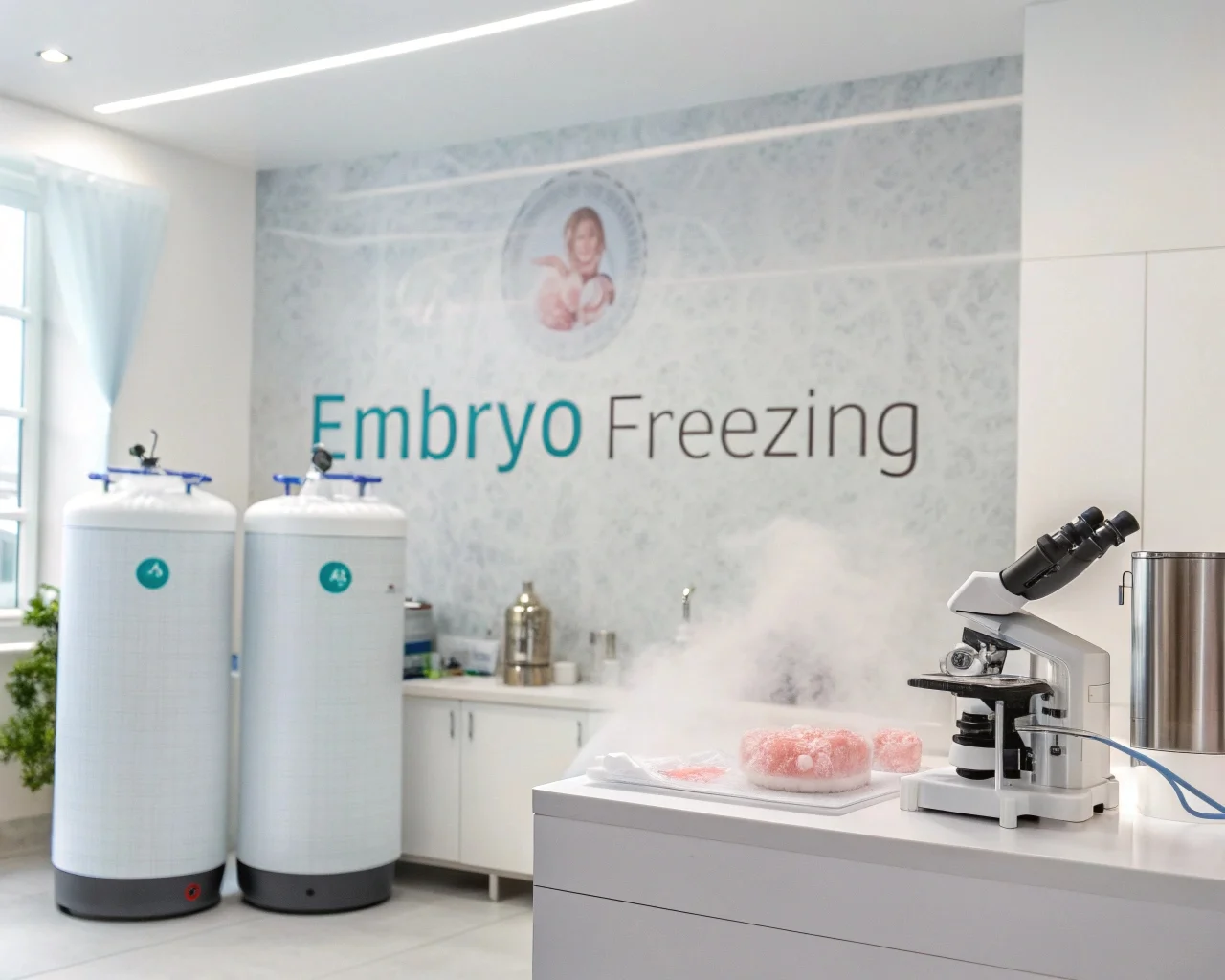
Embryo freezing - also called embryo cryopreservation - is when fertilised eggs are frozen and saved for later. The eggs are kept at very low temperatures. This lets you pause your fertility plans now and try for a baby when you’re ready.
The Science Behind Vitrification - How Modern Freezing Works
Vitrification (vit-rih-fih-KAY-shun) is the method used in almost all embryo freezing today. It freezes the embryo in milliseconds - so fast it turns into a glass-like solid. Think of it like snap-freezing: so quick that nothing has time to form ice crystals.
Older methods froze embryos slowly. That lets ice crystals form inside the cells and cause damage. Vitrification stops that from happening.
During vitrification, the lab uses special chemicals called cryoprotectants. These replace the water inside the embryo’s cells. Then the embryo goes into liquid nitrogen at -196°C. At that temperature, all cell activity stops. The embryo doesn’t age. It can stay viable for years, even decades.
Clinics in India that are NABH-accredited follow ICMR (Indian Council of Medical Research) rules for every step. Their lab standards match the best fertility centres in the UK and Australia.
Who Should Consider Embryo Cryopreservation?
Embryo freezing is a strong option for several types of patients:
Couples doing IVF who have more good embryos than they plan to use right now
Women about to have cancer treatment or surgery that could harm their fertility
People who want to protect their fertility now and have children later
People with conditions like endometriosis or premature ovarian insufficiency (POI) - a condition where the ovaries stop working normally before age 40
Same-sex couples or single people using donor sperm
Embryo Freezing vs. Egg Freezing: Which Is Right for You?
The key difference is simple. Egg freezing stores unfertilised eggs. Embryo freezing stores eggs that have already been fertilized with sperm. Here’s what that means for you:
Factor | Embryo Freezing | Egg Freezing |
Fertilisation required? | Yes - partner or donor sperm needed | No - eggs stored alone |
Success rates (post-thaw) | Higher - ~90–95% embryo survival | Good - ~80–90% egg survival |
Best for | Couples, or those with a sperm donor ready | Single individuals, no partner yet |
Ethical/legal complexity | Higher in some countries | Lower |
Cost difference (India) | Similar - ₹1,50,000–₹3,50,000 full cycle | Similar - ₹1,20,000–₹2,50,000 full cycle |
Note: If you don’t have a partner and aren’t ready to use donor sperm, egg freezing gives you more flexibility. If you have a partner or a donor ready, embryo freezing usually has slightly higher success rates.
How Much Does Embryo Freezing Cost in India, the UK, and Australia?
Embryo freezing has two costs: the upfront procedure fee and the yearly storage fee. Let’s look at both.
Full Cost Breakdown: Cycle, Retrieval, Freezing, Storage, and Transfer
A full embryo freezing cycle is not one single fee. It includes these parts:
Ovarian stimulation (hormone injections) - typically 10–14 days
Monitoring consultations, blood tests, and ultrasound scans
Egg retrieval procedure (under light sedation)
Sperm collection and lab fertilisation
Embryo culture (3–5 days of embryo development in the lab)
Vitrification (the actual freezing process)
First year of storage (often bundled at top Indian clinics)
Medications are charged separately. In India, they can add ₹20,000–₹60,000 ($240–$720 / £185–£570). In the UK, the same drugs cost £800–£2,000.
India vs. UK vs. Australia: Complete Cost Comparison Table
Component | India (₹ / USD / £) | UK (£ / USD) | Australia (AUD / USD) |
Full IVF + embryo freeze cycle | ₹1,30,000–₹3,50,000 ($1,200–$3,000 / £940–£2,360) | £6,000–£13000 ($7,600–$16,500) | AUD 8,000–AUD 12,000 ($5,300–$8,000) |
Medications | ₹30,000–₹70,000 ($240–$720 / £185–£570) | £1,000–£2,500 ($1,260–$3,150) | AUD 1,500–AUD 4,000 ($1,000–$2,650) |
Annual embryo storage | ₹10,000–₹30,000 ($125–$360 / £100–£285) | £300–£600 ($375–$750) | AUD 400–AUD 700 ($265–$465) |
Frozen embryo transfer (FET) | ₹30,000–₹80,000 ($360–$960 / £285–£760) | £1,500–£2,500 ($1,875–$3,125) | AUD 3,000–AUD 5,000 ($2,000–$3,330) |
Typical total savings vs India | - | 75–90% saving | 60–68% saving |
Figures are approximate ranges for 2024–25. Always request a written itemised quote from your clinic. Divinheal can coordinate this for you.
How Much Does It Cost to Use Your Frozen Embryos? (FET Costs)
When you’re ready to try for a baby, you’ll need a Frozen Embryo Transfer (FET) cycle. This is a separate procedure from the original freeze. It costs much less because you don’t need another egg retrieval.
In India, an FET cycle typically costs ₹30,000–₹80,000 ($360–$960 / £285–£760). In the UK, it’s £1,500–£2,500. In Australia, it’s AUD 3,000–AUD 5,000. FET medications add another ₹10,000–₹25,000 ($120–$300). Many patients come back to India just for the FET because the savings are so big.
Annual Embryo Storage Fees: What You’ll Pay Each Year
After freezing, you’ll need to pay an annual storage fee to keep your embryos safe. In India, this is usually ₹10,000–₹30,000 per year (around $125–$360 / £100–£285), depending on the clinic and storage requirements.
UK clinics charge £300–£600 per year. Australian clinics charge AUD 400–AUD 700. Always check if your first year of storage is included in the cycle price. Many top Indian clinics bundle this in.
The Embryo Cryopreservation Process: Step by Step
Here’s exactly what happens during your embryo freezing journey in India. It starts with your first check-up and ends when your embryos are safely stored.
Step-by-Step: From Ovarian Stimulation to Embryo Vitrification
Step 1: Initial consultation and baseline scans (Day 1–3)
Your fertility doctor reviews your medical history. They check your ovarian reserve - the number of eggs you have left - using an AMH blood test and an ultrasound. Then they design a hormone plan just for you.
Step 2: Ovarian stimulation (Days 2–14)
You take hormone injections every day for around 10–14 days to help several eggs develop at the same time. During this period, your clinic checks your progress every few days with blood tests and ultrasound scans and changes the dose if needed.
Step 3: Trigger injection and egg retrieval (Day 15)
When your follicles are the right size, you take a trigger injection. This finishes the process of egg maturation. About 36 hours later, a doctor uses a fine needle guided by ultrasound to collect your eggs. You’ll be lightly sedated. The whole thing takes 15–30 minutes. Most patients rest at the clinic for a few hours, then go back to their hotel.
Step 4: Fertilisation and embryo culture (Days 15–20)
The collected eggs are joined with sperm in the lab. The embryos grow in a controlled setting for 3–5 days. An embryologist grades each one. The best embryos - called blastocysts - are chosen for freezing.
Step 5: Vitrification and storage (Day 20+)
Good embryos are vitrified and placed in liquid nitrogen at -196°C. Your clinic gives you a storage certificate. It lists each embryo’s grade and ID number.
The Frozen Embryo Transfer (FET) Cycle: What to Expect
When you’re ready to use your frozen embryos, you’ll have a separate FET cycle. It’s much simpler than the original freeze.
First, you take oestrogen for 10–14 days. This prepares your uterine lining - the inner layer of the womb. Then you take progesterone for 5–6 days. This creates the best window for the embryo to implant.
The transfer takes about 10 minutes. A doctor guides a thin tube called a catheter through your cervix - the opening of the womb - into the uterus. Then they place the thawed embryo inside. No anaesthetic is needed. Most patients say it feels like a smear test.
A blood test called a beta-hCG is taken 10–14 days later. This checks if the embryo has implanted.
Success Rates and Risks of Embryo Freezing
How Successful Is Embryo Freezing? Real Data by Age
After vitrification, around 90–95% of frozen embryos survive the thaw at the top Indian clinics. But surviving the thaw is not the same as having a successful pregnancy. What really matters is the live birth rate per transfer.
According to HFEA data (2022), frozen embryo transfers in the UK had the following live birth rates by age:
Age at egg retrieval | Embryo survival rate (post-thaw) | Live birth rate per FET (HFEA 2022) |
Under 35 | 90–95% | 50–55% |
35–37 | 88–93% | 40–45% |
38–40 | 85–90% | 30–35% |
Over 40 | 80–88% | 10–20% |
Sources: HFEA Fertility Treatment Trends 2022; Apollo Fertility India clinical data. Individual outcomes vary. Consult your specialist for a personalised prognosis.
Do Frozen Embryos Outperform Fresh Transfers?
In many cases, yes. A 2018 study in the New England Journal of Medicine found that frozen embryo transfers had higher live birth rates than fresh transfers in ovulatory women. The womb has time to recover from the hormones used during egg retrieval, making it more ready for a pregnancy.
Freezing all your embryos instead of doing a fresh transfer straight away is called the ‘freeze-all’ approach. It can actually improve your overall chances of success.
Risks and Side Effects: What You Need to Know
Embryo freezing is safe. But you should know the real risks:
Ovarian Hyperstimulation Syndrome (OHSS) - this is when the ovaries overreact to fertility drugs. It can cause bloating, nausea, and in rare cases, fluid build-up. It affects around 1–2% of IVF patients in a moderate-to-severe form. Doctors watch for signs and can adjust your treatment.
Embryo loss - not all embryos survive the freeze and thaw. Modern vitrification reduces this a lot, but some embryo loss can still happen.
No proven birth defect risk - large studies, including a 2021 review in Human Reproduction, found no increase in birth defects in children born from frozen embryos.
Small procedure risks - egg retrieval has a very small risk of bleeding or infection. These are rare at NABH-accredited clinics.
Best Age to Freeze Embryos: When Should You Act?
Age is the biggest factor in embryo freezing success. The earlier you freeze, the better your embryo quality - and the more options you’ll have.
Is There a Best Age to Freeze Embryos?
Most fertility doctors see the late 20s to early 30s as the best time to freeze embryos. Egg quantity and quality are at their highest then. That means fewer cycles, more good embryos, and better results.
But there’s no hard cut-off age. Women in their late 30s and early 40s can and do freeze embryos and get pregnant. The decision should be based on your own ovarian reserve - not just your age.
Here’s a guide to how many eggs you typically need to end up with one viable (euploid) embryo:
Age at retrieval | Eggs needed per euploid embryo (approx.) | Live birth rate per FET (estimated) |
Under 35 | 4–6 | 50–60% |
35–37 | 7–9 | 40–50% |
38–40 | 10–15 | 30–40% |
Over 40 | 15–20+ | 10–20% |
Sources: Apollo Fertility; Max Healthcare; Oasis Fertility India. Euploid = chromosomally normal embryo.
Is 25 Too Early to Freeze Embryos?
No. Age 25 is not too early. Biologically, it’s a great time. Your egg quality is at its peak. You’re likely to produce more good embryos per cycle. You may only need one cycle to bank enough embryos for your family plans.
The main thing to think about is cost. You’ll pay storage fees for many years. Your plans may also change - a new partner, or a natural pregnancy. Most doctors suggest waiting until 28–30 unless there’s a medical reason. But freezing at 25 won’t cause any harm.
Is 34 or 35 Too Late to Freeze Embryos?
No. But 34–35 is a key turning point. Many fertility doctors say 35 is the age to act - not wait.
After 35, egg quality drops more sharply. The chance of chromosomal problems in embryos also goes up. At 35, you can still get good results. But you may need more eggs retrieved than you would have at 30. A woman who freezes at 35 is in a much better position than one who waits until 38 or 40.
Freezing Embryos at 35, 38, or 40: Real Success Rates by Age
Women at 35, 38, and 40 freeze embryos and go on to have healthy pregnancies. But the numbers do change with age.
At 35, you’ll likely need 1–2 retrieval cycles to bank 3–5 good embryos. Live birth rates per FET are around 40–50%.
At 38, you may need 2–3 cycles. Live birth rates per FET drop to 30–40%. Pre-implantation Genetic Testing (PGT-A) - which screens embryos for chromosomal problems before transfer - is strongly advised.
At 40, you’ll likely need several cycles. Success rates per FET are 10–20%. Your doctor will talk through realistic expectations and how many cycles you’re willing to try.
Embryo Storage: Rules, Duration, and What Happens If You Don’t Use Them
How Long Can an Embryo Be Frozen? UK, Australia & India Rules
Embryos can be stored safely for many years, even decades, and there are cases of babies born from embryos frozen for over 20 years. But the allowed storage time isn’t the same everywhere-it depends on the laws in each country.
Country | Default storage period | Extension available? | Notes |
India | 5–10 years (clinic policy) | Yes, with consent | ICMR guidelines; no strict national statutory limit |
UK | 10 years | Up to 55 years if medically justified | HFEA regulates; extension requires consent forms |
Australia | Varies by state | Yes, renewable | NSW: 5 years renewable; VIC: 10 years renewable |
If you’re an international patient freezing in India, ask the clinic for their storage policy in writing. Find out what happens to your embryos if the clinic closes or if they lose contact with you.
Navigating Decisions: Donation, Discard, or Research
If you decide not to use your frozen embryos - or you reach the end of your storage period - you have four options:
Donate to another patient or couple going through IVF
Donate to scientific or medical research
Compassionate transfer - moving the embryo when pregnancy is no longer possible, as a symbolic act
Discard (let the embryos perish)
These are very personal decisions. Most clinics offer counselling when you reach this point. In India, ICMR rules require written consent for donation and research. You don’t need to decide at the time of freezing. You can update your wishes any time during storage.
Who Is Legally Responsible for Stored Embryos?
By law, the people who created the embryos - the egg and sperm providers, or the intended parents - own them and make all decisions about them. This is set out in consent forms you sign before the procedure.
Your consent form should cover what happens if you split up or divorce. It should also say what happens if you die, and any limits on how the embryos can be used. Read these forms carefully. Ask the clinic’s patient team to explain anything you don’t understand.
Travelling to India for Embryo Freezing: A Practical Guide
Going to another country for medical treatment can feel daunting. But the practical side is simpler than you’d expect. Divinheal handles most of the planning for you.
Visa, Stay Duration, and What to Arrange Before You Fly
UK and Australian patients need a Medical Visa (e-MV) to travel to India for treatment. You can apply through the Indian Visa Online portal. You’ll need:
A letter from your hospital in India confirming your appointment
Proof of insurance or funds
Your passport (valid for at least 6 months from your travel date)
Allow 5–10 business days for e-visa processing. A companion can apply for a Medical Attendant Visa (e-MX) at the same time.
Plan for a stay of 12–16 days for a full embryo freezing cycle. You need to be there from the start of stimulation through egg retrieval and lab confirmation. If you come back for a FET later, plan for a separate trip of around 7–10 days.
Main treatment cities are Delhi (AIIMS, Apollo, Max), Mumbai (Hinduja, Jaslok), and Bangalore (Manipal, Cloudnine). Divinheal can help you find a good serviced apartment or hotel near your clinic.
Why Divinheal Is the Right Choice for Your Journey
Divinheal is a medical travel coordination service - not just a referral agency. Here’s what that means for you:
You get a dedicated patient coordinator from your first enquiry, right through to your follow-up
Divinheal checks every hospital and fertility doctor in its network against NABH and ICMR standards
All cost quotes are itemised and clear - no surprise fees
Divinheal arranges visa support letters, airport transfers, accommodation, and travel between cities
Your medical records and reports are shared securely with your GP or specialist back home
Remote follow-up consultations are set up after you return
Patient Stories: What UK & Australian Patients Say
Emma, 33, London, UK
Emma was diagnosed with endometriosis at 31. Her doctor told her that her fertility might drop faster than normal.
“The cost in the UK was around £5,200 for one cycle, plus £1,800 for medications. I just couldn’t justify that on top of my mortgage. Divinheal sorted everything - I paid ₹1,65,000 in India, including medications and the first year of storage. The clinic felt completely professional. I came home with five frozen embryos and a lot more peace of mind.”
James & Priya, 36 & 34, Melbourne, Australia
James and Priya had two failed IVF cycles in Melbourne, each costing over AUD 10,000. They came to India through Divinheal for their third try, using a freeze-all approach.
“The embryology lab at our clinic in Delhi was genuinely impressive. They produced six blastocysts, froze all of them, and we went back for the FET six months later. Our daughter was born in 2024.”
Total spend in India: ₹2,40,000 for the freeze cycle plus ₹55,000 for the FET - less than the cost of one cycle in Australia.
Stories are illustrative composites based on typical patient journeys. Names changed for privacy. Individual outcomes vary.
Cost Calculator
I know my treatment — show me cost from 3 hospitals
Final Thoughts
Embryo freezing is one of the most powerful ways to protect your future fertility. The science is solid. The success rates are well-proven. And India’s NABH-accredited clinics get the same results as the best centres in the UK and Australia - at 60–70% of the cost.
Whether you’re facing a medical diagnosis, planning ahead, or just not ready for a family yet, embryo cryopreservation gives you choices. The best time to act is when your egg quality is highest - which means sooner rather than later.
Divinheal keeps things smooth and hassle-free, with a dedicated coordinator managing everything from your first enquiry to follow-up, hospital, visa, stay, and doctor coordination.
Ready to take the next step? Contact Divinheal today for a free first consultation and a personal cost estimate from NABH-accredited fertility clinics in India.
Disclaimer: This article provides general information only. It does not constitute medical advice. Please consult a qualified fertility specialist before making treatment decisions.
Plan My Journey
Tell us your condition and budget — our AI matches the right destination, hospital and doctor and visa pathway
Cost Calculator
I know my treatment — show me cost from 3 hospitals
Recommended Article

Best In Vitro Fertilization (IVF) Doctors in Hyderabad
Doctors for Nephrology: Find Kidney Care Specialists
Doctors in Chennai: Find Medical Specialists in India
Best Embryo Freezing Hospitals in Hyderabad: Care Guide
Hospitals for reproductive surgery: Compare options
Hospitals in Gurugram: Guide to Quality Facilities
IVF Treatment in Haryana | Cost, Hospitals & Doctors
TAVR (Transcatheter Aortic Valve Replacement) cost in New Delhi
Tonsillectomy & Adenoidectomy Success Rate in Mumbai
Facelift & Anti-Aging Procedures in Chennai for Ethiopia Patients | Cost, Hospitals
Written by DivinHeal Editorial Contributor, Rahul Kumar, Embryologist | Medically Reviewed by Dr Indu Priya, Gynecologist(MD) Published on: 2026-01-29
Plan My Journey
Tell us your condition and budget — our AI matches the right destination, hospital and doctor and visa pathway
Cost Calculator
I know my treatment — show me cost from 3 hospitals
Booking With DIVINHEAL
Get a free consultation to understand your treatment options
Recommended Article
Best In Vitro Fertilization (IVF) Doctors in Hyderabad
Doctors for Nephrology: Find Kidney Care Specialists
Doctors in Chennai: Find Medical Specialists in India
Best Embryo Freezing Hospitals in Hyderabad: Care Guide
Hospitals for reproductive surgery: Compare options
Hospitals in Gurugram: Guide to Quality Facilities
IVF Treatment in Haryana | Cost, Hospitals & Doctors
TAVR (Transcatheter Aortic Valve Replacement) cost in New Delhi
Tonsillectomy & Adenoidectomy Success Rate in Mumbai
Facelift & Anti-Aging Procedures in Chennai for Ethiopia Patients | Cost, Hospitals
From Consultation to Recovery,
Step by Step
Expert Specialist Matching
Connecting you with the world's top-rated medical experts.
Accredited Hospital Network
Access to JCI & NABH certified healthcare facilities.
Complete Travel Coordination
Hassle-free visa, stay, and local transport assistance.
24/7 Personal Care
Dedicated patient advisors supporting you at every step.
Journey Guidance
Full guidance from start to end of the patient treatment journey.
Expert Specialist Matching
Connecting you with the world's top-rated medical experts.
Everything you
need to know today
Browse through these common inquiries to better understand our patient-focused medical platform.
Yes. Embryo freezing is a well-proven procedure used in fertility clinics around the world. Vitrification - the modern ultra-rapid freezing method - gives embryo survival rates of 90–95% at top NABH-accredited clinics in India. Thousands of healthy children have been born from embryos frozen for years or even decades.
A FET cycle in India costs ₹30,000–₹80,000 ($360–$960 / £285–£760), plus roughly ₹10,000–₹25,000 for medications. In the UK, it’s £1,500–£2,500. In Australia, it’s AUD 3,000–AUD 5,000. Many patients come back to India just for the FET because the savings are so big.
Vitrified embryos stored at -196°C can stay viable for a very long time. Babies have been born from embryos frozen for over 20 years. Storage limits are set by law, not biology. In India, clinics typically allow 5–10-year contracts (renewable). In the UK, the default is 10 years - extendable up to 55 years under HFEA rules. In Australia, limits vary by state.
No. At 25, your egg quality and ovarian reserve are at their peak. This means better embryo quality and possibly fewer cycles. The main thing to think about is cost - you’ll pay storage fees for many years. Most fertility doctors say 28–32 is the best time, balancing quality with the chance you’ll actually need to use the embryos. But freezing at 25 is biologically ideal.
Egg freezing stores unfertilised eggs. Embryo freezing stores fertilised eggs. Embryo freezing usually has slightly higher success rates after thawing - fertilised embryos are stronger. But egg freezing gives you more control if you don’t have a partner or aren’t ready to use donor sperm. The right choice depends on your situation. Divinheal can help you talk through both with a specialist.
For many people, embryo freezing is a practical way to preserve fertility and plan for the future. It’s more affordable in India than in the UK or Australia. However, it doesn’t guarantee pregnancy-success depends on age, embryo quality, and the transfer process, so consult a specialist first.
The main risks are: (1) OHSS (ovarian hyperstimulation syndrome) from the stimulation drugs - your specialist watches for this carefully; (2) embryo loss during the freeze-thaw process - rare with modern vitrification; (3) small risks from egg retrieval, such as bleeding or infection - very rare at accredited clinics. There is no proven increased risk of birth defects in children born from frozen embryos.
You have four options: donate to another patient or couple; donate for medical research; compassionate transfer; or discard. The decision is entirely yours. You don’t need to decide at the time of freezing. ICMR rules in India require written consent before donation. Most clinics offer counselling when you reach this point.
In the UK, NHS support for IVF and embryo freezing is limited and depends on where you live. In Australia, Medicare can help with some IVF costs, but it usually won’t cover treatment done abroad. Most private insurance also doesn’t cover overseas treatment or travel. Divinheal can help you figure out costs and available payment options with partner clinics.
Plan for 12–16 days for your first freeze cycle. The stimulation phase needs daily monitoring - blood tests and ultrasound scans - then egg retrieval, then 3–5 days for embryo culture before freezing. If you come back later for an FET, that’s a separate trip of 7–10 days. Divinheal will give you a personal timeline based on your clinic’s plan.
Divinheal works only with NABH-accredited hospitals (the National Accreditation Board for Hospitals - India’s equivalent of CQC in the UK or ACHS in Australia) that also follow ICMR protocols for reproductive medicine. Before recommending any clinic, Divinheal checks JCI accreditation where applicable, doctor credentials, lab quality standards, and patient outcome data. Your coordinator can share hospital documents on request.
In India, a full IVF + embryo freeze cycle (excluding medications) typically costs ₹1,00,000–₹2,50,000 (£940–£2,360 / AUD 1,900–AUD 4,800). In the UK, the same cycle costs £4,000–£6,000. In Australia, it’s AUD 8,000–AUD 12,000. UK and Australian patients choosing India save 60–70% - with no loss in care quality.
In many cases, yes. A 2018 New England Journal of Medicine study found frozen transfers had higher live birth rates than fresh transfers in ovulatory women. The body has time to recover from hormone stimulation, making the uterine lining more ready. HFEA’s 2022 data shows frozen transfers now make up over 60% of all transfers in the UK - partly because of this.
No. But 35 is the point to act, not wait. After 35, egg quality drops more steeply, and chromosomal problems become more common. Women who freeze at 35 still get good results. But they may need more eggs retrieved than at 30. The key advice: if you’re 34–35 and thinking about it, get an ovarian reserve test now - don’t wait another year.
Still have more questions?
Book a call with our friendly team to learn how DivineHeal simplifies your healthcare journey.








