Written by DivinHeal Editorial Contributor, Samrat Nilesh, Embryologist | Medically Reviewed by Dr Indu Priya, Gynecologist(MBBS,MD) Published on: 2026-01-26
|
🔑 KEY TAKEAWAYS • Most countries set the
maximum age for IVF with donor eggs between 50–55 years. • India’s ICMR 2021 ART
Act sets the recipient age ceiling at 50 — with individual health assessment. • Donor egg IVF success
rates of 60–75% per transfer, and this rate remain steady even for women age
50+. This is because donor age drives outcomes, not the recipient's age. • A full cycle in India
costs ₹3,00,000–₹5,50,000 (~$3,600–$6,600) — saving 60–85% vs UK or UAE private
rates. • Divinheal connects patients from UAE, Nigeria
& the UK to JCI-accredited Indian clinics with dedicated coordinators. |
Maximum Age for IVF With Donor Eggs: What Patients in UAE, Nigeria &
the UK Need to Know
There isn't one fixed global
rule on the maximum age for IVF with donor eggs. In India, treatment is allowed
up to age 50 under the 2021 ART Act. In the UK, there is no strict legal upper
age limit. Although many private clinics usually treat women up to around 55.
The UAE allows it for married couples, usually up to 45–50. If you are in your
40s or 50s and wondering whether IVF is still possible for you, this guide can
help. It explains the exact rules for different countries, the health checks
required to see if you are eligible, and a clear cost comparison with your home
country.
What Is Donor Egg IVF and Why Does Age Matter Less With It?
Donor egg IVF uses eggs from a screened donor, usually aged 21–32. These
eggs are fertilised in a lab with sperm from your partner or a donor. The
embryo is then placed into your womb. The main difference from standard IVF:
your egg quality is no longer the main barrier.
Why Your Age Matters Far Less With Donor Eggs
Age is the biggest reason IVF fails when you use your own eggs. Egg
quality and quantity drop sharply after 35. With donor eggs, the eggs come from
a young, healthy donor. Your job is to carry the pregnancy — not to provide the
eggs.
SART data (2023) shows live birth rates using your own eggs drop to
below 5% after age 42. With donor eggs, clinical pregnancy rates at
JCI-certified Indian clinics stay between 60–75% per transfer. This holds
whether the recipient is 38 or 52. The donor's age has a much bigger impact on
the success than the recipient's age.
Who Typically Considers Donor Egg IVF?
Most patients are women with low ovarian reserve (DOR). This means the
ovaries have fewer eggs than expected for the patient’s age. Others include
women with premature ovarian failure (POF). Some have had repeated IVF failures
with own eggs. Others have a genetic condition they do not want to pass on. For
patients over 43, most fertility specialists suggest donor eggs as the first
option.
In India, the donor's identity is strictly kept private by law as per
the 2021 ART Act. While leading Clinics like Apollo Hospitals Chennai, Fortis
Fertility Noida, Medanta Gurgaon, MAX Hospitals, and Artemis Gurgaon share
detailed donor profiles, they do not reveal personal details. These profiles
typically include information such as physical features, education, medical
history, and genetic test results. However, the donor's name or identity always
remain confidential.
What Is the Maximum Age for IVF With Donor Eggs? (Country Rules)
The answer depends on where you are treated, not where you live. Here are the rules that
apply to the countries most relevant to Divinheal patients:
|
Country. |
Max Age — Donor Egg IVF. |
Key Notes. |
|
U.A.E |
Up to 45–50 (married couples only). |
No treatment for unmarried women; varies by
emirate. |
|
U.K |
No legal limit; most clinics cap at 50–55. |
NHS funded up to age 42; private clinics often
treat to 55 (e.g., London Egg Bank). |
|
Nigeria |
Typically up to 50 (clinic discretion). |
No national law; clinics set own policies.
Advanced care available in India. |
|
India |
Up to 50 years (ICMR 2021 ART Act). |
Legal ceiling for recipient. Individual health
assessed case by case. |
|
Australia |
Up to 50–53 (state-specific). |
Medicare does not fund donor IVF; private cost
AUD 18,000–28,000. |
Sources: ICMR
2021 ART Act (India); HFEA guidance (UK); London Egg Bank published age policy;
UAE Ministry of Health circulars. Verify current rules before travel.
India’s Rules: What the ICMR 2021 ART Act Says
India’s ART Act 2021 sets a clear rule: female recipients must be
between 21 and 50 years old. There is no exception. The same Act requires every
patient over 45 to have a full health check first. This covers heart function,
womb health, and blood sugar levels. The law does not require treatment — it
requires a health check first.
At clinics like Fortis Fertility Noida and Medanta Gurgaon, fertility
doctors and heart specialists work together for patients aged 45+. A
48-year-old with good heart health and a healthy womb gets a different result
than a 48-year-old with high blood pressure that is not under control.
Can I Do IVF at 44, 50, or 54 With Donor Eggs?
At age 44: Yes, IVF with donor
eggs is allowed in almost every country. India, the UK, UAE (married couples),
Nigeria, and Australia all allow it. Health checks are standard.
At age 50: Yes in India (up to the legal ceiling) and yes in UK private
clinics. UAE depends on the emirate and clinic. Australia varies by state.
At age 54: Treatment is usually only available in countries with no
legal upper limit. The UK has no law against it. London Egg Bank treats
patients up to 55. In India, the 2021 ART Act does not allow it above age 50. A
54-year-old from the UK seeking treatment in India would not qualify.
The bottom line: whether you qualify depends on the law in the treatment
country plus your personal health. Age alone is not the answer. Your heart
doctor’s report often matters more than your age.
At What Age Are 90% of a Woman’s Eggs Gone?
Research by Wallace and Kelsey (Human Reproduction, 2010) discovered
that a woman is born with roughly one million eggs. By puberty, that number has
already fallen to around 300,000–500,000. By age 37, most women have around
25,000 eggs left. By 51, fewer than 1,000 remain.
In simple terms, 90% of eggs are typically gone by the early 30s. But
this does not mean 90% of fertile years are over. Egg quality is a separate
issue from egg number. Many remaining eggs can still lead to a pregnancy into
the mid-30s. After 35, both number and quality fall together. Donor egg IVF
uses eggs from a donor in her 20s. This removes both problems in one step.
For patients from the UAE, Nigeria, or the UK who are already in their
40s, this is not new information. The key point: while your own egg supply is largely
fixed, womb readiness is something clinics can improve using hormone
preparation.
Is It Safe to Get Pregnant With Donor Eggs at an Advanced Age?
Donor eggs fix the egg-quality problem. But they do not change what
happens during pregnancy. A 48-year-old womb carries a pregnancy differently
than a 28-year-old womb. Good clinics know this. They use thorough
pre-treatment checks to manage risk.
Maternal Risks Over 45: What the
Data Shows.
Women over 45 carrying donor-egg pregnancies face higher rates of high
blood pressure in pregnancy (15–20% vs 3–5% in younger patients). They also
face higher rates of gestational diabetes (8–12%), pre-eclampsia, and caesarean
delivery. Premature birth rates are higher too. These are not reasons to avoid
treatment. They are reasons to pick a clinic that manages pregnancy health
alongside fertility care.
Fatoumata, 47, from Lagos, first decided against IVF after reading statistics alone. She then had a
consultation at Apollo Hospitals Chennai through Divinheal. The heart
specialist cleared her for treatment with blood pressure control in place. She
had a healthy boy at 48. Her story is not rare. It is the result of proper
pre-screening and care from a team of specialists.
Uterine Receptivity: The Variable Clinics Can Control
Even a healthy 50-year-old womb needs preparation. Indian fertility
clinics use tailored hormone plans — oestrogen priming and progesterone support
— to improve womb readiness before the embryo transfer. In some cases, a mock
transfer is done first. A hysteroscopy — a small camera check inside the womb —
is standard for patients over 45. It costs approximately ₹15,000–₹35,000
($180–$420) at most Indian centres.
Clinics also use the Endometrial Receptivity Analysis (ERA) test. This
finds the exact window when the womb is ready for an embryo. It helps most for
patients who have had failed cycles before. For older patients, getting this
timing right is often the key to a successful cycle.
What Disqualifies Someone From Donor Egg IVF?
Age is rarely the reason someone is turned away. The conditions that
truly rule out treatment are shown in the table below.
|
Category |
Example Conditions |
Why It Matters |
|
Cardiac |
Heart failure that is not under control, severe
arrhythmia. |
Pregnancy raises cardiac output by 40–50%. |
|
Metabolic |
Unmanaged Type 2 diabetes, severe obesity (BMI
>40). |
Increases risk of gestational complications. |
|
Uterine |
Absent uterus, severe Asherman's syndrome. |
No viable implantation site. Surrogacy may be
considered. |
|
Active Cancer |
Current systemic chemotherapy or radiation. |
Hormonal stimulation contraindicated. |
|
Renal |
Dialysis-dependent kidney disease. |
Cannot safely sustain pregnancy-related fluid
shifts. |
Patients with well-managed long-term conditions are often approved after
a multi-specialist check. This includes controlled high blood pressure, stable
thyroid disease, and diet-managed diabetes. The question clinics at MAX
Hospitals and Artemis Gurgaon ask is simple: can this patient safely carry a
pregnancy to term? Not: is this patient too old?
Donor Egg IVF Success Rates: What the Data Actually Shows
Here is why donor egg IVF works so well for older recipients: success is
driven almost entirely by the donor’s age, not yours. The table below shows the
difference between using your own eggs and using donor eggs across age groups.
|
Patient Age. |
Own Eggs (IVF) — Live Birth Rate |
Donor Eggs (IVF) — Clinical Pregnancy Rate |
|
35–37 |
38.3% (SART 2023) |
60–75% per transfer (India JCI clinics) |
|
38–40 |
25.1% |
60–75% (donor age drives success, not recipient) |
|
41–42 |
12.7% |
60–75% — same range maintained |
|
43–45 |
~5% |
55–70% — uterine health becomes key variable |
|
46–50 |
<3% |
50–65% — requires thorough cardiovascular
clearance |
Your own-egg
live birth rates: SART 2023 National Summary Report. Donor-egg clinical
pregnancy rates: reported ranges from JCI-certified Indian IVF centres.
Individual outcomes vary based on uterine health, embryo quality, and cycle
protocol.
Success Rates for Women Over 45 With Donor Eggs at Indian Clinics.
At Fortis Fertility Noida, clinical pregnancy rates for donor-egg IVF
are around 65–70% per fresh embryo transfer. Medanta Gurgaon and Apollo
Hospitals Chennai report similar figures. These cycles use vitrified
(fast-frozen) donor eggs. Post-thaw survival rates are above 90% in
well-equipped labs. This makes frozen donor cycles nearly as effective as fresh
ones.
For a 43-year-old patient, SART data shows a roughly 5% chance of a live
birth using her own eggs. Using a 26-year-old donor’s eggs at the same Indian
clinic, her clinical pregnancy rate rises to 60–70%. That is not a small
improvement. It is why most fertility specialists suggest donor eggs from age
43 onward.
How Often Do Donor Eggs Fail?
Even with high success rates, donor egg cycles can fail. Failure can
happen at implantation (the embryo does not attach). It can happen during early
growth — a positive test that does not progress. Or it can happen later, as an
early miscarriage. Across donor egg IVF cycles in India, the overall failure
rate is roughly 30–40% per single transfer attempt.
The most common reasons include a thin or weak womb lining (the most
controllable factor), possible chromosome problem in the donor embryos (less common
but possible), and issues with the immune system, failure to implant. If the
first cycle fails, clinics usually look into the cause before the second
attempt. They may adjust ERA timing, change progesterone support, or use PGT-A
(preimplantation genetic testing) to check embryos before transfer.
Most patients who succeed do so within 1–2 cycles. Planning for the
chance of a second cycle — rather than expecting one to always work — is the
honest approach. Clinics at Medanta and Apollo talk this through with patients
before treatment starts.
What Are the Main Disadvantages of Using Donor Eggs?
Donor egg IVF has a high success rate. It removes the age-related egg
barrier. But it has real trade-offs to know about before you start.
No Genetic Connection to the Birth Mother
The child will carry the donor’s genetic material, not the mother’s.
This is the most common concern. It is also the one most patients say matters
less over time than they expected. Your body provides the setting in which the
baby grows. How genes behave during pregnancy — called epigenetics — means your
experience of carrying the baby shapes its growth in real ways. Many patients
choose donors who share their ethnic background or physical features.
Emotional Complexity and Disclosure Decisions
Deciding whether to tell your child they were conceived with donor eggs
— and when — is something each family handles in its own way. In India, donors
are anonymous by law under the 2021 ART Act. Clinics including Artemis Gurgaon
and MAX Hospitals require counselling before treatment starts, not after. In
the UAE and UK, family and social views on genetic parenthood vary widely. Good
programmes treat this step as essential.
Increased Pregnancy Risks at Older Ages
Using donor eggs does not reduce the pregnancy risks that come with
being an older mother. Gestational diabetes, pre-eclampsia, and higher
caesarean rates all stay elevated regardless of donor egg use. Patients in good
health can manage these risks with the right care — but they are real. They
should be part of every pre-treatment conversation.
Will My Baby Look Like Me?
The baby will not carry your genes, but physical similarity is possible
through matching. Many clinics let you choose a donor who shares your features.
Caroline, 46, from Manchester, chose a donor with her hair colour and blood type. She says her daughter
looks like “a version of me that I can’t quite explain.” The bond through
pregnancy, birth, and parenting tends to make genetic origin feel less
important over time — not more.
Cost of Donor Egg IVF: India vs UAE, UK, Nigeria and Australia
Cost is usually the first practical question — and India’s advantage is
large. Below are current private-healthcare cost ranges for a single donor egg
IVF cycle. This includes donor screening, egg retrieval from the donor,
fertilisation, and embryo transfer. Travel, accommodation, and optional add-ons
(ERA test, PGT-A screening) are excluded.
|
Country |
Typical Cost |
USD Approx. |
India Cost |
Savings |
|
India |
₹2,50,000–₹5,00,000 |
$3,000–$6,000 |
— |
— |
|
UAE |
AED 30,000–60,000 |
$8,200–$16,300 |
$3,000–$6,000 |
60–78% |
|
UK |
£8,000–£14,000 |
$10,000–$17,500 |
$3,000–$6,000 |
70–85% |
|
Nigeria |
₦3,000,000–₦7,000,000 |
$3,500–$18,000 |
$3,000–$6,000 |
Capability + quality gap |
|
Australia |
AUD 15,000–25,000 |
$9,800–$16,500 |
$3,000–$6,000 |
70–80% |
All figures
mentioned here are approximate and based on private healthcare for 2025–2026.
NHS (UK) and Medicare (Australia) do not fund donor IVF. The prices shown for
India are from clinics that are JCI-accredited or NABH-accredited. However, the
actual cost vary depending on hospital type, protocol, treatment plan and
individual case. Source: Divinheal partner clinic data; UAE Ministry of Health;
HFEA UK; ARS Australia.
Why India Offers These Prices Without Sacrificing Standards
Lower running costs — staff wages, facility costs, medicine buying — are
built into the system. They are not a sign of lower quality. Apollo Hospitals
Chennai, Fortis Noida, and Medanta Gurgaon all hold JCI (Joint Commission
International) accreditation. This is the same standard used to check US
hospitals. NABH (National Accreditation Board for Hospitals) accreditation
covers many other Indian clinics. Donor screening in India follows the 2021 ART
Act — stricter than rules in several European countries.
For UK patients, the saving is roughly £9,000–£15,000 per cycle versus a
London private clinic. For UAE patients, the savings are AED 30,000–50,000.
Most patients from Nigeria find that India offers the latest technology not
available at home. The value is about what India can do, not just what it
costs.
What Is Typically Included in an Indian IVF Package?
Standard packages at partner clinics cover: first fertility
consultation, donor screening (blood tests, ultrasound, genetic panel), egg
retrieval from the donor, ICSI fertilisation (where a single sperm is injected
into each egg), embryo culture, embryo transfer, and standard medicines during
the cycle. After the transfer, patients are usually monitored for 7–10 days.
Some things that are typically not included in the package, such as
hysteroscopy (if needed), PGT-A embryo genetic testing, ERA timing test,
freezing of extra embryos (charged separately), travel, accommodation, and any
pre-screening tests done at home. Always ask for a written package list before
you confirm.
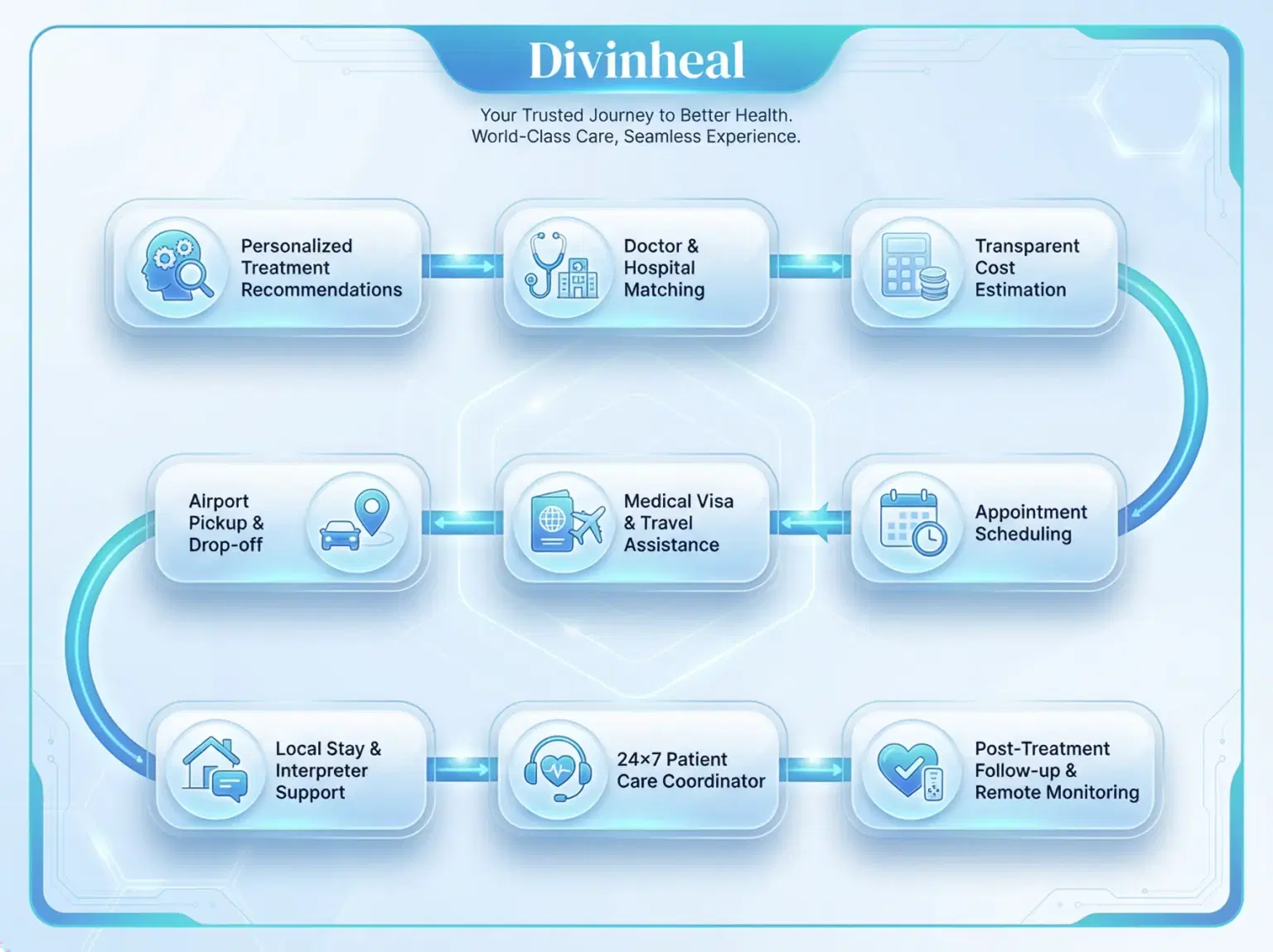
How Divinheal Supports Patients From the UAE, Nigeria, and the UK
Travelling to India for donor egg IVF is more than booking a clinic.
Visa rules, accommodation near the hospital, a 10–16 day stay, contact with
your home doctor, and knowing what to do if a cycle is cancelled — these are
not small concerns. Divinheal handles all of this. Your focus can then stay on
the medical journey.
Medical Visa and Pre-Arrival Planning.
International patients need an Indian medical visa, not a tourist visa.
The visa needs a letter from your Indian hospital confirming your treatment
dates and type. Divinheal sorts this with the clinic. The visa fee is
₹2,000–₹8,000 ($25–$100) depending on your nationality. Most UAE, Nigerian, and
UK nationals get medical visas within 5–10 working days. Your partner can apply
for a medical attendant visa.
Before you travel, Divinheal sets up a teleconsultation with the
fertility specialist. They also review your records and prepare a personal
pre-screening checklist. Your first in-person appointment in India is then
useful from day one — not just an introduction.
Country-Specific Support for UAE, Nigerian, and UK Patients.
For UAE patients: Arabic-speaking coordinators are at Apollo Chennai and
Fortis Noida. Halal food is available at both hospitals. All Divinheal partner
hospitals for fertility hold JCI or NABH certification.
For Nigerian patients: Divinheal takes care of all travel and stay
arrangements. This includes helping with flight routes (Lagos or Abuja to
Delhi, Chennai, or Mumbai), serviced apartments within 2 km of the hospital,
and a dedicated coordinator on WhatsApp throughout your stay. Visa support is
available from your first consultation to your departure.
For UK patients: All Divinheal partner fertility specialists have
international training. Some hold MRCOG (Member of the Royal College of
Obstetricians and Gynaecologists) or an equivalent. Medical records are in
English. A full discharge summary is sent to your GP or private doctor within
48 hours of finishing treatment.
Accommodation and Typical Stay Duration
A standard donor egg IVF cycle usually requires you to stay in India for
about 10–16 days. This includes round 2 days for initial check-ups, 3–5 days to
monitor and prepare the womb lining, 1 day for embryo transfer, and another 5–7
days of rest after the tranfer before you tavel back. Divinheal helps arranges
comfortable serviced apartments close to partner hospitals. You can choose from
budget Options range from budget (₹3,000–₹5,000/night) to premium
(₹8,000–₹15,000/night). You live in an apartment with a kitchen, not in a
hospital ward.
Pre-IVF Preparation for Older Patients: What Indian Clinics Recommend
Getting ready before the cycle clearly improves results — especially for
patients over 44. Indian fertility specialists usually start this in the
teleconsultation, before you book a flight.
Recommended Health Screenings Before Travel.
Standard pre-travel tests (usually done at home): full hormone panel
(FSH, LH, AMH, TSH, prolactin), complete blood count, clotting profile, HIV and
hepatitis B/C, rubella immunity, and a baseline ultrasound to check womb shape.
For patients over 45, an ECG and heart check is standard at Medanta Gurgaon and
Apollo Chennai.
Share test results with the Indian clinic before you arrive where
possible. Results should be within 3 months. This lets the fertility team start
your hormone plan before you get there. It can shorten your time in India by
2–3 days.
Lifestyle Adjustments That Improve Outcomes
Keeping a BMI between 19–30 has the best evidence for improving womb
readiness. Smoking reduces blood flow to the womb — stopping 3 months before
the cycle is advised. Moderate exercise (30 minutes, 4 times a week) supports
hormone balance. More than 4 units of alcohol per week has been linked to lower
success rates in many studies.
Common supplements: folic acid (400–800 mcg daily), Vitamin D (if low —
common in Nigerian patients and UAE indoor workers), CoQ10 (600 mg daily —
mainly for own-egg cycles but sometimes suggested for womb health). Always
check supplements with your fertility specialist before starting.
Choosing a Clinic and the Donor Matching Process
Donor matching looks at blood group, ethnicity, physical features
(height, eye colour, hair colour), education, and genetic screening results
(CFTR, karyotype, expanded carrier screening). At Apollo Hospitals Chennai and
Fortis Fertility Noida, patients get written donor profiles with all these
details. Matching happens before you travel. By the time you arrive in India,
your donor is already confirmed and in the screening process.
If a suitable donor isn't available right away, you may need to wait around 2–6 weeks at most partner clinics. Divinheal coordinators keep track of donor readiness across multiple hospitals. They can advise on which centre has the shortest wait for your profile.
Next Steps: How to Start Your Journey With Divinheal?
The teleconsultation usually takes around 30 minutes and is completely
free. You just need share your recent medical records, the clinic sends a
written review within 48 hours, and Divinheal sorts the clinic shortlist, donor
matching timeline, and visa paperwork from there.
Patients from Dubai, Lagos, London, and over 40 other cities have
completed donor egg IVF at partner clinics in Chennai, Delhi NCR, and Gurgaon.
The process works because every step — medical, logistical, and financial — is
planned before you travel.
Contact a Divinheal coordinator to request your free fertility
consultation and clinic shortlist. The maximum age for IVF with donor eggs may
be 50 in India — but the best time to start planning is now.
Related Links
International Patient Visiting India
- ivf in bengaluru for ethiopia
- ivf in pune for bangladesh
- ivf in india for bangladesh
- ivf in mumbai for bangladesh
- ivf in bengaluru for bangladesh
- ivf in pune for uae
- ivf in bengaluru for uae
- ivf in new delhi for uae
- ivf in hyderabad for uae
- ivf in chennai for bangladesh
- ivf in new delhi for iraq
- ivf in bengaluru for iraq
- ivf in mumbai for iraq
- ivf in chennai for iraq
- ivf in bengaluru for nigeria
- ivf in pune for nigeria
- ivf in hyderabad for nigeria
- ivf in india for nigeria
- ivf in india for ethiopia
- ivf in new delhi for ethiopia
Booking With DIVINHEAL
Get a free consultation to understand your treatment options
Related Links
International Patient Visiting India
- ivf in bengaluru for ethiopia
- ivf in pune for bangladesh
- ivf in india for bangladesh
- ivf in mumbai for bangladesh
- ivf in bengaluru for bangladesh
- ivf in pune for uae
- ivf in bengaluru for uae
- ivf in new delhi for uae
- ivf in hyderabad for uae
- ivf in chennai for bangladesh
- ivf in new delhi for iraq
- ivf in bengaluru for iraq
- ivf in mumbai for iraq
- ivf in chennai for iraq
- ivf in bengaluru for nigeria
- ivf in pune for nigeria
- ivf in hyderabad for nigeria
- ivf in india for nigeria
- ivf in india for ethiopia
- ivf in new delhi for ethiopia
Meet Our Doctors
Meet our team of highly qualified and experienced medical professionals dedicated to providing the best healthcare services.
DivinHeal's Journey

Latest Articles

Hospitals Offering this treatment
India offers premium medical procedures at affordable prices. Discover our most popular treatments, delivered by the country's finest doctors.
Frequently Asked Questions
Get answers to common questions about medical tourism, treatment procedures, and our comprehensive healthcare services.
Ready To Start Your Healing Journey?
Get Personalized Medical Treatment Options From India's Top Hospitals. Our Medical Experts Are Ready To Assist You Every Step Of The Way.