
Written by DivinHeal Editorial Contributor, Rahul Kumar, Embryologist | Medically Reviewed by Dr Indu Priya, Gynecologist(MD) Published on: 2025-11-09
How Many Injections Are Needed for IVF Treatment? Your 2026 Patient Guide
Most women need between 20 and 40 injections in a single IVF cycle - but the exact number depends entirely on your body, your diagnosis and the protocol your specialist chooses. If you're researching how many injections for IVF treatment you'll actually need, this guide gives you a straightforward, clinically grounded answer.
This guide covers the injection timeline stage by stage, what affects how many you'll need, the real safety profile and what IVF treatment costs in India compared to the UK, Australia and Nigeria.
Plan My Journey
Tell us your condition and budget — our AI matches the right destination, hospital and doctor and visa pathway
What Are IVF Injections - and Why Do You Need Them?
The Role of IVF Injections in Stimulating Your Ovaries
IVF injections are hormone-based medications that trigger your ovaries to produce multiple mature eggs in a single cycle. Normally, your body releases just one egg per month. The injections override that limit - giving your specialist more eggs to work with, which directly improves your chances of a successful embryo.
The medications work by mimicking the natural hormones FSH (follicle-stimulating hormone) and LH (luteinising hormone) that your body already produces. They're carefully dosed and monitored with blood tests and ultrasound scans - usually every 2–3 days during stimulation.
Can IVF Be Done Without Injections?
In most cases, no. Natural-cycle IVF exists - it retrieves the single egg your body naturally produces - but it has significantly lower success rates because you're working with just one egg instead of multiple. For the vast majority of patients, controlled ovarian stimulation with injections is the global standard of care and is recommended by ICMR (India's fertility regulator) guidelines.
Exception: Patients with polycystic ovary syndrome (PCOS) who are at high risk of ovarian hyperstimulation syndrome (OHSS) may follow a gentler, low-dose protocol with fewer injections. Your specialist will assess this based on your AMH levels and baseline ultrasound.
Are IVF Injections Safe? Side Effects and Risks Explained
Common Side Effects and How to Manage Them
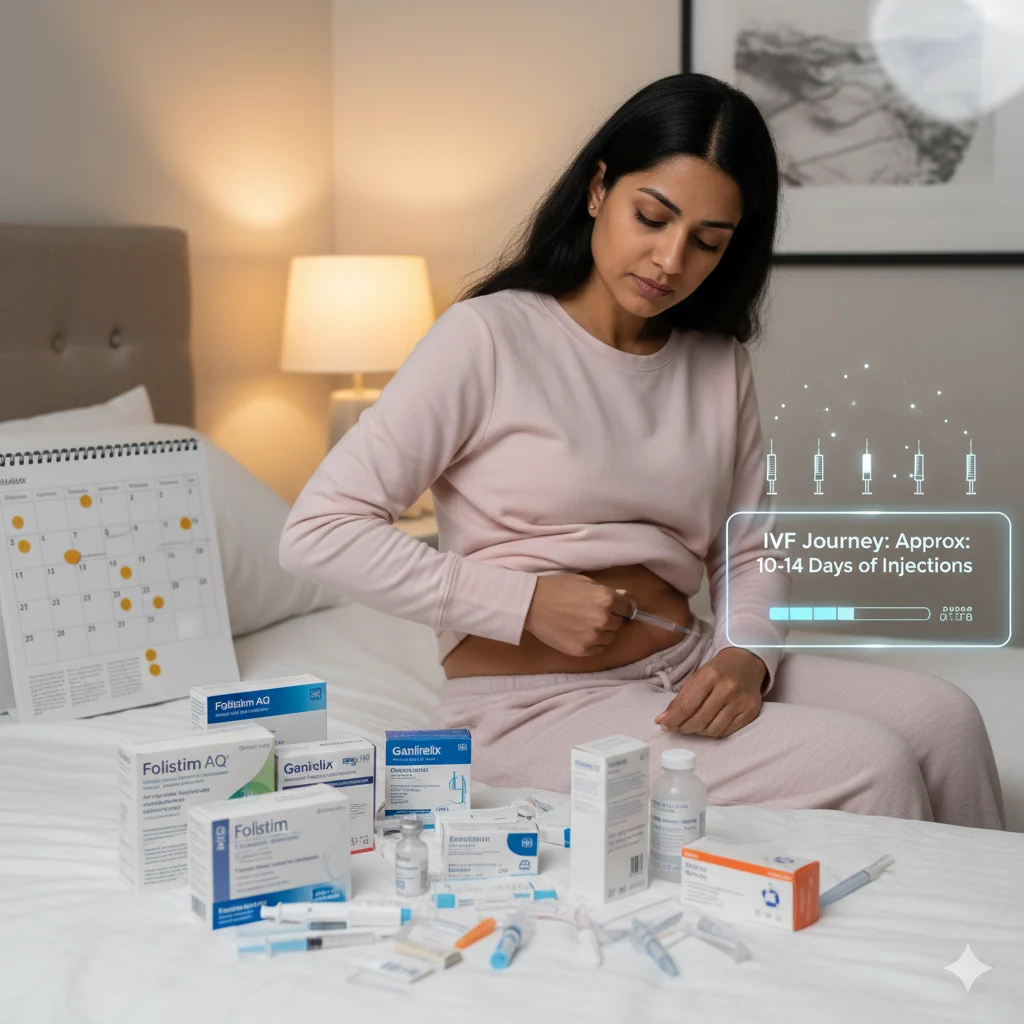
The most common side effects are mild and temporary: bloating, breast tenderness, mood fluctuations and mild abdominal discomfort. These are a normal physiological response to hormonal stimulation and typically resolve within days of stopping medication. Most patients manage them with rest, loose clothing and staying well-hydrated.
The needles used for subcutaneous (under-the-skin) injections are extremely fine - thinner than a typical blood test needle. Most patients describe the sensation as a small pinch. Intramuscular injections (like progesterone in oil, given later in the cycle) are slightly deeper but are manageable and can be administered by a partner after a brief tutorial provided by the clinic.
OHSS: The One Serious Risk to Know About
Ovarian hyperstimulation syndrome (OHSS) - a condition where the ovaries swell and fluid builds up in the abdomen - affects approximately 1–2% of IVF cycles in severe form, according to published data from the European Society of Human Reproduction and Embryology (ESHRE). Mild OHSS is more common (around 20–33%) but resolves on its own without intervention.
NABH-accredited clinics in India monitor for OHSS with regular ultrasounds and can adjust your medication dose or freeze all embryos for a later transfer (called a "freeze-all" strategy) to reduce risk.
Long-Term Safety: What the Research Shows
A large 2019 review published in Human Reproduction Update found no evidence that IVF medications increase the risk of ovarian cancer or other long-term conditions when used under medical supervision. The medications metabolise quickly - most are cleared from your body within 24–72 hours of the last dose.
Is the Egg Retrieval Procedure Painful?
No. Egg retrieval is performed under light sedation or general anaesthesia - you are asleep throughout the procedure. It takes 15–20 minutes. Afterwards, you may feel mild cramping similar to menstrual discomfort for a day or two, which is managed with standard pain relief prescribed by your clinic.
The IVF Injection Timeline: What Happens at Each Stage
A standard IVF cycle involves four phases of injections. Here is what each one does and how long it lasts.
Stage 1: Ovarian Stimulation Injections (8–14 days)
You will inject gonadotropins - medications such as Gonal-F (FSH), Menopur (FSH + LH) or Pergoveris - daily for 8 to 14 days. These stimulate multiple follicles (the fluid-filled sacs containing your eggs) to grow simultaneously. Your clinic monitors your response with ultrasound and blood tests every 2–3 days and adjusts the dose in real time.
Most patients learn to self-administer these injections at home after a brief training session. Leading Indian clinics including Nova IVF and Cloudnine offer video tutorials ahead of treatment.
Stage 2: Preventing Premature Ovulation (5–14 days, overlapping with Stage 1)
Once stimulation begins, a second injection is added: a GnRH antagonist (gonadotropin-releasing hormone antagonist) such as Cetrotide or Orgalutran. This prevents your body from releasing eggs before they're ready for retrieval. It typically starts around day 5 or 6 of stimulation and continues until the trigger shot.
Stage 3: The Trigger Shot (1 injection, precisely timed)
When your follicles reach the appropriate size (usually 18–20mm), your specialist gives the green light for the trigger shot. This is a single injection of hCG (human chorionic gonadotropin) or a GnRH agonist, administered at a precisely scheduled time - typically between 10pm and midnight. Egg retrieval takes place 34–36 hours later. The timing is clinically critical and non-negotiable.
Stage 4: Luteal Phase Support (up to 10–12 weeks if pregnancy is confirmed)
After embryo transfer, you will begin progesterone injections (or vaginal gel/pessaries, depending on your clinic's protocol). Progesterone thickens the uterine lining and supports implantation. If pregnancy is confirmed, this support typically continues until around 10–12 weeks, at which point the placenta takes over progesterone production naturally.
How Many Injections Per Day for IVF?
During the most intensive phase (stimulation + antagonist overlap), you will typically self-administer 2 injections per day. The trigger shot is a single injection. Luteal phase support is usually 1 daily injection, though some clinics use vaginal progesterone instead.
Phase | Duration | Daily Injections |
Ovarian stimulation | 8–14 days | 1–2 |
GnRH antagonist (overlap) | 5–14 days | 1 |
Trigger shot | Single event | 1 |
Luteal phase support | Up to 10–12 weeks (if pregnant) | 1 |
Source: Protocol based on ICMR guidelines and Nova IVF Fertility clinical data.
What Determines How Many Injections You'll Need?
The number of injections varies significantly from patient to patient. Your specialist will set your starting dose based on several key factors and adjust it throughout the stimulation phase based on your body's response.
Your Age and Ovarian Reserve (AMH Level)
AMH (anti-Müllerian hormone) is a blood test that estimates how many eggs your ovaries still have. Women with a lower AMH - typically those over 38 or younger women with diminished ovarian reserve - generally require higher stimulation doses and may need more days of injections to produce sufficient follicles. Women with a high AMH (often those with PCOS) require lower doses to avoid over-stimulation.
Your Fertility Diagnosis - PCOS, Endometriosis, Male Factor
Your underlying diagnosis shapes the entire protocol. Women with PCOS typically begin on a lower dose to reduce OHSS risk. Those with endometriosis may require a longer suppression phase before stimulation begins. If the primary diagnosis is male-factor infertility (low sperm count or motility), the female partner's injection protocol is often relatively standard since the ovaries are unaffected. Your specialist will review your full medical history before finalising a protocol.
How Your Body Responds to Medication
Your doctor monitors follicle growth throughout stimulation and adjusts doses accordingly. A patient whose follicles develop quickly may complete stimulation in 8 days; another may require 14. This variation is not a sign that something is wrong - it is the monitoring system working as intended. The clinical goal is quality eggs at the right maturity stage, not speed.
IVF Treatment Cost in India vs UK, Australia & Nigeria (2026)
What Does One IVF Cycle Cost in India?
A standard IVF procedure cycle in India typically costs between ₹1,50,000 and ₹2,50,000 (approximately $1,800–$3,000 / £1,400–£2,400 / A$2,700–A$4,500). Medications are usually billed separately and add ₹50,000–₹1,00,000 ($600–$1,200) depending on your protocol.
Total cost including medications: approximately ₹2,00,000–₹3,50,000 ($2,400–$4,200). Prices vary by city - Mumbai and Delhi are slightly higher than Chennai or Hyderabad - and by clinic tier.
Country-by-Country IVF Cost Comparison
Country | Average cost per cycle | Approx. in USD | India saving |
India | ₹1.5L–₹2.5L (procedure only) | $1,800–$3,000 | - |
UK | £5,000–£8,000 (excl. drugs) | $6,200–$10,100 | ~65–70% |
Australia | AUD 9,000–AUD 15,000 | $5,800–$9,800 | ~60–70% |
Nigeria | NGN 1,500,000–NGN 3,000,000 | $1,000–$2,000 | Variable |
Sources: Fertility Institute UK; Apollo Fertility India; Bridge Clinic Lagos. Data for guidance only - verify with your chosen clinic before travelling.
For Nigerian patients, India and Nigeria are similarly priced per cycle - but India's clinics offer more advanced technologies (genetic embryo testing, advanced embryology labs, higher cycle volumes) at a comparable price point.
What Does an Indian IVF Package Actually Include?
A standard package at a reputable Indian clinic typically covers: initial consultation, ovarian stimulation monitoring (blood tests and ultrasounds), egg retrieval, ICSI (intracytoplasmic sperm injection) if needed, embryo culture and a fresh embryo transfer. Many clinics include one frozen embryo transfer in the package as well.
What is usually NOT included: medications (billed separately), additional frozen embryo transfers, genetic testing (PGT-A), donor egg or sperm and accommodation.
Financing Your IVF Treatment in India
Understanding What's Included - and What Isn't
Reputable clinics like Cloudnine, Apollo Fertility and Nova IVF provide itemised quotes before you commit. Always request a quote that separates the procedure cost, medication estimate and any additional procedures (ICSI, PGT-A, frozen transfer).
Payment Methods for International Patients
Indian clinics accept international bank transfers, major credit cards (Visa, Mastercard) and in some cases digital wallets. Arrange funds before you travel - treatment often begins promptly on arrival and payment is typically required upfront for the first phase.
Multi-Cycle Packages - Are They Worth It?
If your specialist estimates you may need more than one cycle, multi-cycle packages typically bundle 2–3 cycles at a 20–30% discount compared to paying separately.
Program | Cost (INR) | Cost (USD) | Cycles included |
Single IVF cycle | ₹1,50,000–₹2,50,000 | $1,800–$3,000 | 1 |
Multi-cycle package | ₹3,50,000–₹5,00,000 | $4,200–$6,000 | 2–3 |
Sources: Apollo Fertility, Nova IVF Fertility, Cloudnine Hospital (indicative pricing, 2024–2025). Verify before booking.
Planning Your Medical Trip to India
Visa Requirements: The Medical (M) Visa Explained
Patients from the UK, Australia and Nigeria travelling for IVF require a Medical (M) Visa. You will need an invitation letter from your Indian clinic - this is arranged as part of the onboarding process. Apply 2–3 weeks before your intended travel date. The M-Visa typically grants a 60-day stay, extendable through the Foreigners Regional Registration Office (FRRO) if your treatment requires a longer stay. Patients already in India do not require a separate visa.
Accommodation and Getting Around
Most patients choose serviced apartments near their clinic rather than hotels - they offer kitchens, laundry and more practical space for a 3–4 week stay. For transport, Uber and Ola are reliable and inexpensive across all major Indian cities. Your clinic will typically arrange airport pickup.
Transport option | Typical daily cost | Best for |
Uber / Ola (ride-hailing) | ₹300–₹800 ($4–$10) | Short daily trips to clinic |
Pre-booked clinic/hotel taxi | ₹800–₹1,500 ($10–$18) | Airport transfers, first day |
Auto-rickshaw | ₹150–₹400 ($2–$5) | Short distances within city |
When Can You Fly Home? Post-Transfer Travel Guidelines
Most specialists advise waiting 3–5 days after embryo transfer before flying. Long-haul flights (to the UK, Australia or Nigeria) are generally cleared after this window - there is no clinical evidence that flying after transfer affects implantation rates. If you experienced OHSS symptoms, your doctor may advise a few additional days before travel is cleared.
Self-administration of progesterone injections continues after you fly home. Your clinic will provide a detailed protocol document to share with your GP or local fertility nurse.
Travelling with Medications
You will leave India with a supply of progesterone and any remaining medications. You will need a doctor's letter, original prescriptions and your treatment plan - all in English. Pack medications in an approved medical cooler bag (most airlines allow these as carry-on). UK and Australian customs both permit personal-use prescription medications with the correct documentation.
Why Patients Choose India for IVF
NABH-Accredited Hospitals and Experienced Specialists
India's leading fertility clinics - including Apollo Fertility, Nova IVF, Cloudnine and Indira IVF - are accredited by NABH (National Accreditation Board for Hospitals), India's equivalent of the UK's CQC or Australia's ACHS. Several also hold JCI certification (Joint Commission International), the global gold standard for hospital quality.
According to data published by the Indian Society of Assisted Reproduction (ISAR), leading NABH-accredited clinics in India report clinical pregnancy rates of 40–55% per cycle for women under 35. For women aged 35–40, the rate is approximately 30–40%. These figures are consistent with the best clinics in the UK and Australia.
How Divinheal Helps - From First Enquiry to Flying Home
Divinheal is a medical tourism coordinator, not a clinic. Its role is to connect patients with the right hospital for their specific situation, handle the paperwork and remain available when support is needed. Specifically, Divinheal assists with: clinic selection and appointment booking, M-Visa invitation letters, accommodation recommendations, airport transfers, interpreter support and remote follow-up coordination after you return home.
The value case for IVF in India: The same ICMR-regulated protocols, comparable clinical pregnancy rates, internationally trained embryologists - at a total cost (procedure + medications) of ₹2–3.5 lakh (£1,900–£3,400 / A$3,600–A$6,500). That is a saving of 60–70% versus comparable treatment in the UK or Australia.
Cost Calculator
I know my treatment — show me cost from 3 hospitals
Final Thoughts
If you've done the research to understand how many injections for IVF treatment you'll need - you're already doing this right. The number (20–40 per cycle, most administered at home over 10–14 days) matters less than having a specialist who adjusts your protocol based on your specific response.
India gives you access to that standard of care at a cost that makes multiple attempts financially realistic. A 60–70% saving versus the UK or Australia isn't a compromise - it's the same ICMR-regulated protocols, the same embryology standards and more attempts if you need them.
Written by DivinHeal Editorial Contributor, Rahul Kumar, Embryologist | Medically Reviewed by Dr Indu Priya, Gynecologist(MD) Published on: 2025-11-09
Plan My Journey
Tell us your condition and budget — our AI matches the right destination, hospital and doctor and visa pathway
Cost Calculator
I know my treatment — show me cost from 3 hospitals
Booking With DIVINHEAL
Get a free consultation to understand your treatment options
From Consultation to Recovery,
Step by Step
Expert Specialist Matching
Connecting you with the world's top-rated medical experts.
Accredited Hospital Network
Access to JCI & NABH certified healthcare facilities.
Complete Travel Coordination
Hassle-free visa, stay, and local transport assistance.
24/7 Personal Care
Dedicated patient advisors supporting you at every step.
Journey Guidance
Full guidance from start to end of the patient treatment journey.
Expert Specialist Matching
Connecting you with the world's top-rated medical experts.
Everything you
need to know today
Browse through these common inquiries to better understand our patient-focused medical platform.
Most patients need to be in India for 3–4 weeks for a fresh embryo transfer cycle. The rough timeline: Day 1–14 — stimulation injections (self-administered, so some patients do this from home and fly in for monitoring). Day 14–16 — egg retrieval. Day 3 or 5 post-retrieval — fresh embryo transfer. Day 7–10 post-transfer — fly home. If you do a frozen embryo transfer (FET) in a later cycle, you only need to be in India for 10–14 days.
Divinheal only works with hospitals that hold NABH accreditation, and where available, JCI certification. Specialists are verified against their registration with the Medical Council of India (MCI) and the Indian Society of Assisted Reproduction (ISAR). Divinheal’s team visits clinics in person and reviews ongoing patient outcome data. If a clinic’s standards change, Divinheal removes them from the partner network.
In India, a single IVF treatment cycle typically ranges from ₹1,50,000 to ₹3,50,000 ($1,807 to $4,217 USD). This represents significant affordability compared to many Western countries and often Nigeria, without compromising on quality or success rates. Patients traveling to India find excellent medical care at a fraction of the cost.
If you miss an IVF injection, contact your fertility clinic or doctor immediately for urgent advice. The impact of a missed dose can vary depending on the type of injection and when it was missed, so timely guidance is important. Never double a dose or try to catch up without professional medical instruction.
Most standard health insurance policies — in the UK, Australia, and Nigeria — do not cover IVF treatment, whether at home or abroad. Some specialist fertility insurance add-ons exist but are uncommon. However, because IVF in India is significantly cheaper, many patients find the total out-of-pocket cost is lower than their home-country deductible or co-pay would be anyway. Divinheal can provide detailed invoices and treatment summaries for any insurance claim you wish to make.
The five stages of a standard IVF cycle are: (1) ovarian stimulation with daily injections, (2) egg retrieval under sedation, (3) fertilisation in the embryology lab — using either standard IVF or ICSI, (4) embryo culture and selection over 3–5 days, and (5) embryo transfer to the uterus. Luteal phase support with progesterone follows transfer and continues until a pregnancy test and, if positive, the early weeks of pregnancy.
IVF success rates decline with age because egg quality and quantity both decrease over time. For women under 35 using their own eggs, leading Indian clinics report clinical pregnancy rates of 40–55% per cycle. For women aged 35–37, rates are approximately 38–45%. From 38–40, rates drop to 25–35%, and above 40, to 10–20% per cycle with own eggs. Women who use donor eggs (from a younger donor) can achieve success rates comparable to younger patients regardless of their own age.
NHS England currently recommends that clinical commissioning groups (ICBs) offer up to 3 full cycles of IVF to eligible women under 40 who have been trying to conceive for two or more years. In practice, many ICBs in England only fund 1 cycle due to local budget constraints — check your specific ICB. Scotland, Wales, and Northern Ireland have their own policies. Women 40–42 may be offered 1 cycle if specific criteria are met. This is why many UK patients explore India for their second or third attempt.
Ovarian stimulation injections include gonadotropins such as Gonal-F (FSH only), Menopur (FSH + LH), Pergoveris, and Rekovelle. To prevent premature ovulation, GnRH antagonists like Cetrotide or Orgalutran are used. The trigger shot is typically hCG (Ovitrelle/Pregnyl) or a GnRH agonist. Luteal phase support uses progesterone — either injections (Gestone), vaginal gel (Crinone), or pessaries (Utrogestan), depending on your clinic’s protocol.
FSH and LH-based stimulation medications have half-lives of roughly 24–36 hours, so they clear from your system within 2–3 days of stopping. hCG (the trigger shot) has a longer half-life of 24–36 hours and can remain detectable for up to 10 days — which is why home pregnancy tests taken within 10 days of the trigger shot can give false positives. Progesterone is metabolised rapidly and clears within 24–48 hours of the last dose.
In IUI (intrauterine insemination), washed sperm is placed directly into the uterus around the time of ovulation. The egg and sperm still meet naturally inside the body. In IVF, eggs are retrieved from the ovaries and fertilised with sperm in a laboratory, and the resulting embryo is placed into the uterus 3–5 days later. IUI is less invasive and considerably cheaper (typically £800–£1,200 per cycle in the UK vs £5,000+ for IVF), but it has lower success rates and is recommended only for specific diagnoses such as mild male-factor infertility or unexplained infertility after 12+ months of trying.
Your Indian clinic will provide a full discharge summary and treatment record in English. Share this with your GP or local fertility clinic immediately upon return. For OHSS symptoms that develop after flying, go to your local emergency department — the condition is well understood and manageable by any hospital with access to your records. Divinheal’s coordinators remain available by WhatsApp or email after you return home and can liaise with your Indian clinic on your behalf if needed.
Yes, and it's strongly encouraged. Your partner's presence helps during injections, monitoring appointments, and the emotional intensity of the transfer. Most clinics in India welcome partners at all consultations. If your partner can't travel for the full duration, they can provide a semen sample before leaving (which is frozen for use) or fly in specifically for the retrieval day. Divinheal can arrange accommodation for two and guide both of you through the process.
Still have more questions?
Book a call with our friendly team to learn how DivineHeal simplifies your healthcare journey.








