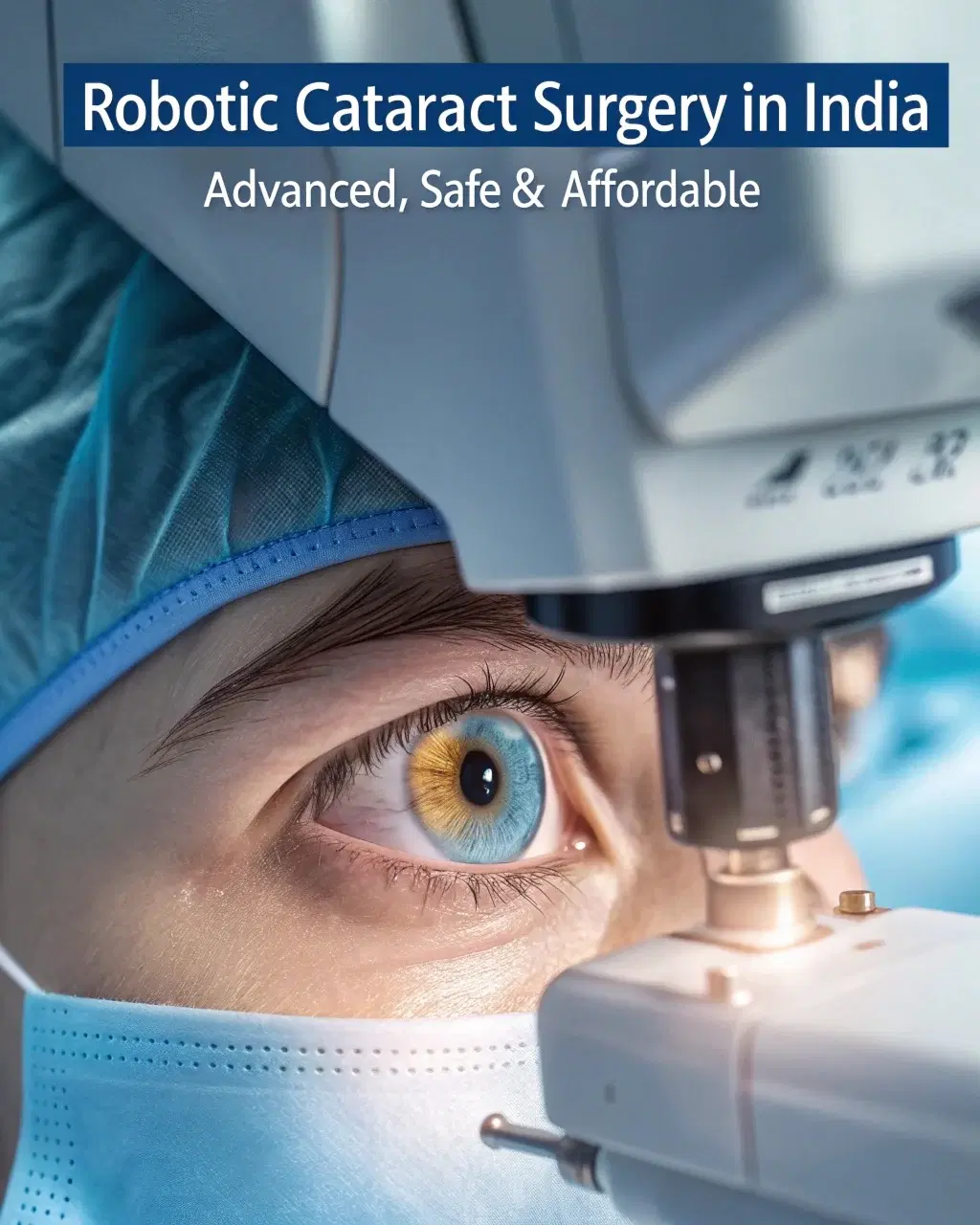
Types of Cataract Surgery in India 2026: Phacoemulsification, FLACS & Costs for Australian & UK Patients
Phacoemulsification — called phaco — costs ₹15,000–₹1,20,000 (approx. AUD 275–2,200 / £145–£1,165)per eye at NABH/JCI-accredited partner hospitals in India. That is 60–80% less than cataract surgery in Australia (AUD 3,000–5,000 per eye) or the UK (£2,000–£3,500). India’s eye hospitals use the same surgery methods and the same IOL brands. Their surgeons train to the same global standards as Australian and UK private hospitals.
This guide explains all three main cataract surgery types in India. It covers IOL options with AUD and GBP prices, full cost breakdowns, and travel tips for Australian and UK patients.
Understanding Cataracts and When Surgery Is Needed
What Are Cataracts and How Do They Affect Vision?
A cataract forms when the eye’s natural lens — normally clear — slowly turns cloudy. This blocks light from reaching the back of the eye. You may notice blurry or hazy vision; poor night vision and glare from headlights; duller or more yellowed colours; trouble reading with up-to-date glasses; and halos around lights. Cataracts grow slowly, usually over years. They mainly come with age, but UV exposure, diabetes, steroid use, or eye injury can also cause them.
When Is Cataract Surgery Recommended?
Surgery is needed when cataracts badly affect daily life — reading, driving, working, or knowing faces — and glasses no longer help. There is no fixed cutoff. The decision depends on how much your vision limits you and whether glasses or better lighting are still enough.
Cataracts cannot be fixed with drops, pills, or lifestyle changes. Surgery to replace the cloudy lens is the only treatment that works. The operation is simple, done as a day case, and has one of the highest satisfaction rates of any planned procedure in medicine.
The General Cataract Surgery Process
In all modern cataract operations, the cloudy natural lens is taken out and replaced with a clear artificial lens called an IOL — short for intraocular lens. The IOL stays in the eye for life. The operation is almost always a day case — you go home within 2–3 hours. Most people have one eye done at a time. The second eye is treated a few weeks later. For patients travelling to India, Divinheal books both eyes in one trip — usually 2–4 days apart. There is recovery time between them, and a check-up before you fly home.
Types of Cataract Surgery: Phacoemulsification, FLACS, MICS, and MSICS
The table below compares all four major cataract surgery types available at NABH/JCI-accredited partner hospitals in India, with AUD and GBP cost figures.
Type | Method | Recovery | Cost (India, per eye) | Best For |
Phacoemulsification (Phaco) | Ultrasound probe breaks and suctions lens | Fast — vision improves in 24–48 hrs | ₹15,000–₹1,20,000 (approx. AUD 275–2,200 / £145–£1,165) | Most cataract types; reliable and widely available |
MICS (Micro-Incision Cataract Surgery) | Advanced Phaco variant; <1.8 mm incision | Very fast — often 1 day | ₹30,000–₹1,50,000 (approx. $360–$1,800 / AUD 540–2,700 / £285–£1,430) | Patients wanting minimal incision and fastest healing |
FLACS (Femtosecond Laser-Assisted) | Laser performs incisions and lens fragmentation before Phaco | Very fast; less inflammation | ₹70,000–₹2,00,000 | Complex cases, premium IOLs, astigmatism correction |
MSICS (Manual Small Incision) | Manual extraction through self-sealing scleral incision | Moderate — 1–2 weeks | ₹10,000–₹45,000 | Advanced/mature cataracts; cost-accessible option |
Sources: Apollo Hospitals Chennai, Fortis Noida, Medanta Gurgaon, MAX Hospitals, Artemis Gurgaon, Paras Hospitals (India partner hospital ophthalmology department direct pricing). Currency conversions at Q1 2026 rates (1 AUD ≈ 54.5 INR; 1 GBP ≈ 105 INR). All figures are approximate private-pay ranges.
Phacoemulsification (Phaco): The Gold Standard
Phacoemulsification — called phaco — is the most widely used cataract surgery in the world. It is the standard approach at all NABH/JCI-accredited partner hospitals. The surgeon makes a tiny 2–3 mm cut in the cornea — the clear front of the eye. An ultrasound probe then breaks the cloudy lens into tiny pieces using high-speed sound waves. Those pieces are suctioned out. The surgeon folds an IOL and slides it through the same small cut. Inside the eye, the IOL opens out and sits in place. The cut seals on its own — no stitches needed.
Phaco works well for cataracts of all kinds. Skilled surgeons complete it in 15–25 minutes. Most patients notice better vision within 24–48 hours. Phaco with a standard monofocal IOL costs ₹15,000–₹1,20,000 (approx. AUD 275–2,200 / £145–£1,165)per eye at partner hospitals.
MICS (Micro-Incision Cataract Surgery): Advanced Phaco Variant
MICS is a refined version of standard phaco. It uses an even smaller cut — less than 1.8 mm, compared to 2–3 mm in standard phaco. The smaller cut causes less astigmatism (blurring from an uneven cornea shape). It may also cut swelling and often speeds up recovery. MICS works best for patients who already have astigmatism. It is also ideal for those choosing premium multifocal IOLs, where a cleaner wound gives the best visual results.
MICS (Micro-Incision Cataract Surgery) is available at Medanta Gurgaon, Apollo Hospitals Chennai, and MAX Hospitals among Divinheal partner hospitals. The cost typically ranges from ₹45,000–₹1,50,000 (approx. $540–$1,800 / AUD 810–2,700 / £430–£1,430) per eye.
FLACS (Femtosecond Laser-Assisted Cataract Surgery): Precision Technology
FLACS uses a femtosecond laser — the same type used in LASIK surgery — to handle key steps before the surgeon starts the phaco stage. The laser makes the corneal cuts with pinpoint accuracy. It also creates the capsulotomy — the round opening in the lens capsule. This is the most precision-sensitive step for getting the IOL centred correctly. The laser also pre-softens the lens, so less ultrasound energy is needed to break it apart.
FLACS is most useful for patients choosing premium multifocal or EDOF IOLs, where a precise capsulotomy directly improves vision quality. It also helps patients with significant astigmatism corrected with a toric IOL and patients with hard, dense cataracts.
FLACS (Femtosecond Laser-Assisted Cataract Surgery) typically costs ₹70,000–₹1,50,000 (approx. $840–$1,800 / AUD 1,260–2,700 / £665–£1,430) per eye. This is approximately 40–60% higher than the cost of standard phacoemulsification
MSICS (Manual Small Incision Cataract Surgery): Cost-Effective for Advanced Cataracts
MSICS uses a self-sealing cut in the white of the eye (scleral tunnel). The cut is larger than in phaco, but no ultrasound probe is needed. The surgeon removes the cataract by hand — in one piece or in sections. Because it does not need phaco equipment, MSICS costs much less. It suits high-volume settings and patients with very hard cataracts, where the firm lens is hard to break with ultrasound.
Most patients from Australia and the UK do not choose MSICS for planned cataract surgery. But it is a good option for patients with advanced cataracts on a tight budget. Recovery takes a little longer — vision usually improves over 1–2 weeks. Cost: ₹15,000–₹40,000 ($180–$480; AUD 278–740; £143–£381) per eye.
What Are the 5 Types of Cataract Surgery?
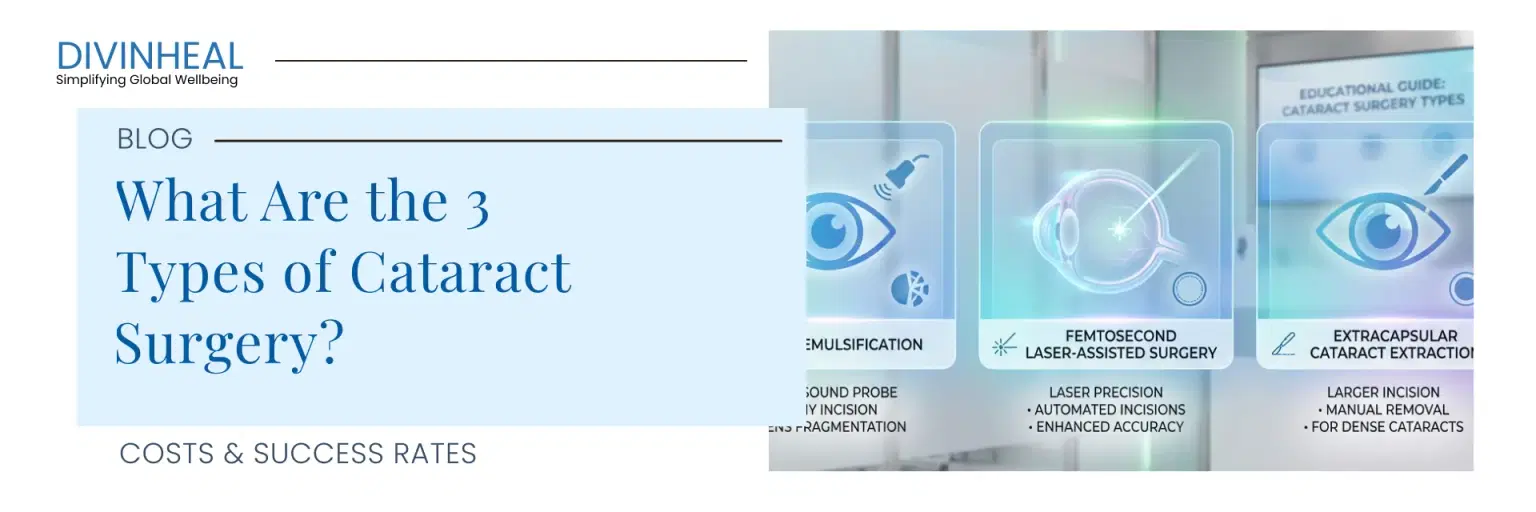
The four main types at Indian partner hospitals are Phaco, MICS, FLACS, and MSICS. A fifth type — ECCE (Extracapsular Cataract Extraction) — appears in older texts. ECCE uses a larger cut and is done by hand. It pre-dates phaco and is now largely obsolete. It is not offered at NABH/JCI-accredited partner hospitals. Phaco and MICS have replaced it for nearly all cases. In today’s practice, the three most relevant types for planned cataract surgery are Phaco/MICS, FLACS, and MSICS for advanced cases.
Which Type of Cataract Surgery Is Best?
The right type depends on your specific cataract, eye anatomy, IOL choice, and budget:
• For most patients with a moderate cataract and a standard monofocal IOL: phacoemulsification (Phaco) is the best choice — well-evidenced, fast recovery, and highly cost-effective
• For patients choosing premium multifocal, EDOF, or toric IOLs: FLACS offers the most precise capsulotomy and IOL centration, maximising premium IOL optical performance
• For patients with advanced cataracts on a tighter budget: MSICS achieves excellent outcomes and is appropriate where phaco equipment is unavailable or where the dense lens nucleus warrants manual removal
• MICS is a refinement of phaco, not a fundamentally different choice — it offers marginal additional benefits (smaller incision, less astigmatism induction) for patients who want the most refined phaco technique
• Your ophthalmologist determines the correct method for you following analysis of your slit-lamp exam results, biometry and history, such as corneal issues, glaucoma or small pupils. Divinheal makes a pre-travel evaluation appointment based on your previous eye test records prior to travel arrangements.
Intraocular Lenses (IOLs): The Most Important Decision After Surgery Type
Your IOL choice decides how well you see after surgery — whether you will need glasses for reading, driving, or both. The IOL is a permanent implant. Choose carefully with your surgeon.
IOL Type | India Cost (add-on, per eye) | Best For | Post-Op Glasses Expectation |
Monofocal (standard) | Included in base package | One fixed distance (distance or near) | Likely need reading glasses (if set for distance) or driving glasses (if near) |
Multifocal | ₹35,000–₹1,25,000 ( $415–$1,480 / AUD 635–2,260 / £330–£1,180) | Spectacle independence at near and distance | Most patients achieve spectacle independence; some glare/halos in low light |
EDOF (Extended Depth of Focus) | ₹30,000–₹1,50,000 ( $360–$1,800 / AUD 540–2,700 / £285–£1,430) | Natural range of vision with fewer halos than multifocal | May need glasses for very fine near work; fewer halos and glare than multifocal |
Toric (astigmatism correction) | ₹30,000–₹1,30,000 ($360–$1,560 / AUD 540–2,350 / £285–£1,240) | Patients with corneal astigmatism needing distance correction | Corrects astigmatism; reading glasses still needed unless combined with multifocal |
All IOL types listed are available at NABH/JCI-accredited Divinheal partner hospitals. AED costs are available — see Divinheal’s UAE cataract surgery guide for AED-specific IOL pricing. IOL selection should be made after detailed biometry and discussion of lifestyle priorities with your ophthalmologist.
Which Is Better — Monofocal or Multifocal?
Neither IOL is always the right answer — the best choice depends on your lifestyle and what matters most to you. Monofocal IOLs give clear, reliable vision at one set distance. They carry very little risk of glare or halos. They are the lowest-cost option and work very well for people happy to wear reading glasses. Multifocal IOLs help to eliminate the dependency on spectacles for near, mid-range, and distant viewing purposes. Most people prefer this option. However, there is one drawback, and that is a few may experience glare and/or halo effects during night time for the first 3–6 months after surgery.
Cataract Surgery Cost in India vs Australia vs UK (2026)
Service Component | India (Private/Partner) | Australia (Self-Funded) | UK (Private) |
Standard Phaco + Monofocal IOL | ₹25,000–₹70,000 | AUD 2,800–4,500 | £2,000–£3,500 |
FLACS (Laser) + Monofocal IOL | ₹70,000–₹1,50,000 | AUD 4,500–6,500 | £3,000–£5,000 |
Phaco/FLACS + Premium Multifocal | ₹65,000–₹2,00,000 | AUD 5,500–10,000 | £3,500–£6,500 |
Sources: Apollo Hospitals Chennai, Fortis Noida, Medanta Gurgaon, MAX Hospitals, Artemis Gurgaon, Paras Hospitals (India partner hospital pricing). Australia: private ophthalmology published tariffs 2025. UK: Spire Healthcare, Nuffield Health, Optical Express published tariffs 2024–25. Currency conversions at Q1 2026 rates.
Cataract Surgery Cost in India: Full Cost by City
India’s two main partner hospital cities for global patients are Delhi NCR (Gurgaon, Noida) and Chennai. Both offer the same technology and similar prices:
• Delhi NCR (Gurgaon / Noida): Standard Phaco ₹35,000–₹90,000 per eye (approx. AUD 510–1,310; £335–£860); FLACS ₹70,000–₹1,50,000 (approx. AUD 1,020–2,185; £670–£1,435.
• Chennai: Standard Phaco ₹30,000–₹85,000 per eye (approx. AUD 435–1,240; £285–£815); FLACS ₹65,000–₹1,40,000 (approx. AUD 945–2,040; £620–£1,340.
• Mumbai (reference — not a partner city): ₹40,000–₹1,05,000 per eye for standard phaco; ₹80,000–₹1,75,000 for FLACS
Note: Bangalore and Hyderabad have excellent eye hospitals but are not currently in the Divinheal partner network. Full coordination services (visa letters, accommodation, patient management) are available only for Delhi NCR and Chennai partner hospitals.
Why India Offers Substantial Savings Without Compromising Standards
India’s cost advantage for Australian and UK patients comes from lower hospital running costs and high procedure volumes — not lower technology or quality. The same femtosecond laser systems (LenSx, Catalys, VICTUS), the same premium IOL brands (Alcon, Johnson & Johnson Vision, Zeiss, Carl Zeiss Meditec), and surgeons trained to global standards are all available at partner hospitals — at 60–80% lower cost than Australian or UK private clinics.
For Australian patients: Medicare covers standard phaco at public hospitals, but waiting times for planned cataract surgery run 6–18 months in most states. Private cataract surgery in Australia costs AUD 3,000–5,000 per eye for standard phaco — not FLACS, not a premium IOL. Even after adding return flights from Sydney or Melbourne (AUD 800–1,400) and 10–14 days of accommodation (AUD 700–1,400), India’s total trip cost stays well below the Australian private cost for FLACS or premium IOL surgery.
For UK patients: NHS cataract surgery is free for eligible patients, but waiting times reach 12–18 months in many trusts. The NHS does not offer premium multifocal or EDOF IOLs. Private UK cataract surgery costs £2,000–£3,500 per eye for standard phaco. India’s total trip cost — including flights and hotels — is typically 50–70% less than UK private pricing for the same or better procedures.
Divinheal’s Partner Hospitals for Cataract Surgery in India
Divinheal’s partner hospitals for cataract surgery are NABH/JCI-accredited institutions in Delhi NCR and Chennai with dedicated, high-volume ophthalmology departments offering all four major cataract surgery types and the full range of premium IOLs.
Hospital | City | Accreditation | Ophthalmology & Cataract Capabilities |
Apollo Hospitals Chennai | Chennai | JCI, NABH | Phaco, MICS, FLACS; full IOL range (monofocal, multifocal, EDOF, toric); international patient centre; English and Arabic support |
Fortis Hospital Noida | Delhi NCR | NABH | Cataract surgery (Phaco, FLACS); premium IOL implantation; ophthalmology and glaucoma management; high-volume eye department |
Medanta Gurgaon | Gurgaon (Delhi NCR) | JCI, NABH | Advanced ophthalmology: Phaco, MICS, FLACS; premium IOL selection including EDOF; dedicated eye care centre; international patient wing |
MAX Hospitals | Delhi NCR | NABH | Cataract surgery and FLACS; full premium IOL range; glaucoma and retinal services; post-operative follow-up for international patients |
Artemis Gurgaon | Gurgaon (Delhi NCR) | JCI, NABH | Cataract surgery; FLACS; premium IOL implantation; laser vision correction; international patient coordination |
Paras Hospitals | Gurgaon (Delhi NCR) | NABH | Ophthalmology: standard Phaco, FLACS, IOL implantation; cost-accessible NABH-accredited care for international patients |
Named ophthalmologists and their specific annual cataract procedure volumes are confirmed by the Divinheal medical team before patient matching. FLACS availability confirmed at Medanta Gurgaon, Apollo Hospitals Chennai, MAX Hospitals, and Artemis Gurgaon. Contact Divinheal for current specialist availability and femtosecond laser platform confirmation at your preferred hospital.
Is Cataract Surgery Safe in India? Success Rates and Risks
Is Cataract Surgery 100% Safe?
No surgery carries zero risk, but cataract surgery has one of the best safety records of any planned procedure in medicine. Per ESCRS (European Society of Cataract and Refractive Surgeons) audit data — the largest published cataract outcomes database — serious complications occur in fewer than 1% of procedures by experienced surgeons at accredited hospitals.
The common temporary adverse reactions can be a mild gritty sensation, mild photophobia, and blurring until adaptation occurs. They last for days to weeks. The rare but serious complications that could arise are: rupture of posterior capsule, which occurs intraoperatively and requires additional measures; retinal detachment, with 0.1-0.2% lifetime probability following cataract surgery; endophthalmitis, which is a severe ocular infection, with a risk rate of 0.03-0.05% per eye; and cystoid macular oedema, due to retinal swelling that leads to blurred vision, which will resolve with topical steroids. Preoperative evaluation, qualified surgeons, and sterile techniques at NABH/JCI-accredited partner hospitals minimize these risks.
Success Rates: What to Expect
Over 95% of cataract surgery patients see a major improvement in vision quality, per ESCRS audit data. For most this means: reading without pre-op glasses with a multifocal IOL; driving without distance glasses with a distance-set monofocal; and a clear gain in colour and contrast. Most patients say cataract surgery is one of the best procedures they have ever had.
Planning Your Cataract Surgery Trip to India: Logistics for Australian & UK Patients
Visa and Travel
The citizens of Australia will need to acquire an Indian Medical e-Visa from indianvisaonline.gov.in (time taken: 5-10 working days; application should be made two weeks prior to travel). Citizens of the UK will need to apply for their visa through VFS Global in London, Manchester, Birmingham, and Edinburgh (time taken: 10-15 working days; application should be made three weeks prior to travel).
Typical in-India stay for bilateral cataract surgery: 8–12 days. Day 1–2: pre-op biometry, IOL review, and medical clearance. Day 3: first eye surgery (day case, home same day or next morning). Day 5–7: second eye surgery. Days 7–10: follow-up check including vision test and IOL confirmation before you fly home. Both eyes can be treated in one trip — Divinheal plans the gap between surgeries and the follow-up schedule before you leave India.
Accommodation and Local Support
Divinheal arranges accommodation near the partner hospital (1–2 km, serviced apartments at ₹3,000–₹7,000 per night — AUD 55–130; £29–£67). Airport transfers on arrival and departure are arranged. A WhatsApp patient coordinator is on hand throughout your stay. All accommodation is at ground floor or lift level.
Post-Surgery Recovery: What to Expect
Immediate Post-Operative Period
Cataract surgery is done under topical anaesthesia (eye drops) or local anaesthesia — general anaesthesia is rarely needed, so recovery is quick. The operation takes 15–30 minutes per eye. You go home within 2–3 hours. A protective eye shield is worn on the first night. Antibiotic and anti-inflammatory drops start on surgery day and continue for 4–6 weeks.
Most patients notice a clear improvement in vision within 24–48 hours. Mild blurring, watering, and light sensitivity are normal for the first few days. Final stable vision settles over 4–8 weeks.
Can I Wash My Hair After Cataract Surgery?
Most eye surgeons advise keeping water away from the eye for the first 1–2 weeks after cataract surgery. Hair washing is generally fine from day 3–5. Tilt your head back — not forward — and keep water away from your face and eye. Use a facecloth to clean around the eye, not in it. This is the safest approach in the first week. Showering is fine right away as long as water does not enter the eye. Swimming should be avoided for 2–4 weeks. Your surgeon gives you written guidance at discharge.
Can I Read and Watch TV After Cataract Surgery?
Yes — for most patients, reading and watching TV are fine within 24–48 hours. Screen use and reading do not harm the healing eye. You may notice some blur or trouble focusing at first, mainly if only one eye has been operated on so far. Mild eyestrain during extended reading or screen time is normal in the first week — take regular breaks. Avoid hard exercise, heavy lifting, and bending at the waist for the first week.
When Can I Drive After Cataract Surgery?
Driving after cataract surgery depends on your vision and your country’s legal driving standard. Most surgeons advise no driving until the first post-op check — usually day 1–2 — confirms your vision meets the legal threshold. With surgery on both eyes, most patients wait until both are done and stable. That is usually within 1–2 weeks of the second surgery.
Can Cataracts Return After Surgery?
No — the natural cataract lens is permanently removed and replaced with an artificial IOL. Cataracts cannot regrow. However, about 20–30% of patients develop posterior capsule opacification (PCO) — sometimes called a ‘secondary cataract’ — months or years after surgery. PCO happens when the membrane behind the IOL turns cloudy. It is treated with YAG laser capsulotomy — a 5-minute painless day-case procedure (no cut) that restores clarity. YAG capsulotomy can be done by any eye surgeon near your home — you do not need to return to India for this.
How Divinheal Supports Australian & UK Cataract Patients
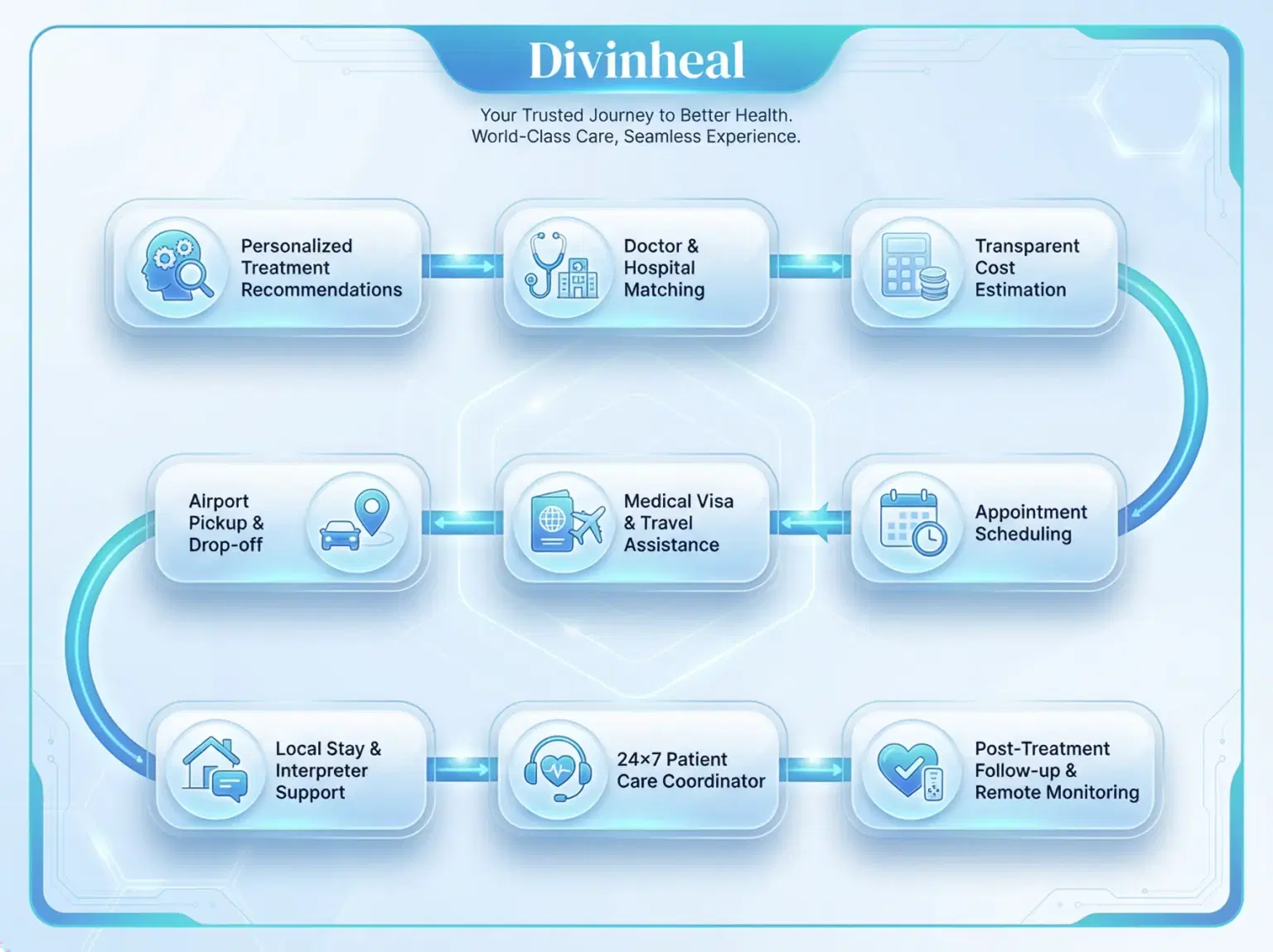
• Pre-Travel Specialist Examination — send your glasses prescription and eye reports, an ophthalmologist from the partner hospital will recommend IOL to you along with the price in AUD/GBP.
• Surgery type and IOL matching — based on your cataract density, eye anatomy, lifestyle, and budget
• Appointment booking within 5–10 days of enquiry
• Indian Medical Visa invitation letter for Australian and UK nationals
• Bilateral surgery planning — scheduling both eyes within a single trip with appropriate interval and post-operative review before return travel
• Accommodation near the hospital (1–2 km) and airport transfers
• A WhatsApp-accessible patient coordinator throughout the India stay
• Post-return telemedicine follow-up with the treating ophthalmologist
• Written discharge summary and IOL specification for your home-country optometrist or ophthalmologist
Divinheal does not charge a placement fee. Partner hospital rates are direct patient pricing. Written cost estimates in AUD or GBP are provided before any commitment to travel. For patients who want to compare with the robotic/FLACS-focused guide for UAE patients, see Divinheal’s companion guide on laser cataract surgery costs.
Margaret is a 71 year woman from Melbourne. She had surgery to remove cataracts from both of her eyes. Margaret wanted to get special lenses called IOLs so she would not have to wear glasses anymore. The cost of this surgery in Australia was 14,000 Australian dollars.Margaret sent her eye measurement information to a doctor at Medanta Gurgaon using a system called Divinheal. The surgeon at Medanta Gurgaon said that multifocal IOLs would be a choice for Margaret.She had surgery on both eyes. The surgeries were five days apart. The total cost for Margaret to have the surgery on both eyes stay in Gurgaon for 12 days. Fly from Melbourne, to Gurgaon and back was around 7,800 Australian dollars.
Final Thoughts
Cataract surgery at NABH/JCI-accredited partner hospitals in India — Apollo Hospitals Chennai, Fortis Noida, Medanta Gurgaon, MAX Hospitals, Artemis Gurgaon, and Paras Hospitals — costs ₹15,000–₹1,20,000 (approx. AUD 275–2,200 / £145–£1,165)per eye for standard phacoemulsification, and ₹60,000–₹1,20,000 ($720–$1,440; AUD 1,110–2,220; £571–£1,143) for FLACS. That is 60–80% less than private cataract surgery in Australia or the UK. You get the same techniques, the same premium IOL brands, and surgeons trained to global standards at JCI/NABH-verified hospitals.
For Australian patients facing 6–18 month public hospital waiting lists — and UK patients facing similar NHS waits or NHS premium IOL exclusions — India offers both eyes treated in a single 10–12 day trip, with fast appointment availability. Contact Divinheal for a free consultation — including a pre-travel IOL recommendation and cost estimate in AUD or GBP from a named surgeon before any travel commitment.
Disclaimer: All cost figures are approximate 2025–2026 estimates at NABH/JCI-accredited partner hospitals. Currency conversions at Q1 2026 rates (1 AUD ≈ 54.5 INR; 1 GBP ≈ 105 INR; 1 USD ≈ 83.5 INR). Individual costs depend on procedure type, IOL selection, hospital tier, and bilateral vs unilateral surgery. Success rates cited from ESCRS EUREQUO published audit data; individual outcomes vary. Patient story is an illustrative composite; name changed for privacy.
Related Links
Booking With DIVINHEAL
Get a free consultation to understand your treatment options
Related Links
DivinHeal's Journey
Latest Articles
Frequently Asked Questions
Get answers to common questions about medical tourism, treatment procedures, and our comprehensive healthcare services.
Ready To Start Your Healing Journey?
Get Personalized Medical Treatment Options From India's Top Hospitals. Our Medical Experts Are Ready To Assist You Every Step Of The Way.