
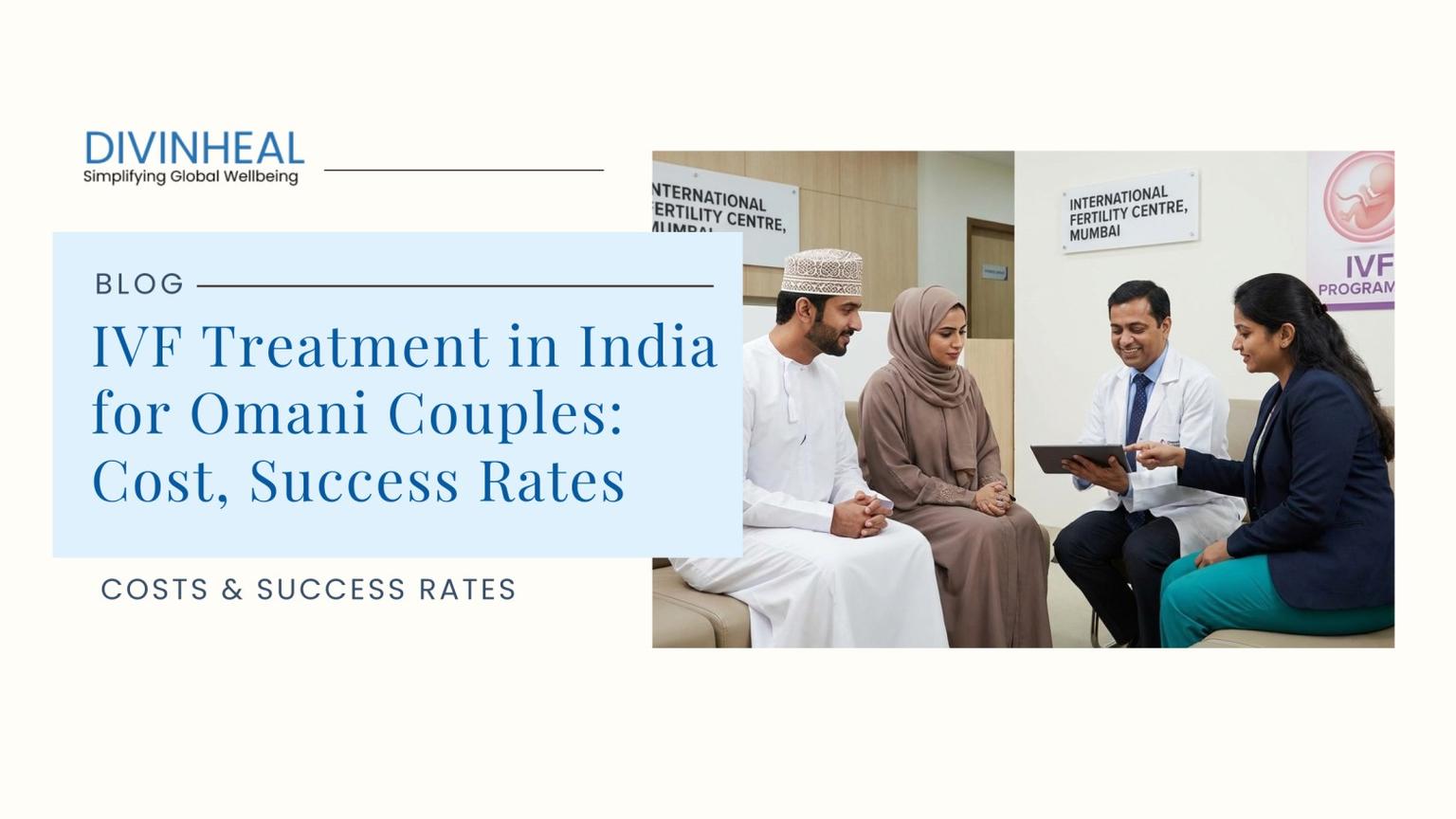
IVF Treatment in India for Omani Couples: Cost & Process

IVF Treatment in India for Omani Couples: Cost & Process

Written by DivinHeal Editorial Contributor, Rahul Kumar, Embryologist | Medically Reviewed by Dr Indu Priya, Gynecologist(MD) Published on: 2025-10-16
IVF Treatment in India for Omani Couples: What to Expect
IVF in India costs ₹1,80,000–₹3,50,000 ($2,150–$4,200;
OMR 825–1,615; AED 7,900–15,400). That is 50–70% less than private care in
Oman, the UAE, or Australia. Top Indian fertility centres get live birth rates
of 40–50% for women under 35. That matches leading Western clinics.
This guide covers what IVF involves and the 5 stages step
by step. You’ll find success rates by age group. There’s also a full cost
comparison in OMR and AED, the best hospitals in India, and a travel guide for
patients from Oman,the UAE, and Australia.
Plan My Journey
Tell us your condition and budget — our AI matches the right destination, hospital and doctor and visa pathway
What Is IVF Treatment and
Who Is It Recommended For?
How IVF Works: The Core Process
IVF (In Vitro
Fertilisation) is a fertility treatment. Doctors collect eggs from a woman’s
ovaries. They fertilize the eggs with sperm in a lab. Then they place the
embryo into the uterus. IVF is the most effective assisted fertility treatment
available. It has led to over 8 million births worldwide since 1978.
IVF works around several
common problems that stop natural conception. Blocked fallopian tubes, low
sperm movement, and poor egg-sperm interaction are all examples. IVF is the
standard treatment when simpler options — like IUI or ovulation induction —
have not worked.
When Is IVF Recommended? Common
Indications
Fertility specialists typically
recommend IVF when:
- Fallopian
tubes are blocked or absent — eggs cannot physically meet sperm without lab
help
- Male
factor infertility: ICSI (intracytoplasmic sperm injection) is performed in
conjunction with IVF for low sperm count, poor mobility, or high DNA
fragmentation.
- Endometriosis — uterine tissue growing outside
the uterus harms egg quality and tube function
- PCOS — polycystic ovary syndrome causes
irregular ovulation; IVF with controlled stimulation works well
- Unexplained infertility — no cause found after
full investigation; IVF gives a direct path to fertilisation
- Recurrent miscarriage — PGT-A genetic embryo
screening cuts the risk of abnormal transfers
- Advanced maternal age — egg quality drops with
age, making natural timed conception unreliable.
What Are the 5 Stages of IVF
Treatment?
A
full IVF cycle takes 4–6 weeks from stimulation to pregnancy test. Knowing
which stages you need to be in India helps you plan your trip. Most
international patients need 12–18 days in India for a fresh cycle.
Stage 1: Ovarian Stimulation (Days
1–14)
Daily injections of FSH and LH hormones
make the ovaries grow more follicles. Follicles are like little bags, and each
one has a potential egg in it. Every two to three days, doctors use blood tests
and ultrasounds to check on growth. They change the dose as needed. A normal
response gives you 8 to 15 follicles. Your ovarian reserve and treatment plan
will determine how long stimulation lasts, which is usually between 8 and 14
days.
The trigger shot — an
hCG or GnRH agonist injection — is given when follicles reach 17–20mm in size.
Egg collection is then booked for 34–38 hours later. Aim to be in India from
about day 3 of stimulation if you are monitoring at the clinic. Divinheal can
arrange some remote monitoring before you travel.
Stage 2: Egg Retrieval (Day 14 —
Outpatient)
Egg collection is
a 20–30 minute procedure. You are under light sedation, so you feel nothing. A
thin needle guided by ultrasound collects fluid from each follicle through the
vaginal wall. Most patients go home the same day. You may have mild cramping
for 1–2 days after. This is normal and managed with standard pain relief. About
80% of collected follicles contain a mature egg.
Stage 3: Fertilisation and ICSI
The lab gets a sperm sample ready on the day of
collection. In a normal IVF procedure, eggs and sperm are put together in a
dish. In ICSI (Intracytoplasmic Sperm Injection), a single sperm is injected
directly into each mature egg. Men with infertility, poor fertilization in
previous cycles, or very low sperm count can use ICSI.
Patients from Oman and the UAE often ask this: yes, in
standard IVF and ICSI, the husband's own sperm is used. When the male partner
has no sperm at all (azoospermia) or a specific genetic condition, only donor
sperm is used. Both partners must agree to everything. All donor programs at registered
Indian fertility centers are run by the ICMR ART Act 2021.
Fertilisation usually
happens within 12–18 hours. About 70–80% of mature eggs fertilise successfully.
Stage 4: Embryo Culture and
Blastocyst Development (Days 3–6)
Fertilised eggs
grow in the lab for 3–6 days. Most leading Indian fertility centres grow
embryos to the blastocyst stage — day 5 or 6 — before transfer. A blastocyst
has passed a key growth checkpoint. This naturally filters out many abnormal
embryos. The result is higher implantation rates compared with day-3 transfers.
If PGT-A
(preimplantation genetic testing for aneuploidy) is used, embryos are biopsied
at the blastocyst stage and then frozen. They transfer in a later cycle after
genetic results arrive — usually 1–2 weeks. PGT-A is available at Apollo
Hospitals Chennai, Fortis Noida, and Medanta Gurgaon.
Stage 5: Embryo Transfer — Fresh
or Frozen
Embryo transfer is
a short outpatient step — no anaesthesia needed. A thin tube carries the chosen
embryo into the uterus under ultrasound guidance. The process takes 10–15
minutes. A pregnancy blood test follows 10–14 days later.
Fresh transfer
happens 3–5 days after collection in the same cycle. Frozen embryo transfer
(FET) happens in a separate, later cycle — usually 4–6 weeks later. FET is
preferred when PGT-A results are still pending, when OHSS risk is high, or when
the uterus needs separate preparation. For international patients, FET is also
practical — you return to India for a shorter trip of 5–7 days just for the
transfer.
IVF Success Rate in India:
Age-Band Data from NABH-Accredited Centres
Success
rates at NABH-accredited fertility centres in India — including Apollo
Hospitals Chennai, Fortis Noida, Medanta Gurgaon, and MAX Hospitals — are
similar to leading private clinics in Australia and the UK, at much lower cost.
|
Age
Group |
India
— LBR (NABH clinics) |
Australia
(Monash IVF) |
UK
(HFEA 2023) |
Donor
Egg (India) |
|
Under
35 |
40–50% |
28–38% |
30–36% |
55–70% |
|
35–37 |
30–40% |
20–28% |
24–30% |
55–70% |
|
38–40 |
20–30% |
12–20% |
14–20% |
55–70% |
|
41–42 |
10–18% |
6–12% |
8–12% |
55–70% |
|
Over
42 (own eggs) |
5%
or less |
2–6% |
2–5% |
55–70% |
Sources:
ICMR (Indian Council of Medical Research)
ART registry and partner hospital totals. Australia: Monash IVF 2025 results
were published. UK: The 2023 annual report from the HFEA (Human Fertilization
and Embryology Authority). All numbers are the number of live births per embryo
transfer. The results of each clinic are different. The Indian centers in
Delhi, Chennai, and Gurgaon usually do the best in these areas.
What Is the Success Rate of IVF
on the First Try?
For women under
35, about 40–50% of first fresh embryo transfers at top Indian centres result
in a live birth. CDC data from the United States backs this up — 55.1% per egg
retrieval for first-cycle patients under 35 in 2020, the most complete ART
dataset available. For women aged 35–37, the figure is 30–40%. For ages 38–40,
it is 20–30%.
For planning, cumulative success rates
over several cycles are more important. HFEA data shows that for women under
38, the cumulative live birth rate after three cycles is between 51% and 68%. A
lot of patients get more than one embryo from one egg retrieval. They then use
frozen transfers between cycles. This cuts down on the cost and work that will
be needed later.
Is IVF 100% Successful?
No fertility treatment can promise a 100% success rate. Even when an
embryo is chromosomally normal (PGT-A screened) and the uterus is
well-prepared, the chance of a live birth per transfer is still only 70–75%.
There are many things that affect each try. The quality of the embryo, the
state of the uterus, and the immune system all have an effect. Reputable
clinics that are NABH/JCI-accredited openly share live birth rates by age
group. If a clinic says its success rate is higher than 60% but doesn't break
it down by age and type of transfer, be careful.
IVF Treatment Cost in
India vs Oman, UAE & Australia (2026)
The table below compares the costs of
fertility treatments at NABH-accredited Indian centers with those at private
clinics in Oman, the UAE, and Australia. It has columns for OMR and AED for
Gulf patients.
|
Country |
Avg
IVF Cycle (approx.) |
In
OMR |
In
AED |
Notes |
|
India |
₹1,80,000–₹3,50,000
($2,150–$4,200; £1,700–£3,300) |
OMR
825–1,615 |
AED
7,900–15,400 |
NABH/JCI-accredited;
most meds included; no wait-list |
|
Oman |
OMR
1,500–3,000 ($3,900–$7,800; £3,100–$6,200) |
OMR
1,500–3,000 |
AED
14,300–28,600 |
Private
clinics in Muscat have limited advanced techniques locally |
|
UAE |
AED
25,000–45,000 ($6,800–$12,200; £5,400–$9,700) |
OMR
2,618–4,715 |
AED
25,000–45,000 |
Donor
egg restrictions at most UAE-licensed clinics |
|
Australia |
AUD
10,000–15,000 ($6,500–$9,800; £5,100–$7,700) |
OMR
2,500–3,750 |
AED
23,800–35,900 |
Out-of-pocket
after Medicare; 3–6+ month public wait-lists |
|
UK |
£5,000–£10,000
($6,000–$12,000) |
OMR
2,300–4,600 |
AED
22,000–44,000 |
NHS
is very limited; private standard; HFEA-regulated |
Apollo Hospitals Chennai, Fortis Noida, Medanta Gurgaon, and MAX Hospitals (India) are the sources. Oman: SFC Fertility Center Muscat projections, 2025. UAE: 2025 benchmarks for private clinics in Dubai. Monash IVF 2025, Australia. UK: 2024 HFEA cost survey. Currency conversions using Q1 2026 exchange rates. All numbers are approximations.
What Does a Standard IVF Cycle
Cost in India?
At Indian facilities approved by NABH, a basic IVF package includes one fresh embryo transfer, egg collection, fertilization, and monitoring. The price ranges from ₹1,80,000 to ₹3,50,000 ($2,150 to $4,200; OMR 825 to 1,615; AED 7,900 to 15,400). The sum may rise as a result of these add-ons:
- Stimulation
drugs: ₹50,000–₹1,00,000 ($600–$1,200); frequently not included in the base
quote
- ICSI:
₹20,000–₹50,000 ($240–$600) — for male factor infertility
- PGT-A
genetic testing, which screens chromosomes prior to transfer, costs
₹40,000–₹80,000 per embryo ($480–$960).
- Embryo
cryopreservation: preserving unused embryos for upcoming cycles costs between
₹30,000 and ₹60,000 ($360 and $720).
- In
the next round, frozen embryo transfer (FET): ₹50,000–₹1,00,000 ($600–$1,200)
- IVF
donor egg (receiver cycle): ₹2,00,000–₹4,00,000 ($2,400–$4,800; OMR 920–1,840)
For Omani patients, the full-cycle cost of OMR 825–1,615 in India is 50–60% less than OMR 1,500–3,000 in private clinics in Muscat. Most approved facilities in Oman and the UAE have legislative restrictions on donor egg IVF. Under the ICMR ART Act of 2021, India provides accessible donor programs with properly screened anonymous donors.
Best IVF Hospitals in
India for International Patients
How to Choose an IVF Clinic in
India: Key Criteria
For international
patients, choosing a clinic involves more than success rates. Here are the key
things to check:
- NABH or JCI accreditation — independent proof of
clinical safety, lab standards, and ethical practice
- Live birth rates by age group — ask for your
specific age bracket, not overall averages
- Volume — high-volume centres (2,000+ cycles a
year) have more skilled embryology teams
- International patient department — dedicated
coordinator, English-speaking team, visa support
- Telemedicine — video follow-up after you return
home reduces the need to stay in India longer
- Specific technique availability — PGT-A, ERA
(endometrial receptivity analysis), donor egg programmes — confirm these before
booking
Divinheal Partner Hospitals by City
The table below shows
Divinheal’s partner hospitals across India’s main fertility centres. All are
NABH or JCI accredited. Divinheal matches each patient to the right hospital
based on their diagnosis, required techniques, and budget.
|
City |
Divinheal
Partner Hospital |
Avg Cycle Cost
(incl. meds) |
Key Strengths |
|
Delhi / Noida |
Fortis Noida, MAX
Hospitals |
₹2,00,000–₹3,80,000
($2,400–$4,550) |
High volume; PGT-A;
ERA testing; extensive international patient dept |
|
Gurgaon |
Medanta Gurgaon |
₹2,20,000–₹3,80,000
($2,650–$4,550) |
Donor egg programme;
blastocyst culture; AI embryo selection |
|
Chennai |
Apollo Hospitals
Chennai |
₹1,80,000–₹3,50,000
($2,150–$4,200) |
JCI-accredited;
Tamil-speaking staff; direct flights from the Gulf |
|
Mumbai |
Top NABH-accredited
centres |
₹2,50,000–₹4,20,000
($3,000–$5,000) |
Large donor bank;
premium hospital setting |
Sources: Direct pricing with a partner hospital. Monitoring, retrieval, fertilization, and one transfer are all expenses. Most centers quote medications separately. The complexity of the procedure determines individual costs.
Which City in India Is Best for
IVF Treatment?
For Oman and UAE
patients, Chennai has a clear travel advantage. Ethiopian Airlines, Air Arabia,
and IndiGo run direct or one-stop flights from Muscat and Gulf cities to
Chennai. Apollo Hospitals Chennai is JCI-accredited with a Gulf patient
department and Tamil/Arabic-speaking support staff.
If you want the
widest range of specialist techniques — PGT-A, ERA, high-volume donor
programmes — choose Delhi-NCR. Fortis Noida, Medanta Gurgaon, and MAX Hospitals
have the largest specialist teams and the highest procedure volumes in India.
For Australian patients, all four cities have direct or one-stop flights via
Singapore, Kuala Lumpur, or Dubai.
Is IVF Pregnancy Safe?
Risks, Preparation & What to Expect
What Are the Risks of IVF? OHSS,
Multiple Pregnancy, and Ectopic
IVF is widely
used and generally safe. The main risks are:
- Ovarian hyperstimulation syndrome (OHSS) — the
ovaries over-respond to stimulation. This causes bloating and discomfort. In
severe cases, fluid builds up in the body. OHSS occurs in 1–5% of cycles. The
risk is higher for PCOS patients. Doctors manage it by adjusting the dose.
Severe OHSS is rare at accredited centres. A freeze-all approach — freezing all
embryos for later FET — removes the OHSS risk after egg collection.
- Multiple pregnancy — putting two embryos into
the uterus doubles the chance of twins. Twins carry a higher risk of premature
birth and low birth weight for the mother and babies. Most NABH-accredited
Indian centres now recommend single embryo transfer (SET) when embryo quality
is good.
- Ectopic pregnancy — the embryo attaches in the
fallopian tube instead of the uterus. This is rare after IVF (less than 1–2% of
transfers). An early ultrasound at 6–7 weeks confirms the embryo is in the
right place.
- Procedure-related risks — egg collection under
sedation carries small but real risks: infection, bleeding, or a reaction to
anaesthesia. These are rare at NABH/JCI-accredited centres with proper safety
protocols.
How to Prepare Your Body for IVF
Treatment
The most
important preparation is medical ,not dietary. Your fertility specialist will
check your ovarian reserve (AMH, antral follicle count), thyroid function,
vitamin D, and sperm DNA fragmentation before you start. Any problems are fixed
first. Poor thyroid control or low vitamin D can directly affect whether the
embryo implants.
Beyond medical
checks, the standard pre-IVF advice is:
- Take folic acid (400–800 mcg daily) for at least
3 months before egg collection — supports early embryo development
- Stop smoking and cut alcohol — both reduce how
well the ovaries respond to stimulation, and harm egg quality
- Maintain a healthy BMI — obesity disrupts
hormone balance and ovarian response; being underweight also lowers ovarian
reserve response.
- Moderate exercise (walking, yoga) — there is no
evidence that specific ‘fertility diets’ improve IVF results beyond general
good nutrition.
- Manage chronic conditions — PCOS, endometriosis,
and diabetes need active management before you start a cycle.
How Does IVF Affect a Woman —
Physically and Emotionally?
Physically, the
stimulation phase causes bloating, mild breast tenderness, and tiredness. These
are all driven by rising hormone levels. They clear up within days of egg
collection. The collection itself causes mild cramping for 1–2 days. Most women
return to light activity within 48 hours and desk work within 24 hours.
For most patients, the most emotionally taxing period is the two-week wait between the embryo transfer and the pregnancy test. Real pressure is created by hope, uncertainty, and hormonal fluctuations. Peer support, modest exercise, and mindfulness have all been shown to be beneficial. Counseling and fertility forums are excellent choices. On-site or video-based fertility counseling is provided by NABH-accredited partner facilities, including Medanta Gurgaon and Fortis Noida.
What Is the Hardest Part
of IVF? Coping Through the Journey
Emotional Coping During the
Two-Week Wait
The ‘two-week
wait’ — the 10–14 days between embryo transfer and the pregnancy test — is the
most emotionally intense phase, by far. Maya, 36, from Sydney, described it as:
feeling every physical sensation and wondering what it means, while trying to
continue with normal life.
The most
effective strategies are simple. Keep up light physical activity. Do not take a
home pregnancy test before the clinic’s set date — it causes distress without
giving useful information. Connect with others going through IVF in peer
support groups. Let yourself be distracted rather than watching for symptoms
all day. Divinheal’s patient coordinator is reachable by WhatsApp throughout
the two-week wait and for 30 days after you return home.
A story is an
illustrative composite. Name changed for privacy.
What to Expect from Your Partner
During IVF
Both partners are impacted by IVF. The woman owns the hormonal and physical experience. However, the emotional burden is shared. Partners frequently feel powerless. They wish to make things better but are unsure of how. Practical support is the most helpful: attend appointments, take care of daily duties like transportation and medication, and be present without adding to the stress.
Talk clearly
about what you need — active listening vs problem-solving, company vs alone
time. This stops misunderstandings during an already high-stress period.
Divinheal’s patient guides include a partner preparation section, available on
request.
Post-IVF Care for Oman, UAE &
Australian Patients
After transfer,
you will get a written medication plan. It covers progesterone supplementation,
any extra medications, activity limits, and warning signs to watch for. These
instructions are the same whether you are in India or have gone home.
Divinheal partner
hospitals arrange video follow-up for the pregnancy blood test result (day
10–14 post-transfer), early scan review (6–7 weeks), and medication changes.
Your specialist in India gives a full medical summary to hand over to your GP
or ObGyn in Oman, UAE, or Australia. This handover is arranged before you leave
India — not after.
Planning Your IVF Trip to
India from Oman, UAE & Australia
A
full IVF cycle (stimulation to fresh transfer) needs about 14–18 days in India.
A frozen embryo transfer (FET) cycle needs 5–8 days. Many Divinheal patients
start stimulation at home with remote monitoring, then fly to India on days 3–5
of stimulation. This cuts the in-India time to 10–12 days for a fresh cycle.
|
Country |
Visa
Type |
Processing
& Notes |
|
Oman |
Indian
Medical e-Visa |
3–7
working days. Divinheal provides a hospital invitation letter. Apply at least
2 weeks before travel. |
|
UAE |
Indian
Medical e-Visa |
3–5
working days. UAE passport holders are typically eligible for an e-Visa.
Divinheal provides all support documents. |
|
Australia |
Indian
Medical Visa |
5–10
working days. Apply via VFS Global. Divinheal provides a hospital invitation
letter and medical documentation. |
Sources:
Indian Bureau of Immigration; VFS Global. Processing times are estimates.
Divinheal provides all supporting documents — hospital invitation letter,
treatment plan, cost estimate — for visa applications.
Accommodations: Within one to two
kilometers of the partner hospital, Divinheal sets up serviced flats. It is
customary to have a second bed or companion room. The majority of patients
travel with a family member or spouse. The food recommendations during
stimulation are supported by apartments with kitchenettes. Depending on the city
and tier, the price ranges from INR 2,500 to 6,000 per night ($30 to $72; OMR
11.5 to 27.5).
For patients from Oman, Apollo Hospitals Chennai and Divinheal coordinators
offer patient support in Arabic. You can ask a female gynecologist to be your
treating physician. At the time of clinic matching, indicate this desire.
How Divinheal Supports
Patients from Oman, UAE & Australia
Each patient is matched by Divinheal with the appropriate NABH-accredited fertility facility according to their diagnosis, age, necessary procedures, and financial constraints. Apollo Hospitals Chennai offers accessible donor programs under the ICMR ART Act 2021 for Omani patients in need of donor egg IVF. Medanta Gurgaon provides high-volume blastocyst culture and ERA testing for UAE patients who have repeated implantation failure. Fortis Noida has a dedicated international patient department and manages more than 2,000 cycles a year for Australian patients needing PGT-A.
What Divinheal Coordinates
Divinheal handles the full
medical journey to India:
- Clinic matching based on diagnosis, age,
required techniques (PGT-A, ICSI, donor egg, ERA), and budget
- Hospital appointment booking within 1–2 weeks of
enquiry
- The
partner hospital's invitation letter for a medical visa
- Lodging
one to two kilometers from the treatment center
- Airport
transfers on arrival and departure
- A
patient coordinator who can be reached via WhatsApp during your stay
- If
taking medication at home, remote monitoring coordination during stimulation
- Post-return
telemedicine coordination with your treating specialist
- A
written medical report for your doctor or obstetrician in Australia, Oman, or
the United Arab Emirates
Divinheal does not charge a
placement fee. Partner hospital rates are direct patient pricing. A written
cost estimate in your currency — OMR, AED, or AUD — is available before you
commit.
Why Patients from Oman, UAE &
Australia Choose Divinheal
Three reasons consistently come up in patient feedback: (1) Divinheal matches you to the hospital that fits your case , not the most expensive option. (2) Your patient coordinator is available from first enquiry through to post-return follow-up — not just during your India stay. (3) Divinheal gives you all cost estimates in your home currency before you travel — no surprises.
Cost Calculator
I know my treatment — show me cost from 3 hospitals
Final Thoughts
IVF treatment
in India at NABH-accredited fertility centres — Apollo Hospitals Chennai,
Fortis Noida, Medanta Gurgaon, and MAX Hospitals — delivers live birth rates of
40–50% for women under 35. Costs are ₹1,80,000–₹3,50,000 ($2,150–$4,200; OMR 825–1,615;
AED 7,900–15,400). That is 50–70% less than private care in Oman, the UAE, or
Australia.
Oman and UAE
patients who need donor egg programmes often cannot access them at home. India
provides the legal framework and clinical capacity through the ICMR ART Act
2021. Australian patients facing long public wait-lists can get access in India
within 1–2 weeks of enquiry. For all three patient groups, the cost difference
over two or three cycles can determine whether treatment is affordable at all.
Contact
Divinheal for a free case evaluation — including a written cost estimate in
your currency, a clinic match based on your diagnosis, and a consultation with
a named fertility specialist.
Disclaimer: All
cost figures are approximate 2025–2026 estimates for private healthcare.
Currency conversions at Q1 2026 rates. Success rate figures are aggregate
estimates from NABH-accredited partner hospitals and published registry data;
individual outcomes will vary. Patient stories are illustrative composites;
names changed for privacy. All medical claims should be verified by the
Divinheal medical team before publication.
Plan My Journey
Tell us your condition and budget — our AI matches the right destination, hospital and doctor and visa pathway
Cost Calculator
I know my treatment — show me cost from 3 hospitals
Recommended Article

Best In Vitro Fertilization (IVF) Doctors in Hyderabad
Doctors for Nephrology: Find Kidney Care Specialists
Doctors in Chennai: Find Medical Specialists in India
Best Embryo Freezing Hospitals in Hyderabad: Care Guide
Hospitals for reproductive surgery: Compare options
Hospitals in Gurugram: Guide to Quality Facilities
4D Ultrasound Treatment in India: Costs and Details
TAVR (Transcatheter Aortic Valve Replacement) cost in New Delhi
Tonsillectomy & Adenoidectomy Success Rate in Mumbai
Facelift & Anti-Aging Procedures in Chennai for Ethiopia Patients | Cost, Hospitals
Written by DivinHeal Editorial Contributor, Rahul Kumar, Embryologist | Medically Reviewed by Dr Indu Priya, Gynecologist(MD) Published on: 2025-10-16
Plan My Journey
Tell us your condition and budget — our AI matches the right destination, hospital and doctor and visa pathway
Cost Calculator
I know my treatment — show me cost from 3 hospitals
Booking With DIVINHEAL
Get a free consultation to understand your treatment options
Recommended Article
Best In Vitro Fertilization (IVF) Doctors in Hyderabad
Doctors for Nephrology: Find Kidney Care Specialists
Doctors in Chennai: Find Medical Specialists in India
Best Embryo Freezing Hospitals in Hyderabad: Care Guide
Hospitals for reproductive surgery: Compare options
Hospitals in Gurugram: Guide to Quality Facilities
4D Ultrasound Treatment in India: Costs and Details
TAVR (Transcatheter Aortic Valve Replacement) cost in New Delhi
Tonsillectomy & Adenoidectomy Success Rate in Mumbai
Facelift & Anti-Aging Procedures in Chennai for Ethiopia Patients | Cost, Hospitals
From Consultation to Recovery,
Step by Step
Expert Specialist Matching
Connecting you with the world's top-rated medical experts.
Accredited Hospital Network
Access to JCI & NABH certified healthcare facilities.
Complete Travel Coordination
Hassle-free visa, stay, and local transport assistance.
24/7 Personal Care
Dedicated patient advisors supporting you at every step.
Journey Guidance
Full guidance from start to end of the patient treatment journey.
Expert Specialist Matching
Connecting you with the world's top-rated medical experts.
Everything you
need to know today
Browse through these common inquiries to better understand our patient-focused medical platform.
IVF is generally not considered painful. Daily stimulation injections cause a mild pinch and occasional bruising. Egg collection is done under sedation — you feel nothing during the procedure. Mild cramping for 1–2 days after is normal and managed with over-the-counter pain relief. Embryo transfer needs no anaesthesia and is usually described as a brief feeling of pressure, similar to a cervical smear.
Yes, natural conception after IVF is possible for some couples. Studies have documented natural pregnancies in couples who conceived through IVF, especially when the original cause of infertility was temporary or has resolved. This is more common for couples with unexplained infertility or mild male factor issues. However, it cannot be predicted for individual couples — always discuss your specific chances with your fertility specialist.
In IVF, gestational age is counted from the egg collection date. This is treated as equivalent to day 14 of a natural 28-day cycle. So at the point of transfer (day 3 or 5 after collection), you are already 2 weeks and 3–5 days pregnant in clinical terms. A positive pregnancy blood test at day 10–12 post-transfer means you are about 3.5–4 weeks pregnant by clinical dating. Your specialist will give you a formal gestational age and expected due date when the blood test confirms a viable pregnancy.
IVF is most successful under 35, specifically in the mid-to-late 20s. Live birth rates at top Indian fertility centres reach 40–50% per transfer for women under 35. Success drops after 35 and falls faster after 38. Donor egg IVF raises success rates to 55–70% per transfer, regardless of the recipient’s age. The right approach depends on your ovarian reserve (AMH and antral follicle count), not age alone. Your specialist will check this at the first consultation.
Deepika Padukone and Ranveer Singh have not publicly confirmed using IVF. Deepika announced a pregnancy in 2024. IVF is a private medical decision — Indian celebrities, like anyone else, are not required to disclose it. What is documented is that IVF is increasingly common in India across all income groups, with over 50,000 cycles completed annually at ICMR-registered ART clinics. Public discussions about fertility — by figures across entertainment, sport, and business — have helped reduce stigma around treatment.
Yes — in standard IVF and ICSI, the husband’s or male partner’s own sperm fertilises the collected eggs. Donor sperm is only used when the male partner has no retrievable sperm at all (non-obstructive azoospermia confirmed after surgical sperm retrieval) or has specific inheritable genetic conditions. Donor sperm IVF needs full informed consent from both partners and is done under the ICMR ART Act 2021 guidelines at registered Indian fertility centres. Anonymous, screened donors are available at partner hospitals, including Apollo Chennai and Fortis Noida.
Australia: Medicare provides a partial rebate on certain components (egg collection and transfer), but it does not fully support IVF. This usually lowers out-of-pocket expenses by AUD 2,000–4,000 every cycle. AUD 6,000–12,000 is still the out-of-pocket expense for full cycles. Waitlists for public fertility programs in Victoria, New South Wales, and Queensland are three to twelve months long and have stringent qualifying requirements. UK: For qualified women under 40, NICE guidelines suggest up to three NHS-funded cycles. According to local legislation, the majority of Clinical Commissioning Groups really support one to three rounds. Waitlists for the NHS usually last 12 to 24 months. Generally speaking, women over 40 are ineligible for NHS-funded IVF using their own eggs. Compared to private treatment in the UK, India, through Divinheal offers 65–80% cost reductions for those who are ineligible or do not wish to wait.
Research suggests that by age 30, a woman retains about 12% of her original egg supply. By age 40, this drops to about 3%. The ‘90% gone by 30’ framing broadly matches ovarian reserve modelling published in Human Reproduction (Wallace & Kelsey, 2010), though individual variation is significant. What matters clinically is not the total egg count but your AMH (anti-Müllerian hormone) level and antral follicle count. These are the direct predictors of how well your ovaries respond to IVF stimulation. Your specialist will measure these at the first consultation.
A standard IVF stimulation cycle involves 8–14 days of daily injections — typically one or two per day. A single ‘trigger shot’ is given 34–38 hours before egg collection. This completes the final stage of egg maturation. The total number of injections ranges from 10 to 30 based on your protocol. Injections are self-administered using fine-gauge pen needles. Most patients become comfortable with the technique within 2–3 days.
A single fresh IVF cycle takes 4–6 weeks from day 1 of stimulation to the pregnancy blood test. For international patients planning the India trip, the in-India time is 12–18 days for a fresh cycle, or 5–8 days for a frozen embryo transfer cycle. Initial consultations and baseline tests can be done remotely or in India on arrival — Divinheal coordinates both options. Pre-treatment workup (AMH, antral follicle count, semen analysis) is ideally done at home before you travel.
Divinheal offers the following services: airport transportation; a dedicated WhatsApp patient coordinator during the stay and for 30 days after return; telemedicine coordination with the treating specialist; clinic matching based on medical profile; hospital appointment scheduling at NABH/JCI-accredited partner hospitals; a medical visa invitation letter; lodging 1-2 km from the clinic; telemedicine coordination with the treating specialist; and a written medical summary for your GP at home. Before you decide to travel, cost estimates in OMR, AED, or AUD are given. There isn't a placement charge.
Still have more questions?
Book a call with our friendly team to learn how DivineHeal simplifies your healthcare journey.








