

Written by DivinHeal Editorial Contributor, Rahul Kumar, Embryologist | Medically Reviewed by Dr Indu Priya, Gynecologist(MD) Published on: 2026-05-17
Adenomyosis Symptoms, Treatment & Cost in
India 2026: Complete Guide for UAE & UK Patients
Adenomyosis is a condition where
uterine lining tissue grows into the muscle wall of the uterus. It affects an
estimated 20-35% of women. Many go undiagnosed for years. Their pain is often
put down to 'normal' period pain.
Treatment at NABH/JCI-accredited
partner hospitals in India costs Rs 2,00,000-4,00,000 ($2,093-$4,185; AED
7,675-15,349; £1,553-£3,105) for adenomyomectomy. This is far less than AED
30,000-80,000 in the UAE or £12,000-£25,000 in the UK.
This guide covers adenomyosis
symptoms, the difference from endometriosis, and all treatment options. It also
explains how Divinheal supports UAE and UK patients seeking care in India.
Plan My Journey
Tell us your condition and budget — our AI matches the right destination, hospital and doctor and visa pathway
What Is Adenomyosis? Understanding the Condition
What Is Adenomyosis?
Adenomyosis occurs when the
endometrium — the tissue that lines the inside of the uterus — grows into the
myometrium. The myometrium is the muscle wall of the uterus. Think of it like
roots pushing through a wall that should stay smooth. This tissue keeps acting
like normal endometrium. It thickens and bleeds with each menstrual cycle.
Because this blood gets trapped
inside the muscle, the muscle swells and becomes inflamed. This makes the
uterus larger, thicker, and tender. Adenomyosis is different from
endometriosis, where similar tissue grows outside the uterus. Both conditions
can exist in the same patient at the same time.
What Are the Symptoms of Adenomyosis?
The most common symptoms of
adenomyosis are:
• Heavy menstrual bleeding (menorrhagia) — flooding,
clots, and periods lasting longer than 7 days are characteristic. About 50-60%
of women with adenomyosis report this as their main complaint.
• Severe menstrual cramps (dysmenorrhoea) — deep, aching
cramps that are much worse than normal. They often start before your period and
last all the way through it.
• Chronic pelvic pain — dull, constant pelvic pain or
pressure that may be present even outside of menstruation.
• Enlarged uterus — the uterus may feel 2-3 times its
normal size on examination. Some women notice their lower abdomen looks rounder
or fuller (adenomyosis belly).
• Painful intercourse (dyspareunia) — particularly with
deep penetration.
• Bloating and abdominal pressure — a lasting feeling of
fullness in the lower abdomen.
• Fertility difficulties — adenomyosis can affect
implantation and is associated with increased miscarriage rates in some
studies.
Up to 35% of women with
adenomyosis have no symptoms at all, especially in milder cases. The condition
is sometimes found by chance during imaging for another reason.
What Does Adenomyosis Belly Look Like?
'Adenomyosis belly' is lower
abdominal swelling caused by an enlarged uterus and bloating. Unlike general
weight gain, the swelling sits in the lower abdomen and pelvis. You may feel a
hardness or firmness where the enlarged uterus sits. The abdomen can look round
and full even in slim women.
The bloating is often present
throughout the month — not just during your period. It tends to get worse
during and around menstruation.
|
Feature |
Adenomyosis
Belly |
Endo Belly
(Endometriosis) |
|
Primary cause |
Enlarged, inflamed uterus;
fluid retention; uterus may increase 2-3x normal size |
Inflammation from implants
outside the uterus; bloating from gas, constipation, bowel involvement |
|
Sensation |
Heavy, constant pressure in
the lower abdomen; the uterus is palpably enlarged; bloating is often present
throughout the cycle |
Bloating that can appear
rapidly, often linked to flare-ups; associated with gas and cramping |
|
Associated pain |
Deep, central pelvic pain;
constant heavy ache; worsens during menstruation |
Widespread pelvic pain;
sharp, radiating; linked to bowel and bladder dysfunction in severe cases |
|
Management |
Targeting uterine
inflammation and size: hormonal therapy, adenomyomectomy |
Anti-inflammatory diet, gut
health management and laparoscopic excision of implants |
What Are the Four Stages (Severity Levels) of Adenomyosis?
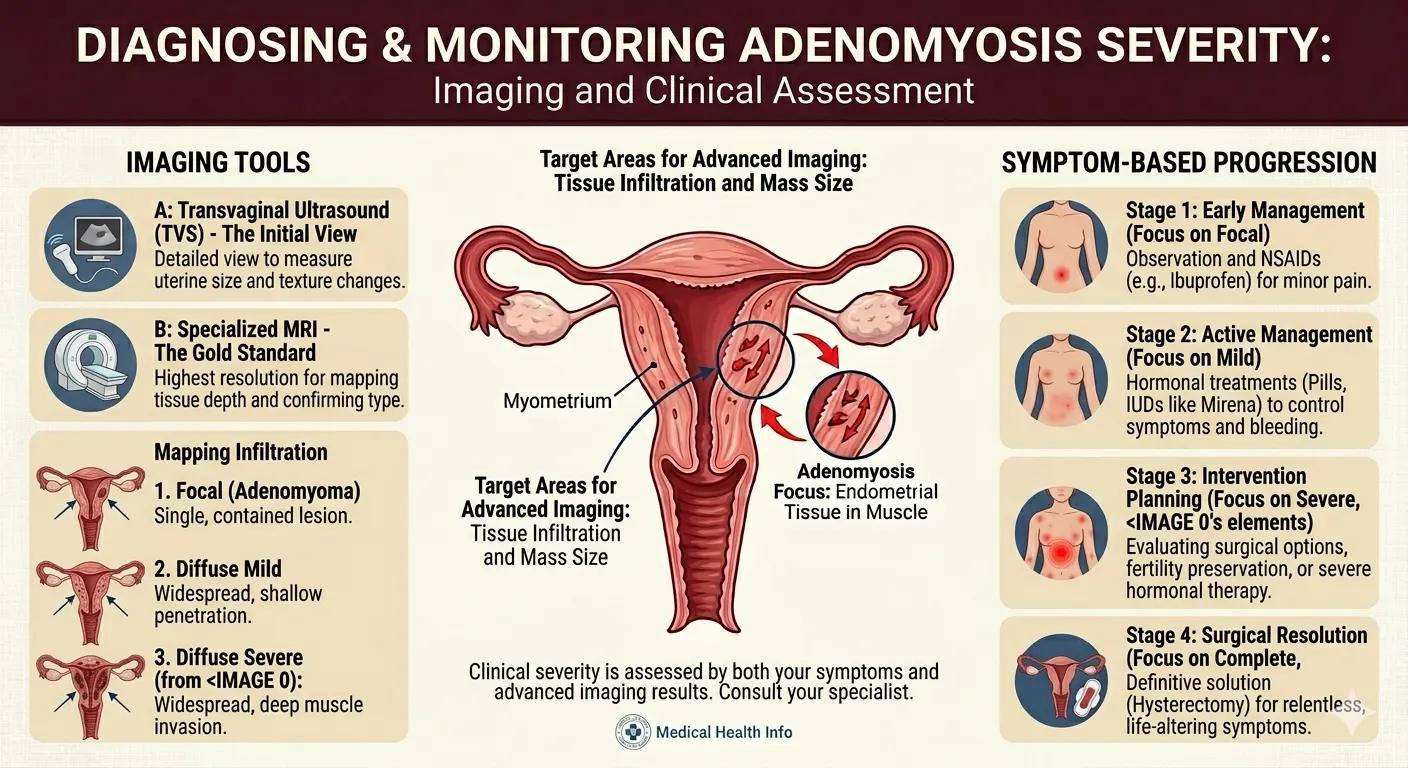
Adenomyosis is not formally staged the same way as endometriosis. Clinically, severity is classified by how deeply and widely the tissue has grown into the muscle wall on MRI:
• Mild (superficial) adenomyosis — endometrial tissue
goes less than 25% into the myometrial thickness. Symptoms are often minimal.
This stage may respond well to hormonal therapy.
• Moderate adenomyosis — involvement of 25-50% of the
myometrial wall. Symptoms are significant. Response to hormonal therapy varies.
Adenomyomectomy may be suitable.
• Severe adenomyosis — tissue grows beyond 50% of the
myometrial wall. The uterus becomes noticeably enlarged. Surgery is often
needed.
• Diffuse vs focal (adenomyoma) — adenomyosis may be
diffuse (spread through the whole uterine wall) or focal (collected as an
adenomyoma — a tumour-like mass). A focal adenomyoma can often be removed
surgically while keeping the rest of the uterus intact.
Staging terms are not
universally standardised. Your gynaecologist will assess severity based on
imaging and your symptoms. This guides treatment selection.
Adenomyosis vs Endometriosis: Understanding the
Differences
Adenomyosis and endometriosis
are often confused. They share overlapping symptoms and can exist in the same
patient. But they are different conditions. They need different tests and
different treatments.
|
Feature |
Adenomyosis |
Endometriosis |
|
Location |
Endometrial tissue grows
INTO the uterine muscle (myometrium) |
Endometrial-like tissue
grows OUTSIDE the uterus — on ovaries, fallopian tubes, pelvic lining |
|
Primary symptoms |
Heavy painful periods;
enlarged uterus; pelvic pressure and bloating; pain at rest |
Chronic pelvic pain;
painful intercourse; bowel/bladder symptoms; infertility |
|
Typical age |
Most common in women aged
35-50; often post-childbirth |
Affects women from puberty
to menopause; approximately 10% of reproductive-aged women (WHO, 2023) |
|
Diagnosis |
Transvaginal ultrasound;
MRI (diagnostic accuracy >85% at specialist centres) |
Imaging plus laparoscopy —
definitive diagnosis requires direct visualisation |
|
Surgical options |
Adenomyomectomy
(uterus-sparing); uterine artery embolisation; hysterectomy (definitive) |
Laparoscopic excision of
endometrial implants; hormonal suppression; hysterectomy for severe cases |
|
Can they occur together? |
Yes — adenomyosis and
endometriosis frequently coexist in the same patient |
Yes — up to 50% of women
with endometriosis also have adenomyosis |
How Do I Know If I Have Adenomyosis or Endometriosis?
Telling adenomyosis apart from
endometriosis — or confirming both are present — needs imaging and sometimes
surgery. Key signs that may point to adenomyosis over endometriosis:
• Symptoms mainly tied to your menstrual cycle (very
heavy periods, severe cramping) — more typical of adenomyosis.
• An enlarged, tender uterus on examination — a clear
sign of adenomyosis.
•Pelvic pain that spreads to the bowel, bladder, or
lower back, especially outside your period — more typical of endometriosis.
•Difficulty getting pregnant with a normal-looking
uterus on the first ultrasound — more likely endometriosis.
Many patients have both
conditions. An MRI read by a specialist radiologist is the best single test. It
can show myometrial changes (adenomyosis) and lesions outside the uterus
(endometriosis). Laparoscopy is still the definitive test for endometriosis.
Which Is More Serious — Adenomyosis or Endometriosis?
Both conditions are serious.
Both can affect your quality of life, fertility, and mental health.
Endometriosis is harder to diagnose. It often takes 7-10 years from first
symptoms to a confirmed diagnosis. In severe cases, it can spread to the bowel,
bladder, and diaphragm.
Adenomyosis often causes more
intense symptoms from the start. Very heavy periods can cause anaemia, and
cramps can be severe. But it is usually contained within the uterus and can be confirmed
more easily by MRI.
Neither is more 'serious' in an
absolute sense. The impact depends on severity, your symptoms, and your
fertility goals. Both need specialist review and treatment.
How Is Adenomyosis Diagnosed?
How Do You Confirm Adenomyosis?
Adenomyosis is diagnosed mainly
through imaging. A definitive diagnosis without surgery (hysterectomy) is not
possible, but imaging at specialist centres is highly accurate:
• Transvaginal Ultrasound (TVUS) — the first imaging test
your doctor will order. A specialist sonographer looks for signs like uneven
muscle texture, small cysts in the muscle wall, and a blurry border between the
endometrium and myometrium. Sensitivity for adenomyosis is 70-83% with expert
TVUS.
• MRI — the most accurate non-invasive test for
adenomyosis. MRI clearly shows the junctional zone (the border between the
endometrium and myometrium). It shows how deep and widespread the adenomyosis
is. Diagnostic accuracy exceeds 85% at specialist centres. MRI is especially
useful before adenomyomectomy to plan the surgery.
•Clinical history and examination — a tender, enlarged
uterus on pelvic examination in a woman with typical symptoms strongly suggests
adenomyosis.
A firm pathological diagnosis
needs uterine tissue — so imaging gives a 'probable adenomyosis' finding until
surgery confirms it. For most patients, specialist imaging is enough to guide
treatment. At Divinheal partner hospitals, pre-operative MRI is standard before
any planned adenomyomectomy.
Does Adenomyosis Affect the Bowels?
Yes — adenomyosis can affect
your bowels in several ways. The enlarged, inflamed uterus can press on nearby
bowel structures. This may cause: bloating and a feeling of fullness;
constipation (pressure on the rectum or sigmoid colon); and more urgent or frequent
bowel movements during your period. Some women also experience diarrhoea or
painful bowel movements during periods.
These symptoms look a lot like
irritable bowel syndrome (IBS). This is why many women with adenomyosis are
first told they have IBS before the correct diagnosis is made. If your bowel
symptoms are severe, your doctor should also check for endometriosis affecting
the bowel (rectovaginal endometriosis). This needs an MRI and specialist
review.
Comprehensive Treatment Options for Adenomyosis
Medical Management: Hormonal Therapies and Pain Relief
Medical management is the usual
first step for adenomyosis. It is especially suited for women who want to keep
their fertility or are not yet ready for surgery:
• Hormonal intrauterine system (Mirena IUS) — a
progestogen-releasing coil placed inside the uterus. It greatly reduces
menstrual bleeding and pain for many patients with adenomyosis. It can be used
long-term.
• Progestogens (oral or injectable) — regulate the
menstrual cycle and reduce endometrial growth; norethisterone,
medroxyprogesterone acetate.
• Combined oral contraceptive pill — reduces cycle
frequency and severity when taken continuously.
• GnRH agonists (e.g., leuprolide, goserelin) — these put
your body into a temporary menopause-like state. This shrinks the adenomyotic
tissue and gives significant symptom relief. They are only suitable for
short-term use (6 months typically) because of bone density effects.
• NSAIDs (ibuprofen, naproxen) — pain relief during
menstruation. Most effective when started 1-2 days before your period begins.
Hormonal therapies manage
symptoms but do not cure adenomyosis. Symptoms often return when treatment
stops. They work best as a bridge to surgery. They also suit women close to
menopause, when adenomyosis often regresses on its own.
Adenomyomectomy: Surgical Treatment That Preserves the Uterus
Adenomyomectomy is surgery that
removes adenomyotic tissue from the uterus while preserving the uterus. It is
the main surgical option for women with adenomyosis who want to keep their
uterus and/or their fertility.
The surgeon removes the affected
areas of myometrium and rebuilds the uterine wall. For focal adenomyosis
(adenomyoma), the surgery removes a distinct mass with clearer edges. For
diffuse adenomyosis, the surgery is more complex. Full clearance may not always
be possible.
Recovery after adenomyomectomy:
hospital stay typically 3-5 days; return to light activities 2-4 weeks; return
to full activities 6-8 weeks. The procedure is generally done by open surgery
or sometimes laparoscopically for focal lesions. Many patients report less pain
and lighter bleeding after surgery. There is a risk of adenomyosis coming back
over time, as adenomyotic tissue can regrow.
Uterine Artery Embolisation (UAE) for Adenomyosis
UAE (not to be confused with the
country UAE) is a minimally invasive procedure done by a radiologist. Small
particles are injected into the uterine arteries to cut the blood supply to the
adenomyotic tissue. This can shrink the uterus and reduce heavy bleeding. It
suits women who want to avoid major surgery.
The UAE is not recommended for
women who want to become pregnant. It may affect the blood supply to the uterus
and how the endometrium works. UAE for adenomyosis is available at Medanta
Gurgaon and Apollo Hospitals Chennai, among partner hospitals.
Hysterectomy: The Definitive Treatment
Hysterectomy — surgical removal
of the uterus — is the only definitive cure for adenomyosis. It is the right
choice when symptoms are severe and have not responded to medical or
conservative surgical management. It is also right when you do not want to preserve
fertility, and when adenomyosis is greatly affecting your quality of life.
After a hysterectomy, adenomyosis cannot come back.
Most hysterectomies for
adenomyosis at partner hospitals are done laparoscopically (total laparoscopic
hysterectomy, TLH). Hospital stay is 2-4 days. Recovery is 2-4 weeks.
Holistic and Lifestyle Approaches
Diet and lifestyle changes can
reduce the inflammation caused by adenomyosis. They can improve how you feel
alongside medical and surgical treatment:
• Anti-inflammatory diet — cutting inflammatory foods and
adding anti-inflammatory foods is the most evidence-backed dietary approach for
reducing adenomyosis symptom severity.
• Foods to avoid: highly processed foods; excessive red
meat (particularly processed meats); refined sugar and high-glycaemic foods;
trans fats; excessive alcohol and caffeine.
• Foods to prioritise: fruits and vegetables
(particularly cruciferous — broccoli, kale, cauliflower, which support
oestrogen metabolism); omega-3 fatty acids (oily fish, flaxseed, walnuts);
legumes; whole grains.
• Regular moderate exercise — reduces systemic
inflammation and prostaglandin levels. Yoga, swimming, and walking are good
choices as they avoid high-impact abdominal strain.
• Stress management — chronic stress raises cortisol,
which can upset hormonal balance and worsen pain. Mindfulness, meditation, and
psychological support are valuable adjuncts.
These steps may not cure
adenomyosis, but they can help manage symptoms and make daily life a little
easier when combined with proper medical treatment. Before trying any
supplements or alternative therapies, it’s a good idea to check with your
gynaecologist to make sure they’re suitable for you.
Adenomyosis Treatment Cost in India vs UAE vs UK
(2026)
Adenomyosis treatment in India
costs 60-80% less than UAE or UK private healthcare — without any drop in
clinical standards. The table below shows key services with AED and GBP
figures.
|
Service |
India
(partner hospitals) |
UAE (AED /
USD approx.) |
UK (GBP /
USD approx.) |
|
Specialist consultation |
Rs 1,000-4,000 ($11-$42;
AED 39-154; £8-£31) |
AED 500-1,000 ($136-$272) |
£200-£450 ($270-$606) |
|
Diagnostic MRI + TVUS |
Rs 10,000-25,000
($104-$261; AED 385-960; £78-£194) |
AED 1,500-4,000
($408-$1,089) |
£500-£1,300 ($674-$1,752) |
|
Adenomyomectomy
(uterus-sparing surgery) |
Rs 2,00,000-4,00,000
($2,093-$4,185; AED 7,675-15,349; £1,553-£3,105) |
AED 30,000-80,000
($8,167-$21,780) |
£12,000-£25,000
($16,167-$33,682) |
|
Laparoscopic excision
(endometriosis) |
Rs 3,00,000-6,00,000
($3,138-$6,276; AED 11,526-23,052; £2,330-£4,657) |
AED 50,000-100,000
($13,612-$27,224) |
£15,000-£30,000
($20,210-$40,420) |
|
Hospital stay (per day) |
Rs 10,000-25,000
($104-$261; AED 384-960; £78-£194) |
AED 1,000-5,000
($272-$1,361) |
£500-£1,000 ($673-$1,346) |
Sources:
The cost estimates are based on prices from major private hospitals in India,
such as Apollo Hospitals, Fortis Healthcare, Medanta, Max Healthcare, Artemis
Hospitals, and Paras Health. UAE prices are based on private gynaecology
clinics in Dubai, and UK costs are taken from published private treatment
prices from Spire Healthcare and BMI Healthcare for 2024–25. Currency
conversions are calculated using average Q1 2026 exchange rates. These are
estimated private-pay costs, and the final amount can vary depending on the
hospital, surgeon, type of procedure, and length of stay.
What India Adenomyomectomy Packages Typically Include
At Divinheal partner hospitals,
an adenomyomectomy package usually covers the consultation with the
gynaecologist, pre-operative tests, surgeon and anaesthesia fees, surgery
charges, medicines during the hospital stay, and follow-up appointments after
discharge. A standard 3–5 day hospital stay is normally included, while ICU
care is only needed in specific medical situations. Costs such as extra
hospital days, additional tests, accommodation outside the hospital, and
flights are generally separate. Patients receive a detailed quote in AED or GBP
before confirming travel.
Divinheal's Partner Hospitals for Adenomyosis
Treatment in India
Divinheal refers UAE and UK
patients to NABH/JCI-accredited partner hospitals in Delhi NCR and Chennai.
These hospitals have dedicated gynaecology departments and specialist
laparoscopic surgeons.
|
Hospital |
City |
Accreditation |
Gynaecology
& Adenomyosis Capabilities |
|
Apollo Hospitals Chennai |
Chennai |
JCI, NABH |
Advanced gynaecological
surgery; adenomyomectomy; laparoscopic endometriosis excision; MRI and 3D
ultrasound diagnostics; international patient centre with Arabic and English
support |
|
Fortis Hospital Noida |
Delhi NCR |
NABH |
Gynaecology and obstetrics;
minimally invasive gynaecological surgery; adenomyomectomy; high-volume
laparoscopic procedures; international patient coordinator |
|
Medanta Gurgaon |
Gurgaon (Delhi NCR) |
JCI, NABH |
Dedicated gynaecology and
urogynecology department; adenomyomectomy and endometriosis excision; 3T MRI
diagnostics; international patient wing |
|
MAX Hospitals |
Delhi NCR |
NABH |
Gynaecological oncology and
benign gynaecology; minimally invasive surgery; adenomyosis and endometriosis
management; post-operative fertility support |
|
Artemis Gurgaon |
Gurgaon (Delhi NCR) |
JCI, NABH |
Gynaecology and
laparoscopic surgery; adenomyomectomy; endometriosis excision; international
patient coordination |
|
Paras Hospitals |
Gurgaon (Delhi NCR) |
NABH |
Gynaecology and obstetrics;
laparoscopic surgery for benign uterine conditions; adenomyosis management;
cost-accessible NABH-accredited care |
Named gynaecologists and their
annual adenomyomectomy and endometriosis excision volumes are confirmed by the
Divinheal medical team before patient matching. Apollo Hospitals Chennai has
dedicated Arabic-speaking international patient support for UAE patients.
Contact Divinheal for current specialist availability.
Planning Your Adenomyosis Treatment Trip to India
Visa and Travel for UAE and UK Patients
UAE nationals apply for the Indian
Medical e-Visa at indianvisaonline.gov.in. Processing takes 3-5 business days.
UK nationals apply via VFS Global in London, Manchester, Birmingham, or
Edinburgh. Processing takes 10-15 working days — apply at least 3 weeks before
travel. Both nationalities need an Indian Medical Visa (MED category) for
planned surgical treatment. Divinheal provides the hospital invitation letter —
the critical document for all Medical Visa applications.
Direct flights from Dubai to
Delhi usually take about 3 hours, and around 3.5 hours to Chennai. Flights from
London Heathrow Airport to Delhi are generally about 8.5 hours long. If you are
travelling for an adenomyomectomy or laparoscopic excision, most patients plan
to stay for around 10–14 days. This gives enough time for pre-surgery tests,
the procedure itself, recovery in the hospital, and a final follow-up check
before flying home.
Accommodation and Logistics
Divinheal arranges accommodation
near the partner hospital (1-2 km away). Serviced apartments cost Rs
3,000-7,000 per night — AED 115-269; £24-£55. Airport transfers on arrival and
departure are coordinated. For UAE patients, Arabic-speaking patient coordinators
are available at Apollo Hospitals Chennai and Medanta Gurgaon. A
WhatsApp-accessible patient coordinator supports all patients throughout their
stay in India.
How Divinheal Supports UAE and UK Adenomyosis Patients
• Pre-travel specialist review — upload your existing
ultrasound or MRI reports and clinical records. A named gynaecologist at the
partner hospital provides a written assessment, recommended procedure, and cost
estimate in AED or GBP before you commit to travel.
• Specialist matching based on procedure type
(adenomyomectomy, laparoscopic excision, UAE radiological, or hysterectomy) and
fertility goals.
• Appointment booking within 1-2 weeks.
• Indian Medical Visa invitation letter.
• Accommodation near the hospital and airport transfers.
• Arabic-speaking coordinator for UAE patients.
• Post-return telemedicine follow-up with the treating
gynaecologist.
• Written discharge summary for your home-country
gynaecologist.
Divinheal does not charge a placement fee. Partner hospital rates are direct patient pricing. Written cost estimates in AED or GBP are provided before any travel commitment.
Cost Calculator
I know my treatment — show me cost from 3 hospitals
Final Thoughts
Adenomyosis is a serious but
treatable condition. For UAE and UK patients, NHS waiting times can be long, and
UAE private costs high. India's NABH/JCI-accredited partner hospitals offer
adenomyomectomy from Rs 2,00,000 ($2,093; AED 7,675; £1,553), laparoscopic
endometriosis excision from Rs 3,00,000 ($3,138; AED 11,526; £2,330), and
hysterectomy when needed — all at 60-80% less than UAE or UK private pricing.
Appointments are available within 1-2 weeks of enquiry.
Divinheal handles everything —
from uploading your MRI scans for a pre-travel specialist review to scheduling
your post-return telemedicine follow-up. UAE and UK patients can access expert
gynaecological care in India with full logistical support. Contact Divinheal
for a free case evaluation.
Written by DivinHeal Editorial Contributor, Rahul Kumar, Embryologist | Medically Reviewed by Dr Indu Priya, Gynecologist(MD) Published on: 2026-05-17
Plan My Journey
Tell us your condition and budget — our AI matches the right destination, hospital and doctor and visa pathway
Cost Calculator
I know my treatment — show me cost from 3 hospitals
Booking With DIVINHEAL
Get a free consultation to understand your treatment options
From Consultation to Recovery,
Step by Step
Expert Specialist Matching
Connecting you with the world's top-rated medical experts.
Accredited Hospital Network
Access to JCI & NABH certified healthcare facilities.
Complete Travel Coordination
Hassle-free visa, stay, and local transport assistance.
24/7 Personal Care
Dedicated patient advisors supporting you at every step.
Journey Guidance
Full guidance from start to end of the patient treatment journey.
Expert Specialist Matching
Connecting you with the world's top-rated medical experts.
Everything you
need to know today
Browse through these common inquiries to better understand our patient-focused medical platform.
Adenomyosis is a gynaecological condition where the uterine lining (endometrium) grows into the muscle wall of the uterus (myometrium). This causes heavy painful periods, an enlarged uterus, and chronic pelvic pain. It is a serious condition. It can greatly affect your quality of life, daily functioning, fertility, and mental health. Adenomyosis is not cancerous and does not raise cancer risk. With the right diagnosis and treatment, most women get significant or complete symptom relief. Severity determines the approach — mild adenomyosis may respond to hormonal therapy, while severe diffuse adenomyosis may need surgery.
The main symptoms are: very heavy menstrual bleeding (flooding, large clots, periods lasting more than 7 days); severe menstrual cramps much worse than typical period pain; chronic pelvic pain or pressure at any time of the month; and an enlarged, bulky uterus causing lower abdominal fullness ('adenomyosis belly'). Other symptoms include painful intercourse, bloating, and difficulty conceiving. Up to 35% of women with adenomyosis have minimal or no symptoms and are diagnosed incidentally.
An adenomyoma is a focal, tumour-like collection of adenomyotic tissue within the myometrium. It is a localised form of adenomyosis rather than diffuse involvement. Symptoms are similar to diffuse adenomyosis (heavy painful periods, pelvic pressure) but may feel more intense in one spot. An adenomyoma may be felt on examination as a focal uterine mass. On MRI, it appears as a distinct, uneven lesion within the myometrium. Focal adenomyomata are often easier to remove surgically (adenomyomectomy) than diffuse adenomyosis. Surgical margins are clearer, and a more complete removal is possible.
The exact cause of adenomyosis is not fully understood. The most supported theories are: de novo development from displaced endometrial stem cells that have migrated into the myometrium; previous uterine trauma (childbirth, caesarean section, dilatation and curettage procedures, which may disrupt the endometrial-myometrial junction); oestrogen dependence — adenomyosis is driven by oestrogen and typically regresses after menopause; and an inflammatory environment within the uterine wall. Risk factors include having had children, previous uterine surgery, and being in the 35-50 age range. Adenomyosis is less common (but not absent) in nulliparous women.
Adenomyosis can have a much bigger impact on daily life than many people realise. Heavy bleeding may lead to iron-deficiency anaemia, causing constant tiredness, weakness, and brain fog. For some women, the pain during periods can be so severe that they need to miss work, classes, or normal daily activities each month. Ongoing pelvic pain can also affect mood, concentration, sleep, and relationships. The enlarged, tender uterus causes discomfort in clothing and during physical activity. Painful intercourse affects intimate relationships. Fertility difficulties and pregnancy loss cause real psychological distress. Many women with adenomyosis describe their symptoms as 'invisible' — they look well on the outside while suffering serious pain inside.
Yes — you can live with adenomyosis without treatment, especially in milder cases. Adenomyosis naturally regresses after menopause when oestrogen levels fall. However, leaving severe adenomyosis untreated for many years carries risks: iron-deficiency anaemia from chronic heavy bleeding; growing fertility difficulties; significant ongoing pain affecting your quality of life and mental health; and in some cases, uterine enlargement that presses on nearby organs. The decision to treat — and which treatment to choose — should be based on how severe your symptoms are, your fertility goals, and how much adenomyosis affects your daily functioning.
Yes — adenomyosis can affect fertility and may increase the risk of miscarriage, although doctors are still studying exactly how it happens. In some women, it may make it harder for an embryo to implant successfully because it can change the normal structure and movement of the uterus. It may also create inflammation inside the uterus, making the environment less favourable for pregnancy. Women with adenomyosis may have lower success rates with IVF, including lower implantation and live birth rates. For some women, hormone treatment with GnRH agonists before IVF or surgery such as adenomyomectomy may improve the chances of pregnancy, although research is still developing and outcomes can differ for each person.
Non-surgical approaches include: (Medical) Hormonal IUS (Mirena), oral progestogens, GnRH agonists for short-term use, combined oral contraceptive pill — all reduce menstrual bleeding and pain. NSAIDs for pain relief during menstruation. (Dietary/lifestyle) An Anti-inflammatory diet; reducing red meat, processed foods, and refined sugar; increasing omega-3 fatty acids, cruciferous vegetables, and whole grains. Regular moderate exercise (yoga, swimming, walking). Stress management and adequate sleep. Heat therapy (a hot water bottle or heated pad on the lower abdomen) gives symptom relief for many patients. These steps do not cure adenomyosis but can meaningfully reduce your symptom burden.
Adenomyosis pain can badly disrupt sleep, especially around menstruation. A foetal position (curled on your side with knees drawn up) reduces pressure on the uterine ligaments. It is often more comfortable than lying flat. A pillow between your knees in the foetal position reduces pelvic torque. A hot water bottle or heat pad on the lower abdomen before sleep eases cramping. Take NSAIDs or prescribed analgesics before bed — do not wait until pain is severe. Avoid large meals and alcohol in the evening, as these can worsen bloating. A firm mattress tends to be more comfortable than a very soft surface. If pain stops you sleeping regularly, raise this with your gynaecologist — it affects treatment decisions.
Certain foods may make adenomyosis symptoms feel worse, especially those linked to inflammation or higher oestrogen levels. Many women notice more pain, bloating, or heavy periods after eating a lot of processed or fast foods, sugary foods, red or processed meat, drinking alcohol, or having too much caffeine. Some women also feel better after reducing dairy, although this does not affect everyone. Food triggers can be different for each person, so it can help to pay attention to which foods seem to worsen your symptoms. Every woman with adenomyosis can react differently to foods. Keeping a food and symptom diary may help you understand which foods seem to make your symptoms better or worse over time.
Adenomyosis belly appears as a rounded, protruding lower abdomen, mainly below the navel. It looks like a small 'pooch' or early pregnancy bump. The swelling is caused by uterine enlargement (the uterus may be 2-3 times its normal size) and associated fluid retention and inflammatory bloating. Unlike general weight gain, the swelling in adenomyosis is concentrated in the lower abdomen and pelvis. The uterus may be felt as a firm mass beneath the skin. The bloating may be fairly constant — not just around your period — and may worsen during and around menstruation. Many women report difficulty fitting into clothes they wore before their symptoms began, even without weight gain.
Among Divinheal partner hospitals for adenomyosis: Apollo Hospitals Chennai (JCI/NABH — dedicated gynaecology, adenomyomectomy, Arabic support); Medanta Gurgaon (JCI/NABH — urogynecology, minimally invasive surgery, 3T MRI); MAX Hospitals Delhi NCR (NABH — gynaecology and fertility); Fortis Noida (NABH — high-volume laparoscopic gynaecological surgery); Artemis Gurgaon (JCI/NABH — laparoscopic gynaecology); Paras Hospitals Gurgaon (NABH — cost-accessible). Divinheal matches patients to the right specialist based on procedure type, fertility goals, and budget.
Divinheal provides: pre-travel specialist review by a named gynaecologist at the partner hospital; written procedure recommendation and cost estimate in AED or GBP; Indian Medical Visa invitation letter; accommodation near the hospital; airport transfers; Arabic-speaking coordinator for UAE patients; post-return telemedicine follow-up; and written discharge summary for your home-country gynaecologist. There is no placement fee — all partner hospital rates are direct patient pricing.
Still have more questions?
Book a call with our friendly team to learn how DivineHeal simplifies your healthcare journey.








