
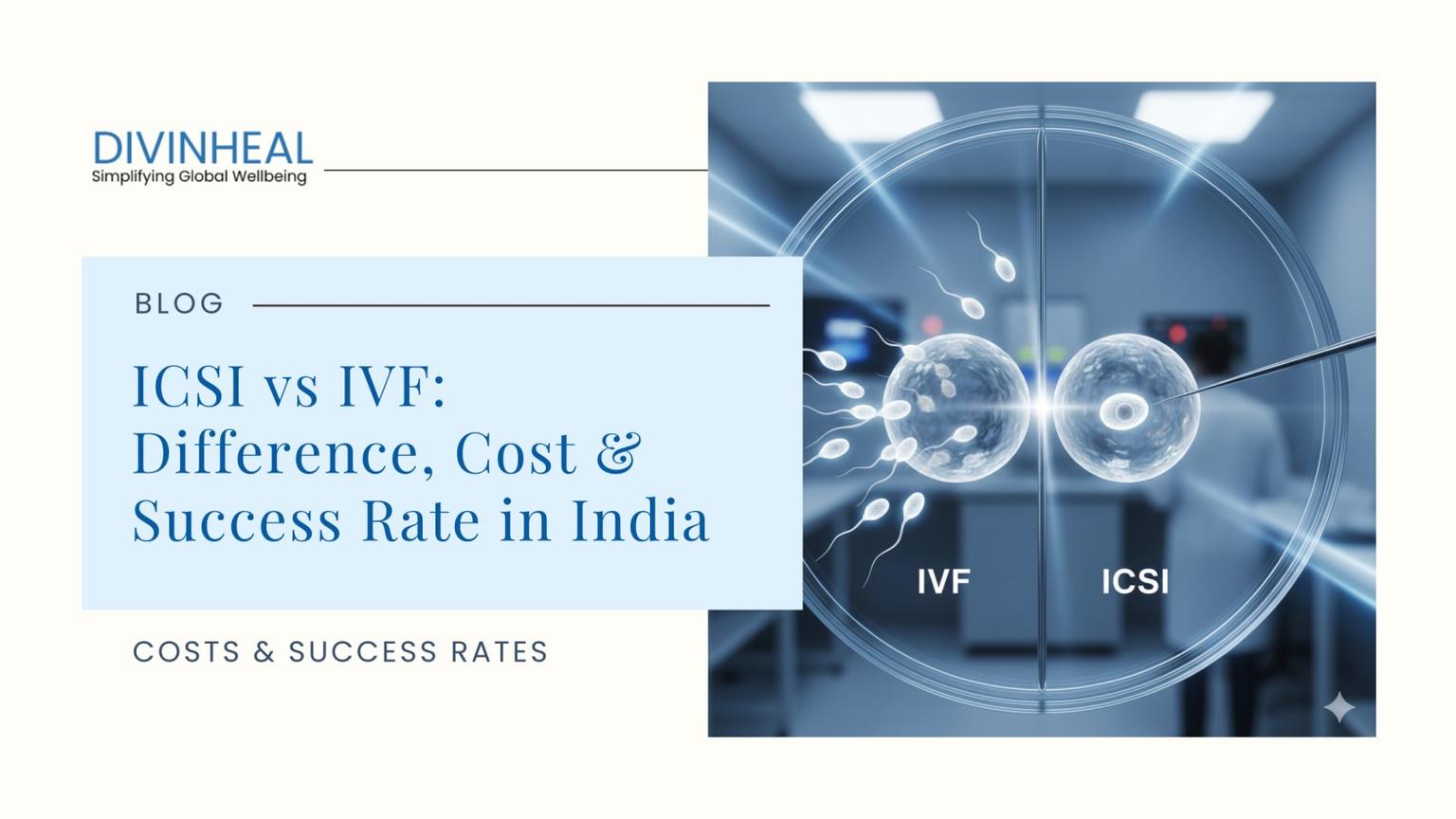
ICSI vs IVF: Differences, Success Rates & Costs in India 2026

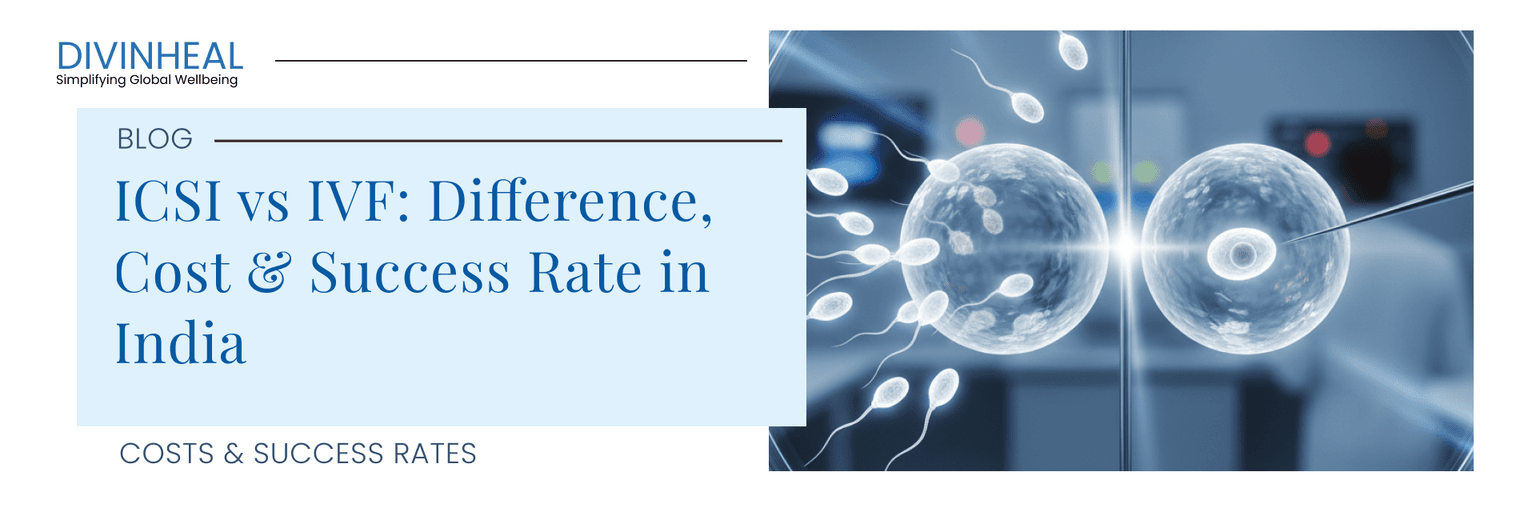
ICSI vs IVF: Differences, Success Rates & Costs in India 2026

Written by DivinHeal Editorial Contributor, Rahul Kumar, Embryologist | Medically Reviewed by Dr Indu Priya, Gynecologist(MD) Published on: 2025-11-24
ICSI vs IVF: Key Differences, Success Rates and Costs for Patients From Nigeria, Australia and the UK
KEY TAKEAWAYS
|
You’re already in the decision phase of your fertility journey. You need a clear answer — not more definitions. Here it is: IVF and ICSI are almost the same treatment. The only real difference is what happens in the lab at the moment of fertilisation. ICSI uses a needle to inject one sperm directly into an egg. Standard IVF places sperm near an egg and lets fertilisation happen on its own.
Which one you need depends almost entirely on sperm quality. The key question is: can a sperm penetrate an egg without help? This guide walks through how to decide. It covers the success rate data that matters. It also covers costs for patients from Nigeria, Australia, and the UK.
Plan My Journey
Tell us your condition and budget — our AI matches the right destination, hospital and doctor and visa pathway
What Is the Difference Between IVF and ICSI?
IVF and ICSI share the same core process. Eggs are retrieved after hormone treatment. They are fertilised in a lab. Embryos grow for 3–5 days. Then one or more embryos are placed into the uterus. Everything before and after fertilisation is the same. The two methods differ only at the fertilisation step.
How Standard IVF Works
In standard IVF, retrieved eggs go into a lab dish with prepared sperm. Thousands of sperm are added to each egg. One sperm enters the egg on its own. This relies on the sperm having normal movement and shape. When sperm quality is good, fertilisation rates reach 60–80% of mature eggs.
IVF is used for:
Blocked or damaged fallopian tubes
Moderate to severe endometriosis
Polycystic ovary syndrome (PCOS)
Unexplained infertility
Mild male factor infertility where sperm count and movement are reduced but not severe
At Fortis Fertility Noida, Medanta Gurgaon, and Apollo Hospitals Chennai, standard IVF is the base of most fertility cycles. ICSI is added only when there is a clear reason.
How ICSI Works — and When It’s Actually Needed
In ICSI, an embryologist picks one sperm under a powerful microscope. The sperm is held still. It is then injected directly into the egg using a glass needle thinner than a human hair. The sperm does not need to navigate or enter the egg on its own.
ICSI is the right choice for:
Severe oligospermia (very low sperm count, typically < 5 million/mL)
Severe asthenospermia (< 32% progressive motility)
Severe teratospermia (> 96% abnormal forms)
Cases where sperm must be surgically retrieved through TESE or PESA
It is also used after a previous IVF cycle where fewer than 30% of mature eggs were fertilised.
One honest consideration: some Indian clinics use ICSI as a default for all cycles. They do this even when there is no male factor infertility. They say it maximises fertilisation rates. This makes sense in complex cases. But ESHRE and HFEA guidelines do not recommend routine ICSI without a clinical reason. If your doctor plans to use ICSI and your semen analysis is normal, ask your specialist to explain the specific reason for your case.
ICSI vs IVF: Side-by-Side Comparison
Factor | Standard IVF | ICSI |
How fertilisation happens | Sperm are placed near egg in a lab dish; fertilisation occurs naturally | Single sperm is injected directly into the egg by an embryologist |
Primary use case | Female factor infertility, unexplained infertility, mild male factor | Severe male factor: low count, poor motility, abnormal shape; surgically retrieved sperm |
When NOT typically needed | If male factor infertility is severe — ICSI may be required | If sperm quality is normal — standard IVF achieves equivalent fertilisation rates |
Egg damage risk | Minimal — no physical manipulation of egg | Small risk of egg damage during injection (< 5% of eggs at most accredited labs) |
Cost in India | ₹1,00,000–₹3,00,000 ($1,050–$3,200) | ₹1,20,000–₹2,60,000 ($1,250–$2,800) — ICSI adds ₹15,000–₹35,000 vs standard IVF |
Success rate (under 35, India JCI clinics) | 40–50% clinical pregnancy rate per cycle | 40–50% — similar rate when male factor is the only indication; higher vs IVF when male factor is severe |
Sources: ESHRE Guidelines on Routine Use of ICSI (2023); HFEA Code of Practice (2024); ICMR 2021 ART Act guidelines. Success rates from JCI-accredited Indian clinic reported ranges. Individual outcomes vary.
What Are the Downsides of ICSI?
ICSI is safe and well-established. But it has some risks that standard IVF does not. Patients choosing ICSI should know these before they agree to the procedure. This is especially true for patients with no clear male factor.
Egg Damage Risk During Injection
Needle injury can occur to the egg through ICSI procedure. The rate of injury per egg is between 2% and 5%. Therefore, for ten mature eggs, zero or one egg can get injured. In case you go to Medanta Gurgaon or MAX Hospitals, the probability of such occurrence will be minimal. It increases to high levels in clinics that perform less than 200 ICSI cycles per annum.
Male Infertility and Genetic Transmission
Sometimes low sperm count has a genetic cause. This includes Y-chromosome microdeletions or abnormal chromosomes. In these cases, ICSI can pass these genetic factors to a male child. That child may face the same fertility challenges. This is not a reason to avoid ICSI when it is the right treatment. But it is a reason to get genetic counselling before you proceed. This is especially important for patients with azoospermia or a history of repeated miscarriage.
Apollo Hospitals Chennai and Artemis Gurgaon offer pre-ICSI genetic counselling and karyotyping. This is part of the workup for patients with severe male factor infertility. It should be standard care, not optional.
Are ICSI Babies Different From IVF Babies?
This is one of the most common concerns — and the evidence is reassuring. Multiple large follow-up studies have tracked children born via ICSI for up to 18 years. These include data from the HFEA (UK) and the Human Genetics Commission. The finding across most studies: ICSI children show no major increase in birth defects, developmental delay, or health problems. This holds compared to children conceived naturally or via standard IVF.
A small number of studies found a slight increase in rare chromosomal problems. But this is linked to the underlying male factor infertility — not the ICSI technique. For most patients where ICSI is the right choice, child health outcomes match those of natural conception.
How to Know If You Need ICSI or Standard IVF
It will be suggested to you by your fertility expert according to your reports. The important test here is the semen analysis. It evaluates the count, motility, and morphology. The reference ranges defined by the WHO in 2021 are currently considered the standard guidelines. If all three are within normal range, then conventional IVF would generally be the first choice.
✅ Choose Standard IVF if… | ✅ Choose ICSI if… |
Your semen analysis shows normal count, motility, and morphology | Semen analysis shows severe oligospermia (low count), asthenospermia (poor motility), or teratospermia (abnormal shape) |
Previous IVF cycles achieved adequate fertilisation (≥ 60% of mature eggs) | A previous IVF cycle had poor fertilisation (< 30% of mature eggs fertilised) |
Infertility is primarily female-factor (PCOS, endometriosis, tubal factor) | Sperm must be surgically retrieved (TESE, PESA) — natural fertilisation is unlikely |
Unexplained infertility with no identified male factor | You are using frozen sperm where post-thaw survival is limited |
The decision framework is aligned with ESHRE guidelines on routine use of ICSI (2023), and HFEA Code of Practice (2024). However, there could be other medical indications for your doctor to advise on ICSI. You can discuss these issues with your physician.
A note for patients from Nigeria, Australia, or the UK: if you have a recent semen analysis (within 6 months), bring it. Divinheal shares this with the Indian specialist before your first teleconsultation. This often means you get a protocol recommendation before you book a flight.
What Is the Success Rate of IVF and ICSI?
Success rates for IVF and ICSI are broadly similar when used for the right reason. The most important factor is the woman’s age at egg retrieval. Egg age drives embryo quality. Embryo quality drives most of the difference in outcomes.
Age Group | IVF — Clinical Pregnancy Rate | ICSI — Clinical Pregnancy Rate | Live Birth Rate (both methods) |
Under 35 | 40–50% | 40–50% | 32–40% |
35–37 | 35–42% | 35–40% | 28–35% |
38–40 | 25–33% | 22–30% | 18–25% |
Over 40 | 10–18% | 10–18% | 8–14% |
References: Data from HFEA 2023 UK National Data, FSA (Fertility Society of Australia) registry, accredited clinic in India according to ICMR. Clinical Pregnancy Rate – confirmation of fetal heartbeat at 6-week ultrasound scan. Live Birth Rate – about 8-12 % below clinical pregnancy rate. Figures are per single cycle. Results differ widely.
The table above shows why “Which is more successful — IVF or ICSI?” has no single answer. For a patient with normal sperm, both methods give the same results. For a patient with severe male factor infertility, ICSI produces far better fertilisation rates. More embryos are available to transfer. That improves the total chance of pregnancy.
The most useful number for patients planning financially is the cumulative success rate — not the per-cycle rate. After 3 cycles, cumulative live birth rates reach 60–70% for women under 37 at JCI-accredited Indian centres. This matches published HFEA UK cumulative data.
Success Rates by Country: What to Expect in India, Australia, UK, and Nigeria
IVF and ICSI are not more effective in India than in the UK or Australia — on a like-for-like basis. What India offers is the same clinical outcome at much lower cost. Published live birth rates per cycle for women under 35 are broadly similar across all four countries — roughly 30–40%. The differences come from clinic quality, patient age mix, and embryo transfer policies. Not from the country.
Where Indian fertility centres at JCI level have shown strong performance:
• Embryo freezing and thaw survival: 95–98% survival at accredited labs
• ICSI fertilisation rates: 70–80% of mature eggs
• Strong blastocyst development rates at top centres
These lab metrics are the best quality indicators. They matter more than headline success rate figures, which can be skewed by patient selection.
At What Stage Do Most IVF Cycles Fail?
Knowing where IVF cycles most often fail helps patients ask better questions. It also sets more realistic expectations. There are three main phases where failure happens:
Phase 1 — Stimulation and egg retrieval: About 10–20% of IVF cycles are cancelled before egg retrieval. This happens because the ovaries produce too few follicles or too many (OHSS). Poor ovarian response is most common in women with low AMH and women over 40. At Medanta Gurgaon and Fortis Fertility Noida, doctors use lower doses for high-risk patients. This reduces OHSS risk while keeping egg yield.
Phase 2 — Fertilisation: With standard IVF, about 10–20% of cycles produce no fertilised eggs — even with enough eggs retrieved. This usually happens because of unexpected sperm-egg interaction failure. It is the most common reason a clinic switches from IVF to ICSI in a follow-up cycle. In ICSI cycles, fertilisation failure is rare (< 5% when mature eggs are injected) but still possible.
Phase 3 — Implantation: This is the most common cause of IVF failure. Even when a good blastocyst is transferred, implantation fails in about 40–60% of single-embryo transfer cycles. The two most common causes are chromosomal problems in the embryo and poor endometrial readiness. PGT-A testing can screen for chromosomal issues. ERA timing analysis can address endometrial readiness. If you have had two or more failed transfers with good-quality embryos, these tests are worth discussing with your specialist.
IVF and ICSI Costs: India vs Australia, UK and Nigeria
The biggest reason patients travel to India for IVF and ICSI is cost. Below is a current comparison of private-healthcare costs per cycle. All figures exclude medications unless noted.
Country | IVF Cycle (Private) | ICSI Cycle (Private) | India Equivalent | Saving |
India | ₹1,00,000–₹3,00,000 ($1,050–$3,200) | ₹1,20,000–₹2,60,000 ($1,250–$2,800) | — | — |
Australia | AUD $10,000–$15,000 ($7,100–$10,746) | AUD $6,000–$8,000 (ICSI add-on ~AUD $1,000) | $2,100–$4,200 | 60–75% |
UK | £3,,500–£8,000 ($4,729–$10,810) | £5,500–£6,000 (ICSI add-on ~£500–£1,000) | $2,100–$4,200 | 50–65% |
Nigeria | ₦2,000,000–₦4,500,000 ($1,300–$2,900) | ₦2,500,000–₦5,000,000 (ICSI premium included) | $2,100–$4,200 | Capability + access gap |
All amounts are approximate ranges for private health care services for 2025-2026. Australian costs indicated before applying the Medicare rebate (offsetting the cost by AUD $2,000 - $5,000 based on the individual’s eligibility). NHS offers free IVF treatment to eligible patients from the UK; private prices are shown for ineligible individuals. Indian prices indicated for foreign patients in accredited hospitals.
What Does IVF/ICSI Cost in Australia?
The cost of one round of IVF in Australia ranges from AUD $10,000 to AUD $15,000 without Medicare assistance. The Medicare rebate cuts costs by around AUD $2,000-$5,000, and hence, many couples have to spend between AUD $6,000 and AUD $10,000 per cycle of IVF.
Medication costs another AUD $2,500-$5,000. Most quotes for base packages exclude this cost. Benchmark data is available from the Fertility Society of Australia (FSA). The patient can compare his/her clinic's quote to FSA data.
India’s JCI clinics offer the same lab quality at 60–75% lower cost. The total saving per cycle — including travel and accommodation — remains AUD $5,000–$9,000 compared to out-of-pocket Australian private costs.
What Does IVF/ICSI Cost in the UK?
The cost for private treatment varies from £3,500 to £8,000 per cycle at most of the clinics licensed by the HFEA. Additional procedures like ICSI cost an extra £500 to £1,000. NHS-funded treatments can be provided to those who have qualified according to the CCG eligibility criteria, which generally involve women aged up to 39 years, a healthy BMI, not being a smoker, and satisfying the relationship status criteria.
For UK patients who do not qualify for NHS funding — or who cannot wait 12–24 months — India offers private-quality care at a 50–65% cost saving. UK patients get the same standards for documentation and embryo tracking. Most Indian JCI clinics issue treatment records in the same format as UK clinics. This makes it easy for your UK GP to follow up.
What Does IVF/ICSI Cost in Nigeria?
Fertility treatment costs in Nigeria have risen sharply. A full IVF cycle at a reputable Lagos or Abuja clinic now costs ₦2,000,000–₦4,500,000 ($1,300–$2,900). The bigger issue for many Nigerian patients is access — not cost. Advanced lab techniques are not widely available in Nigerian clinics. These include ICSI with time-lapse imaging, PGT-A genetic testing, and ERA analysis. These are standard at JCI-accredited Indian centres.
Divinheal coordinates:
Flight routing from Lagos and Abuja to Delhi and Chennai
Medical visa documents
Accommodation near partner hospitals
A dedicated English-speaking coordinator from first enquiry through post-treatment follow-up
What Does an IVF/ICSI Cycle Cost in India?
At JCI- or NABH-accredited Indian fertility centres, a standard IVF cycle costs ₹1,00,000–₹3,00,000 ($1,050–$3,200) for international patients. ICSI cycles cost ₹1,20,000–₹2,60,000 ($1,250–$2,800). These are the all-in procedure costs. Medications, diagnostic tests, and add-on procedures are billed separately. Partner clinics — Apollo Hospitals Chennai, Fortis Fertility Noida, Medanta Gurgaon, MAX Hospitals Delhi, and Artemis Gurgaon — all publish clear, itemised pricing for international patients.
What’s Not Included: Hidden Costs to Budget For
Base package prices for IVF or ICSI in India rarely include everything. Knowing the add-on costs before you book prevents budget surprises during treatment.
Add-on / Hidden Cost | Typical India Cost | Notes |
Initial consultations + hormone panel + semen analysis | ₹2,000–₹6000+ ($25–$75) | Often excluded from base package quotes |
Medications (stimulation + progesterone) | ₹15,000–₹50,000 ($160–$510) | Highly variable — depends on individual stimulation response |
ICSI surcharge (if not in base package) | ₹15,000–₹35,000 ($160–$330) | Ask upfront whether ICSI is included or billed separately |
PGT-A embryo genetic testing | ₹50,000–₹1,00,000 ($480–$960) per batch | Recommended for patients over 38 or with recurrent failure |
Embryo freezing + storage (per year) | ₹15,000–₹30,000 ($160–$320)/year | If surplus embryos are vitrified for future FET cycles |
Accommodation (per week in India) | ₹10,000–₹30,000/week ($120–$320/week) | Serviced apartments near partner hospitals; 3–4 weeks typical stay |
All India Cost Estimates are Rough Ranges for 2025–2026 at Clinics Partnered With JCI/NABH Hospitals. Get a Detailed Quote in Writing That Covers Your Entire Treatment Journey Before Confirming Your Booking.
The most underestimated cost is medications. Stimulation costs vary a lot based on how your ovaries respond. A patient needing aggressive stimulation may pay ₹1,20,000–₹1,50,000 in medications alone. A low responder might pay ₹40,000–₹60,000. Ask your clinic for a medication cost estimate based on your AMH level before you budget.
Travelling to India for IVF/ICSI: Visa, Stay and Logistics
How Long Do You Need to Stay in India?
A full IVF or ICSI cycle typically needs a stay of 3–4 weeks. Here is the breakdown:
10–14 days of monitoring during ovarian stimulation
1–2 days for egg retrieval
5 days of embryo culture
1 day for embryo transfer
3–5 days of post-transfer rest before flying
Some patients reduce this to 2.5 weeks by doing early monitoring at home via telemedicine. Divinheal sets up a teleconsultation with the Indian specialist before you travel. This lets part of the protocol be designed remotely — making your in-country phase shorter.
Visa Requirements for Nigerian, Australian and UK Patients
International patients need an Indian e-Medical Visa. You apply online. You need a hospital invitation letter from your treating Indian clinic. Most Nigerian, Australian, and UK passport holders receive the visa within 5–10 working days. Accompanying partners may apply for a medical attendant visa.
Divinheal provides the hospital invitation letter as part of onboarding. The coordinator gives you a visa checklist and embassy contact details. Guidance on documentation — including proof of funds and travel insurance — is included.
Clinic-Specific Country Notes
For patients from Nigeria: direct and connecting flights are available between Lagos (LOS), Abuja (ABV) to Chennai (MAA), Delhi (DEL) and Mumbai (BOM). Divinheal offers serviced apartments located within a radius of 5 km from Apollo Hospital, Chennai and Fortis Fertility, Noida. WhatsApp services are provided by a coordinator during the 2 weeks following transfer.
For patients from Australia: There are direct flights between Sydney, Melbourne, Brisbane and Chennai/Delhi. All Divinheal partner hospitals have either JCI or NABH accreditation. The discharge letter will be in English and sent to your Australian GP within 48 hours after repatriation.
For UK patients: flights from London Heathrow, Manchester, and Birmingham connect to Delhi NCR and Chennai. All Divinheal partner specialists have international training equal to UK MRCOG or FRCS standards. A formal discharge summary is sent to your NHS GP within 48 hours. This includes embryo freeze reports if applicable.
How to Choose a Fertility Clinic in India: What Actually Matters
Accreditation Standards
JCI accreditation follows the standards that have been used to evaluate hospitals in the US, Australia, and Western Europe. NABH (National Accreditation Board for Hospitals) is the Indian national body that follows similar stringent criteria. NABH is not a marketing slogan. Both certifications involve an inspection of the facility every year. The Divinheal partner hospitals have one or both certifications. The list of hospitals include: Apollo Hospitals in Chennai, Fortis Memorial Research Institute, Gurugram, Medanta Gurgaon, MAX Hospitals in Delhi, and Artemis Gurgaon.
Laboratory Metrics That Predict Outcomes
The headline success rate a clinic publishes is the least reliable way to compare clinics. It is affected by the age profile of patients treated. It can also be selectively calculated. More useful metrics to ask for:
Fertilisation rate (target: > 70% of mature eggs)
Blastocyst development rate (target: > 50% of fertilised eggs)
Embryo thaw survival rate (target: > 95%)
OHSS hospitalisation rate (should be < 1% with modern protocols)
Ask specifically: Do you apply time-lapse imaging technology? Do you measure the ICSI success rates on an embryologist-by-embryologist basis? What is the clinic’s published live birth rate per age bracket? Failure to provide specific figures should raise alarm bells.
What to Look for in a Fertility Specialist
For patients from Nigeria, Australia, and the UK, look for these credentials in an Indian fertility specialist:
DGO (Diploma in Gynaecology and Obstetrics) plus DNB or MD Reproductive Medicine; or
Fellowship in IVF from a recognised training centre
Many senior specialists at Fortis, Apollo, and Medanta also hold international fellowships from European or North American centres. Divinheal provides specialist CVs on request before you confirm a clinic booking.
What to Do Before and After Your IVF/ICSI Cycle
Preparation Before Starting
Before your India trip, Divinheal sets up a teleconsultation with your assigned specialist. This is typically within 5–7 working days of first contact. You share recent test results:
Hormone panel (FSH, LH, AMH, TSH)
Semen analysis (within 6 months)
Uterine ultrasound
Infectious disease screen
The specialist reviews these and confirms the protocol — IVF or ICSI, stimulation dose, and provisional start date — before you book flights.
Lifestyle choices that promote positive results: keeping the body mass index within the range of 19–29; quitting smoking at least three months before the stimulation cycle; limiting alcohol intake to less than four units per week; consumption of folate (folic acid) in the dosage of 400-800 micrograms daily for at least three months before commencing.
After the Cycle: The Two-Week Wait
After embryo transfer, take all prescribed medications — typically progesterone and oestrogen — exactly as directed. Light activity is fine. Avoid hard exercise, saunas, and hot baths. A 2018 review in Fertility and Sterility found no evidence that bed rest after embryo transfer improves outcomes. This is consistent with ICMR 2021 ART Act guidance.
Most patients fly home 3–5 days after transfer. The beta hCG pregnancy test (10–14 days post-transfer) can be done at your local clinic. Your Indian specialist reviews the result via telemedicine. If positive, a 6-week scan is scheduled — either locally or reviewed remotely by the Indian clinic.
If the First Cycle Does Not Succeed
Failure of the initial cycle does not necessarily mean a dead end. Multiple cycles increase the cumulative success rate substantially compared to the single-cycle success rate. Cumulative live birth rates for three cycles amount to 60%-70% for women under 37 years old, using Indian clinics accredited by the Joint Commission International. If any embryos remain frozen, frozen embryo transfer cycle will cost considerably less, around ₹80,000-₹1,50,000 ($960-$1,800), and no stimulation procedure will be required.
After a failed cycle, Divinheal sets up a review consultation with the treating specialist. The specialist reviews cycle data — fertilisation rate, embryo development, and endometrial thickness at transfer. Depending on findings, they may recommend:
Changing the stimulation protocol
Adding PGT-A embryo testing
ERA timing analysis for the uterus
Immunological investigation if implantation failure is suspected
Cost Calculator
I know my treatment — show me cost from 3 hospitals
Ready to Find Out Whether IVF or ICSI Is Right for You?
The answer depends on your specific test results. A Divinheal teleconsultation with an Indian fertility specialist can give you that clarity before you travel. Share your recent semen analysis, hormone panel, and medical history. You will receive a written protocol recommendation within 48 hours.
Divinheal partners with Apollo Hospitals Chennai, Fortis Fertility Noida, Medanta Gurgaon, MAX Hospitals Delhi, and Artemis Gurgaon. Patients from Lagos, Sydney, Melbourne, London, and Manchester have completed IVF and ICSI cycles at these centres. Contact a Divinheal coordinator to request your free initial consultation and cost estimate.
Plan My Journey
Tell us your condition and budget — our AI matches the right destination, hospital and doctor and visa pathway
Cost Calculator
I know my treatment — show me cost from 3 hospitals
Recommended Article

Best In Vitro Fertilization (IVF) Doctors in Hyderabad
Doctors for Nephrology: Find Kidney Care Specialists
Doctors in Chennai: Find Medical Specialists in India
Best Embryo Freezing Hospitals in Hyderabad: Care Guide
Hospitals for reproductive surgery: Compare options
Hospitals in Gurugram: Guide to Quality Facilities
IVF Treatment in Haryana | Cost, Hospitals & Doctors
TAVR (Transcatheter Aortic Valve Replacement) cost in New Delhi
Tonsillectomy & Adenoidectomy Success Rate in Mumbai
Facelift & Anti-Aging Procedures in Chennai for Ethiopia Patients | Cost, Hospitals
Written by DivinHeal Editorial Contributor, Rahul Kumar, Embryologist | Medically Reviewed by Dr Indu Priya, Gynecologist(MD) Published on: 2025-11-24
Plan My Journey
Tell us your condition and budget — our AI matches the right destination, hospital and doctor and visa pathway
Cost Calculator
I know my treatment — show me cost from 3 hospitals
Booking With DIVINHEAL
Get a free consultation to understand your treatment options
Recommended Article
Best In Vitro Fertilization (IVF) Doctors in Hyderabad
Doctors for Nephrology: Find Kidney Care Specialists
Doctors in Chennai: Find Medical Specialists in India
Best Embryo Freezing Hospitals in Hyderabad: Care Guide
Hospitals for reproductive surgery: Compare options
Hospitals in Gurugram: Guide to Quality Facilities
IVF Treatment in Haryana | Cost, Hospitals & Doctors
TAVR (Transcatheter Aortic Valve Replacement) cost in New Delhi
Tonsillectomy & Adenoidectomy Success Rate in Mumbai
Facelift & Anti-Aging Procedures in Chennai for Ethiopia Patients | Cost, Hospitals
From Consultation to Recovery,
Step by Step
Expert Specialist Matching
Connecting you with the world's top-rated medical experts.
Accredited Hospital Network
Access to JCI & NABH certified healthcare facilities.
Complete Travel Coordination
Hassle-free visa, stay, and local transport assistance.
24/7 Personal Care
Dedicated patient advisors supporting you at every step.
Journey Guidance
Full guidance from start to end of the patient treatment journey.
Expert Specialist Matching
Connecting you with the world's top-rated medical experts.
Everything you
need to know today
Browse through these common inquiries to better understand our patient-focused medical platform.
Neither is better in every case. ICSI is better when sperm quality is severely low. It achieves fertilisation rates of 70–80% even with very poor sperm. Standard IVF is better — or just as good — when sperm quality is normal. It avoids the small egg-damage risk that comes with the ICSI injection. The choice should be based on semen analysis results. It should not be used as a default.
ICSI carries a small risk of egg damage during injection — 2–5% of eggs at most experienced labs. If severe male factor infertility has a genetic cause (e.g., Y-chromosome deletion), ICSI can pass this to male children. ICSI also costs more than standard IVF by about ₹15,000–₹35,000 ($180–$420) in India. None of these are reasons to avoid ICSI when it is the right clinical choice. There are reasons to have an informed conversation with your specialist before you consent.
No — not in any clinically meaningful way. Multiple large follow-up studies found no major increase in birth defects, developmental delay, or health problems in ICSI children. Long-term data from HFEA (UK) backs this up. A small increase in chromosomal problems has been seen in some studies, but this is linked to the underlying male factor infertility — not the ICSI technique itself.
No. ICSI is part of an IVF cycle. It is not a standalone procedure. The IVF steps — ovarian stimulation, egg retrieval, embryo culture, and embryo transfer — are all required when ICSI is used. ICSI only replaces the fertilisation step within an IVF cycle. The term “ICSI cycle” means an IVF cycle where ICSI is the fertilisation method.
India (international patient package): ₹1,20,000 – ₹2,60,000 ($1,250 – $2,800). Australia (private, before Medicare rebate): AUD $11,000 – $16,000 ($7,200 – $10,500). UK (private):£5,500–£9,000 ($6,900–$11,400). Nigeria: ₦2,500,000–₦5,000,000 ($1,600–$3,200).
Certainly, although the increase would be small. ICSI would require more effort on the part of the embryologist, specialized equipment, and skillful micromanipulation. In India, ICSI charges above regular IVF procedure would generally be between ₹15,000 and ₹35,000 (£180-£420). In the United Kingdom, the ICSI charge would be around £500-£1,000. In Australia, the ICSI premium would be approximately AUD $800-$1,500. Based on clinical advantage of ICSI, however,
Clinical pregnancy rates for ICSI on a first attempt at JCI-accredited Indian clinics: about 40–50% for women under 35; 30–40% for women 35–38; 15–25% for women 38–40; and 8–15% for women over 40. These rates are for a single transfer cycle. The cumulative rate across multiple attempts rises to about 60–70% after 3 cycles for women under 37.
For women under 35: about 40–50% chance of clinical pregnancy per cycle at Indian JCI clinics. The live birth rate is about 32–40%. The chance falls with age. Even under the best conditions, IVF does not succeed on the first attempt for roughly half of patients. This is normal. It does not mean the care is poor. Most specialists suggest budgeting emotionally and financially for 2–3 cycles.
The majority of IVF failures take place during implantation. The embryo fails to implant into the endometrium despite appearing to be viable and healthy under laboratory conditions. Implantation failure is responsible for up to 40–60% of all failed transfer cycles. Failure in the stimulation phase (cancellation of the cycle before egg collection) contributes to around 10–20% of failures. Failure of fertilization (failure to fertilize any collected oocytes) represents around 10% of cases. PGT-A screening determines embryo viability. ERA testing determines the exact window for implantation.
Absolute contraindications are rare. They include: Active ovarian cancer during treatment Conditions that make pregnancy life-threatening (severe heart failure, dialysis-dependent kidney disease) Absence of a uterus (surrogacy may be considered as an alternative) Most other conditions — PCOS, endometriosis, uterine fibroids, mild thyroid disease, controlled diabetes — can be managed with proper pre-cycle preparation. Age is not a disqualifier in India for women using their own eggs (up to ~45 at most clinics) or for donor egg cycles (up to 50 per ICMR 2021 guidelines).
No. No fertility treatment has a 100% success rate. Even under the best conditions — optimal age, excellent egg quality, good sperm, experienced clinic — about 40–50% of IVF cycles per transfer do not result in pregnancy. This is not a failure of the technology. In natural conception, only about 25–30% of embryos implant per menstrual cycle. IVF success improves meaningfully when patients and clinics respond to what each cycle reveals.
No, at 37 years old, the chances of pregnancy from IVF treatment cycles through your own egg cells are around 28-35% according to HFEA UK stats (2023). The clinical pregnancy rate at Indian JCI fertility centres also falls in line with this range. While fertility success decreases as age advances, 37 years is not an age when you stop being able to conceive. AMH test results at 37 are more reliable predictors of success than age.
There has been no confirmation from Mukesh Ambani and Nita Ambani regarding the conception of their kids. Rumors regarding celebrities and fertility treatments are prevalent in the Indian media, but it remains to be proven that this particular couple resorted to such measures. The only thing that is certain is that there are countless individuals who have successfully used IVF and ICSI to build their families in India and around the world.
Still have more questions?
Book a call with our friendly team to learn how DivineHeal simplifies your healthcare journey.








